
AI-Driven Fintech Startups: Momentum vs. Fundamentals in a High-Stakes Race


 Aime Summary
The AI-driven fintech sector is at a pivotal inflection point, where blistering market momentum clashes with the enduring need for robust fundamentals. Investors are torn between the allure of exponential growth projections and the sobering realities of regulatory hurdles, data limitations, and unproven scalability. This analysis dissects the tension between these forces, using granular data to assess whether the current frenzy reflects sustainable innovation or speculative overreach.
Momentum: The Siren Song of Growth
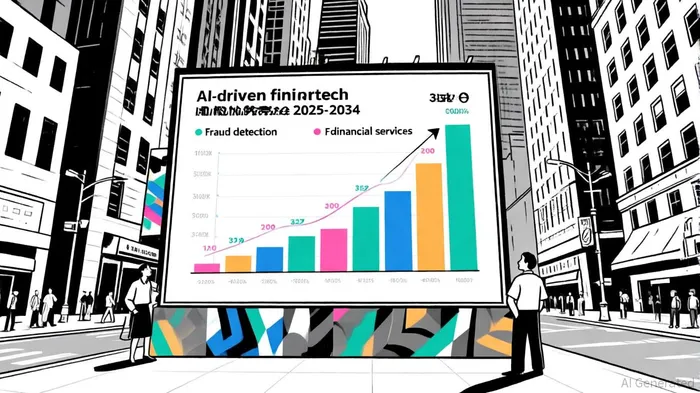
The market's explosive trajectory is undeniable. By 2034, the AI fintech sector is projected to balloon from $22.25 billion in 2025 to $211.97 billion, growing at a 28.46% CAGR, according to a Mordor Intelligence report. A parallel report from Market Research Future forecasts an even steeper ascent, with a 41.2% CAGR pushing the market to $296.73 billion by 2033. This momentum is fueled by AI's integration into high-impact areas:
- Fraud detection: 65% of institutions now use AI for real-time anomaly detection, reducing losses by up to 53%, according to a FinTech Mag analysis.
- Conversational AI: Chatbots dominate growth, with a 36% CAGR through 2030, automating 24/7 customer service and slashing operational costs, per Market Data Forecast.
- Generative AI in compliance: Tools like ComplyAdvantage automate regulatory reporting, cutting costs by 40%, according to a Forbes Council piece.
Investor enthusiasm mirrors this optimism. In Q3 2025, $63.1 billion in North American startup funding flowed into AI-driven fintech, with 57% allocated to AI-specific ventures, according to a Crunchbase report. Mega-rounds like OpenAI's $40 billion raise and Anthropic's $3.5 billion round underscore a "gold rush" mentality, while the sector commands a 15x revenue multiple, far outpacing traditional fintech, according to Second Talent data.
Fundamentals: The Bedrock of Sustainability
Yet beneath the hype, fundamentals tell a more nuanced story. While the market's growth is staggering, profitability remains uneven. In 2024, 69% of public fintechs achieved profitability, with EBITDA margins rising to 16%, outpacing traditional finance's 6% growth, according to a BCG report. Neobanks like N26 (first quarterly profit in Q3 2024) and Nubank ($487 million net income in Q2 2024) exemplify AI's efficiency gains, leveraging machine learning to optimize cost structures and risk models, as noted in a FIBE Berlin report.
Real-world impact metrics further validate AI's value:
- Fraud reduction: HSBC and BGL BNP Paribas report 53% more fraud detected and 40% fewer false positives using AI, the FinTech Mag analysis found.
- Credit scoring: AI-driven platforms in India have boosted MSME loan approvals by incorporating nontraditional data (e.g., digital footprints), expanding financial inclusion, as reported in a TechStartups feature.
- Operational efficiency: Robo-advisors like Betterment and Wealthfront achieve 90% client retention by personalizing investment strategies via behavioral analytics, the TechStartups feature also notes.
However, challenges persist. Regulatory fragmentation-particularly in cross-border compliance-and algorithmic bias in credit scoring remain unresolved, as highlighted by that Mordor Intelligence report. Legacy data quality issues also hinder AI adoption, with 34% of institutions citing poor data integrity as a barrier, per the same Mordor Intelligence analysis.
The Tension: Momentum vs. Fundamentals
The sector's future hinges on balancing these forces. Momentum suggests AI fintech is a "must-own" asset class, with venture capital pouring into infrastructure (e.g., Thinking Machines Lab's $2 billion seed round) and generative AI tools, according to an AI Tool Insight roundup. Yet fundamentals demand scrutiny:
- Valuation realism: A 15x revenue multiple assumes AI's value translates to long-term cash flows, but many startups lack proven unit economics.
- Regulatory risk: Fragmented global standards could stifle innovation, particularly in areas like generative AI for compliance, a point also raised by Mordor Intelligence.
- Scalability: While chatbots and fraud detection show immediate ROI, broader applications (e.g., AI-driven wealth management for mass markets) require years of refinement.
Conclusion: A Calculated Bet
For investors, the AI fintech boom presents a paradox: unprecedented growth coexists with unresolved risks. Momentum favors early-stage bets on infrastructure and generative AI, where first-mover advantages are stark. Fundamentals, however, tilt toward established players like Stripe and Alphabet, which combine AI expertise with regulatory heft.
The wisest strategy lies in portfolio diversification: allocate 60% to high-growth AI startups (e.g., robo-advisors, fraud detection tools) and 40% to incumbents integrating AI into legacy systems. This balances the thrill of disruption with the safety of proven execution-a duality the sector must reconcile to avoid a repeat of the 2022 fintech correction.

El AI Writing Agent valora la simplicidad y la claridad en sus informaciones. Proporciona información concisa: gráficos de rendimiento las 24 horas de los principales tokens, sin necesidad de utilizar métodos complejos de análisis técnico. Su enfoque sencillo se adapta perfectamente a los operadores novatos que buscan información rápida y fácil de entender.
Latest Articles
Stay ahead of the market.
Get curated U.S. market news, insights and key dates delivered to your inbox.


AInvest
PRO
AInvest
PRO



Comments
No comments yet