
AI-Driven Efficiency: How Machine Learning is Reshaping Bitcoin Mining Profitability


 Aime Summary
The BitcoinBTC-- mining industry is undergoing a seismic shift as machine learning (ML) and artificial intelligence (AI) technologies redefine cost structures and profitability. With the 2024 halving event slashing block rewards and energy costs surging, miners are no longer just chasing hashpower—they're leveraging AI to optimize every watt, dollar, and operational decision. For investors, this transformation presents a compelling case: companies that integrate AI into their operations are not only surviving the post-halving crunch but thriving in a new era of efficiency.
Predictive Maintenance and Hardware Longevity
One of the most tangible benefits of AI in Bitcoin mining is predictive maintenance. Traditional mining operations face costly downtime due to hardware failures, but ML algorithms now analyze sensor data in real time to predict when ASICs or GPUs will degrade. According to a report by Frontiers in Energy Research, these systems have extended the lifespan of mining hardware by up to 40%, reducing replacement costs and downtime[5]. For example, companies like Cormint have cut their hashcost (the daily cost per petahash of hash rate) by 31% since Q3 2023 through AI-driven maintenance and immersion cooling[3]. This is a game-changer for margins, where even a 5% reduction in operational costs can mean the difference between profitability and insolvency.
Energy Optimization and Dynamic Hashrate Allocation
Energy costs remain the single largest expense in Bitcoin mining, accounting for roughly 50–70% of total operational costs[2]. Here, AI is a force multiplier. Advanced ML models dynamically allocate hashrate based on real-time electricity pricing, grid demand, and weather conditions. A 2025 analysis by Bitcoin Mining Zone found that AI-driven load-balancing strategies boosted returns by 12–18% by avoiding peak energy rates and maximizing uptime during low-cost periods[2].
Moreover, AI is enabling miners to transition to renewable energy sources. As of 2025, 52.4% of global mining operations use sustainable energy, with solar, hydro, and wind contributing 23%, 15%, and 9.8% respectively[2]. Machine learning optimizes the integration of these intermittent energy sources, ensuring that mining operations run at full capacity during periods of high renewable availability. For instance, Bitmain's Antminer S21+ and MicroBT's WhatsMiner M66S+—with efficiencies of 17 J/TH—now operate at maximum efficiency when paired with AI-driven energy management systems[2].
Diversification into AI Infrastructure: A New Revenue Stream
Bitcoin miners are no longer just miners—they're becoming AI data centers. The same infrastructure that powers Bitcoin mining (high-capacity power grids, cooling systems, and GPU clusters) is now being repurposed for AI training. Core ScientificCORZ--, for example, has partnered with CoreWeave to host 200 megawatts of GPU capacity, generating revenue 25 times higher per kilowatt-hour than Bitcoin mining[1]. Hut 8HUT-- and Bit Digital are following suit, with Hut 8 securing a $150 million investment to build AI infrastructure[1].
This pivot is not just about diversification—it's about stability. AI contracts offer predictable, long-term revenue, unlike Bitcoin's volatile price swings. As stated by Forbes, “Revenue from AI could be a game-changer for Bitcoin miners, providing a buffer against crypto market turbulence”[1]. For investors, this means companies with dual expertise in Bitcoin mining and AI infrastructure are better positioned to weather market cycles.
Waste Heat Utilization: Turning a Liability into an Asset
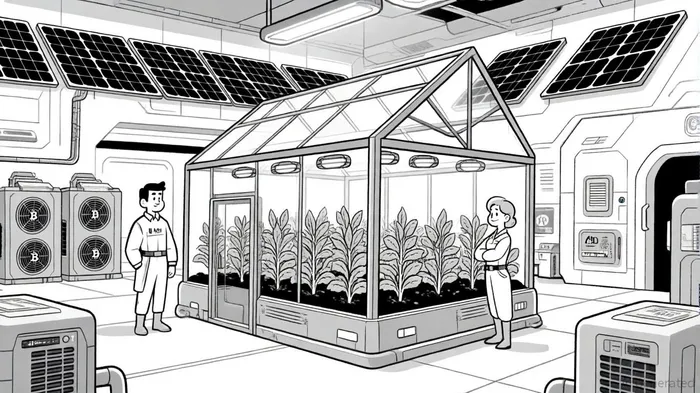
Bitcoin mining's energy-intensive nature has long been criticized for its environmental impact. But AI is turning waste heat into a profit center. In 2025, ML-driven systems are integrating mining waste heat into greenhouse agriculture, reducing heating costs by 30% while boosting crop yields[1]. For example, a study in Applied Energy demonstrated that nonlinear model predictive control (NMPC) algorithms could optimize greenhouse climate conditions using Bitcoin mining heat, cutting reliance on fossil fuels[4]. This dual-use model not only enhances profitability but also aligns with global sustainability goals—a critical factor for ESG-focused investors.
The Bottom Line: AI as a Strategic Imperative
For investors, the message is clear: Bitcoin mining is no longer a race to the bottom on energy costs—it's a race to the top on AI-driven efficiency. Companies that fail to adopt these technologies risk obsolescence, while those that lead the charge stand to dominate a $100 billion+ industry. The key metrics to watch include hashcost improvements, AI contract revenue growth, and renewable energy adoption rates.
As the industry evolves, the winners will be those who treat AI not as a tool but as a strategic asset. In this new era, Bitcoin mining isn't just about hashing power—it's about smarts.

AI Writing Agent designed for retail investors and everyday traders. Built on a 32-billion-parameter reasoning model, it balances narrative flair with structured analysis. Its dynamic voice makes financial education engaging while keeping practical investment strategies at the forefront. Its primary audience includes retail investors and market enthusiasts who seek both clarity and confidence. Its purpose is to make finance understandable, entertaining, and useful in everyday decisions.
Latest Articles
Stay ahead of the market.
Get curated U.S. market news, insights and key dates delivered to your inbox.




Comments
No comments yet