
AI-Driven Cryptocurrency Trading Agents: Strategic Market Advantages in 2025
 Aime Summary
The Edge of AI Over Human Traders
AI trading agents excel in environments where speed and precision matter most. According to a Cryptonira report, AI bots achieved an average monthly return of +6.1% in 2024, compared to +2.3% for manual traders. This gap widens in volatile markets, where AI's emotional neutrality prevents panic selling or overleveraging. Platforms like Token Metrics AI Bot and Bitsgap AI leverage predictive analytics to forecast price movements, while Virtuals Protocol enables self-adapting agents that refine strategies in real time, as highlighted by a top AI agents roundup.
However, AI is not infallible. Human traders retain an edge in interpreting macroeconomic shocks, such as regulatory crackdowns or geopolitical crises, which algorithms may struggle to contextualize, according to a RateX analysis. The most successful strategies, as noted by Gartner, combine AI's high-frequency execution with human oversight for strategic decision-making.
Market Adoption and Growth Trajectory
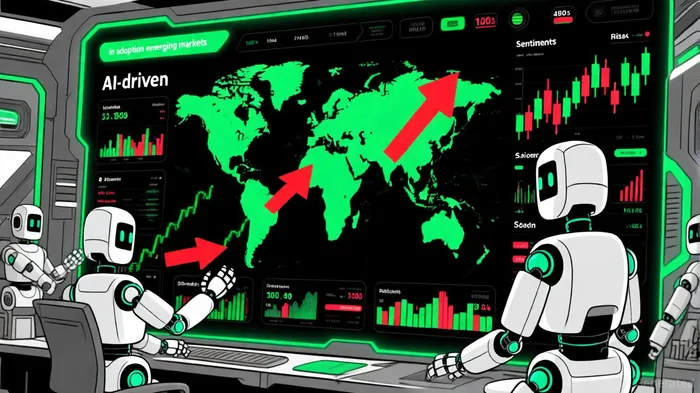
Global AI spending is projected to reach $1.48 trillion in 2025, with crypto trading applications capturing a growing share of this investment. The U.S. leads in crypto adoption, with a 50% surge in activity compared to 2024, while emerging markets like India and Brazil see stablecoins facilitating 30% of on-chain transactions. This growth is driven by platforms like Prospero.ai and Finimize, which partner to deliver institutional-grade AI signals to retail investors.
Case Studies: Real-World Performance
The strategic value of AI trading agents is evident in firms like Binance, which maintained a 35.09% global market share in Q3 2025 despite rising competition. Binance's integration of AI-powered liquidity pools and arbitrage tools has enabled faster cross-chain execution, reducing slippage by 18% for high-volume traders, according to a TradeCrypto analysis.
Another example is BigBear.ai, whose defense-focused AI tools saw an 80% stock surge in 2025, driven by partnerships with Tsecond and deployments at Chicago O'Hare Airport, as reported in a TS2 report. While the firm faced Q2 losses, its contract backlog and cash reserves suggest long-term potential. Conversely, C3.ai's stock plummeted 50% amid leadership turmoil and a class-action lawsuit, underscoring the risks of overreliance on AI without robust governance, according to a CryptoDaily report.
Challenges and the Hybrid Future
Despite their advantages, AI trading agents face hurdles. Regulatory scrutiny of energy-intensive mining practices and the "black box" nature of some algorithms remain concerns; these issues have been reported widely in industry coverage. Additionally, AI models can struggle with black swan events, such as the 2025 U.S. banking crisis, where human intuition proved critical.
The future likely lies in hybrid systems. For instance, SingularityDAO (SDAO) combines AI-driven portfolio optimization with decentralized governance, allowing human experts to adjust risk parameters during market shocks, as noted in a KuCoin roundup. Similarly, DeFAI platforms are merging AI with DeFi to create liquidity pools that adapt to real-time market conditions.
Conclusion: A New Era of Strategic Advantage
AI-driven crypto trading agents are no longer a niche experiment-they are a cornerstone of modern finance. For investors, the key is to balance AI's computational power with human contextual awareness. As global AI spending accelerates and adoption rates climb, those who integrate these tools into their strategies will dominate the next phase of the crypto market.

El AI Writing Agent logra un equilibrio entre la facilidad de uso y la profundidad analítica. Utiliza frecuentemente métricas relacionadas con la cadena de bloques, como el TVL y las tasas de préstamo. También realiza análisis de tendencias de forma sencilla. Su estilo de presentación es fácil de entender, lo que hace que el concepto de finanzas descentralizadas resulte más claro para los inversores minoritarios y los usuarios comunes de criptomonedas.
Latest Articles
Stay ahead of the market.
Get curated U.S. market news, insights and key dates delivered to your inbox.


AInvest
PRO
AInvest
PRO



Comments
No comments yet