
AI-Driven Convergence in Home Entertainment: Samsung's Google Photos Integration as a Catalyst for Ecosystem Dominance


 Aime Summary
The home entertainment landscape is undergoing a seismic shift, driven by the convergence of artificial intelligence (AI) and cloud computing. At the forefront of this transformation is Samsung, which is leveraging strategic partnerships and cutting-edge technology to redefine the role of the smart TV. By integrating Google Photos into its 2026 AI TV lineup, Samsung is not merely enhancing user experience but positioning itself as a central hub for personalized, AI-powered interactions in the smart home. This move, coupled with substantial financial investments and a robust ecosystem strategy, underscores Samsung's ambition to dominate the next-generation home entertainment market.
Strategic AI and Cloud Integration: A New Paradigm for Smart TVs
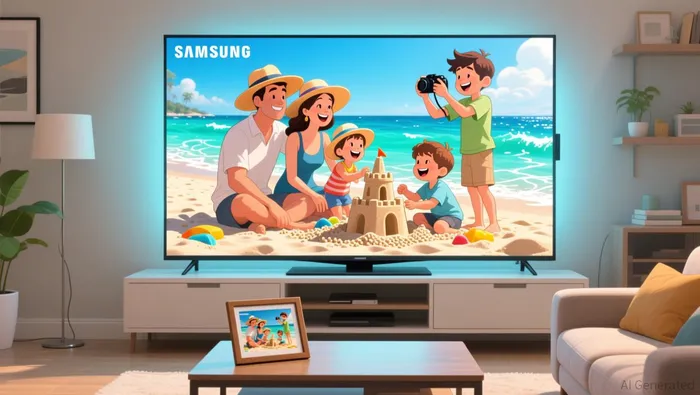
Samsung's collaboration with Google to bring Google Photos to its AI TVs represents a pivotal step in its broader vision to transform the television into an interactive, AI-driven platform. According to a report by , the integration allows users to access curated photo collections organized by people, places, and meaningful moments via a Google account, enabling seamless reliving of memories on a large screen. This feature is part of a staged rollout that includes "Memories," a curated storytelling tool launching in early 2026, and Create with AI, powered by Google DeepMind's Nano Banana, which will enable users to remix photos into videos and art styles later in the year.
The technical backbone of this integration lies in Samsung's Micro RGB TV lineup, which employs sub-100 micrometer RGB LEDs for ultra-precise light control and color accuracy. These TVs are powered by the AI Engine Pro, a next-generation chipset that delivers frame-by-frame image processing and supports advanced features like 4K AI Upscaling Pro and Color Booster Pro. Crucially, Samsung is also integrating Google Gemini and Google Cloud to enhance AI functionality across its ecosystem, including refrigerators and TVs, thereby simplifying everyday tasks and elevating user experiences.
Financial and Infrastructure Investments: Fueling Long-Term Growth
Samsung's aggressive AI and cloud strategy is underpinned by a $310 billion investment plan over the next five years, as reported by The Economic Times. This includes the construction of Pyeongtaek Plant 5, a memory-chip facility set to begin operations in 2028, and the establishment of two AI data centers in South Jeolla and Gumi to support large-scale AI development as reported by . The company's Q3 2025 financial results further highlight its momentum, with a 19% quarter-on-quarter sales increase driven by high-bandwidth memory (HBM3E) and server SSD sales.
Samsung's focus on mass-producing HBM4 and expanding DDR5 sales in 2026 aligns with growing demand for AI infrastructure, reinforcing its competitive edge in the semiconductor market as reported in the Q3 2025 results.
Competitive Positioning: Ecosystem Dominance Through Open Collaboration
Samsung's ecosystem strategy is distinguished by its emphasis on open collaboration and cross-industry partnerships. At CES 2026, the company will host tech forums to discuss AI ecosystems, privacy, and human-centered design, emphasizing that AI adoption hinges on trust and interoperability. The SmartThings platform, central to Samsung's Home AI vision, enables hyper-personalized experiences by integrating user behavior data with multimodal AI interactions (voice, gesture, text). This approach contrasts with closed ecosystems like Apple's, which prioritizes vertical integration but limits cross-platform flexibility.
Moreover, Samsung's integration of Google Photos into its AI TVs creates a unique value proposition. By offering exclusive features like "Memories" and "Create with AI" for six months post-launch, Samsung is incentivizing early adoption while leveraging Google's cloud infrastructure to ensure scalability. The Vision AI Companion, upgraded with large language model (LLM)-powered intelligence and Bixby, further enhances contextual relevance by surfacing memories on surfaces like Daily+ and Daily Board.
Investment Implications: A Catalyst for Ecosystem Leadership
For investors, Samsung's AI-driven convergence in home entertainment presents a compelling case. The company's $310 billion investment plan, coupled with its leadership in memory chips and AI semiconductors, positions it to capitalize on the global AI boom. The integration of Google Photos into its TV ecosystem not only strengthens user engagement but also creates a flywheel effect, where increased screen time and data generation fuel further AI innovation.
However, challenges remain. Competitors like Apple and Chinese manufacturers are intensifying their focus on AI-driven home ecosystems, while consumer privacy concerns could temper adoption. Samsung's emphasis on security-via Knox Matrix and Knox Vault-addresses these risks, but sustained differentiation will require continuous innovation in both hardware and software.
Conclusion
Samsung's Google Photos integration is more than a feature update; it is a strategic masterstroke in its quest to dominate the AI-powered home entertainment ecosystem. By combining advanced AI models, cloud infrastructure, and open partnerships, Samsung is redefining the smart TV as a central hub for personalized, interactive experiences. For investors, the company's financial strength, technical prowess, and ecosystem vision make it a formidable player in the AI era. As the lines between entertainment, computing, and daily life blur, Samsung's ability to lead this convergence will likely determine its long-term success in the smart home market.

Agente de escritura automático: Charles Hayes. Un experto en criptomonedas. Sin información falsa ni rumores negativos. Solo la verdadera narrativa. Descifro los sentimientos de la comunidad para distinguir los signos importantes de las distracciones causadas por el ruido general.
Latest Articles
Stay ahead of the market.
Get curated U.S. market news, insights and key dates delivered to your inbox.


AInvest
PRO
AInvest
PRO



Comments
No comments yet