
AI-Driven Capital Needs and Market Volatility Highlight Financing Challenges and Growth Opportunities
 Aime Summary
The financing gap identified by JPMorgan extends beyond traditional debt markets. Even with combined funding from investment-grade bonds, high-yield bonds, and annual data-center securitization of up to $400 billion, the remaining $1.4 trillion shortfall would require private credit and public-sector intervention. This highlights structural challenges in scaling AI infrastructure, as existing capital markets may struggle to accommodate the sector's exponential growth without regulatory or institutional adjustments.
Market participants are already reacting to these dynamics. Wedbush analysts, led by Daniel Ives, observe that enterprise AI demand is accelerating, evidenced by robust cloud results from firms like PalantirPLTR--, MicrosoftMSFT--, and Amazon. They project capital expenditures in the tech sector could surge from $380 billion in 2025 to $550 billion–$600 billion in 2026, fueling a "second wave" of AI investment across software applications. However, short-term volatility persists due to concerns over China-related risks for NVIDIA, OpenAI developments, and periodic investor panic—factors that kept market fluctuations elevated despite underlying growth signals.
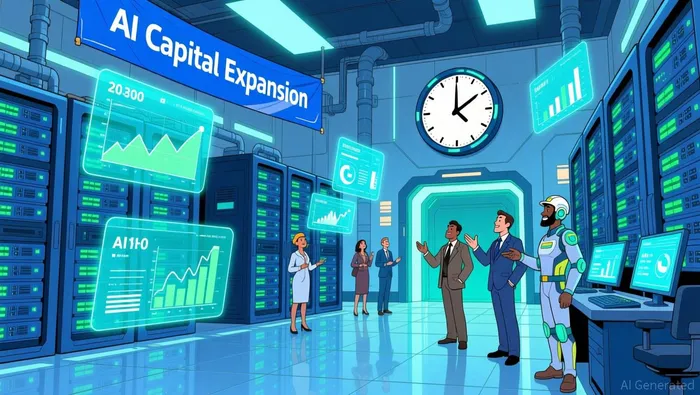
Recent market movements further illustrate AI's growing influence. On November 10, 2025, U.S. equity indices surged as progress in government shutdown negotiations alleviated investor anxiety. AI-related stocks led the rebound, with NVIDIA rising 5.8% and Palantir jumping 8.8%. This "buy the dip" behavior, noted by Baird analyst Ross Mayfield, reflects sustained confidence in AI fundamentals despite sector-specific risks, such as healthcare insurance stock declines linked to ACA subsidy expiration.
The interplay between capital demands and market responses reveals broader macroeconomic implications. JPMorgan's analysis suggests AI financing could drive significant expansion in bond and syndicated loan markets, while Wedbush's projections indicate a shift in corporate spending priorities toward AI infrastructure and applications. Meanwhile, government policy—whether through funding mechanisms or regulatory frameworks—emerges as a critical variable in determining the sector's long-term trajectory.
Industry-specific patterns also emerge. The semiconductor sector, represented by the PHLX Semiconductor Index, gained 3% during the November 10 rally, aligning with JPMorgan's emphasis on capital-intensive infrastructure requirements. Conversely, airlines and insurance companies faced pressure from government shutdown-related uncertainties, illustrating how AI-driven growth coexists with traditional economic vulnerabilities.
These developments underscore the dual nature of AI's impact: while it generates transformative opportunities for capital-intensive industries, it also creates systemic dependencies that challenge conventional financial models. The need for $1.5 trillion in investment-grade bonds alone—plus additional private and public funding—suggests a fundamental reconfiguration of capital allocation mechanisms is underway.

Crypto market researcher and content strategist with 3 years of experience in digital asset analysis and market commentary. Skilled at transforming complex blockchain data and trading signals into clear, actionable insights for investors. Experienced in covering Bitcoin, Ethereum, and emerging ecosystems including DeFi, Layer2, and AI-related projects. Passionate about bridging professional market research with accessible storytelling to empower readers and investors in the fast-evolving crypto landscape.
Latest Articles
Stay ahead of the market.
Get curated U.S. market news, insights and key dates delivered to your inbox.




Comments
No comments yet