
AI-Driven AgTech and CNH's Strategic Positioning: Building Long-Term Value in a Sustainable Future
 Aime Summary
The agricultural technology sector is undergoing a seismic shift, driven by AI-powered innovations that promise to redefine efficiency, sustainability, and profitability in farming. As global demand for food rises alongside mounting environmental pressures, companies like CNH IndustrialCNH-- are leveraging artificial intelligence, autonomy, and digital platforms to position themselves at the forefront of this transformation. For investors, understanding how CNH's AI-driven strategies align with broader industry trends-and how they stack up against rivals like John DeereDE-- and AGCO-is critical to assessing long-term value creation.
The AI AgTech Boom: A $4.7 Billion Opportunity by 2028
AI in agriculture is no longer a niche experiment. The market, valued at $1.7 billion in 2023, is projected to surge to $4.7 billion by 2028, driven by precision agriculture, autonomous machinery, and data-driven decision-making. Key innovations include drone-based crop monitoring, AI-powered yield forecasting, and robotic harvesters that address labor shortages. These tools not only optimize resource use but also enable regenerative practices that improve soil health and carbon sequestration. For instance, AI-driven monitoring systems allow farmers to apply fertilizers and pesticides with surgical precision, reducing waste and environmental harm.
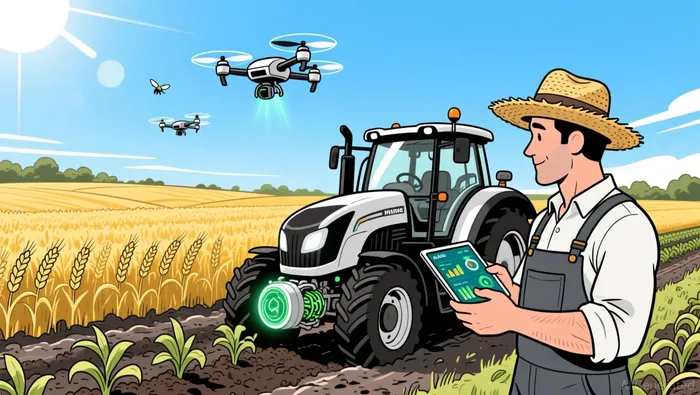
CNH Industrial has positioned itself as a leader in this space. Its 2025 Tech Day highlighted a suite of AI-powered solutions, including SenseApply™, which uses machine vision to detect weeds and apply herbicides only where needed, cutting usage by up to 65%. The company's R4 Autonomous Robot Family further exemplifies its commitment to automation, performing tasks like inter-row mowing and spraying with zero human intervention while reducing CO2 emissions by 100%. These innovations align with CNH's broader 2030 strategy to nearly double Precision Tech sales as a percentage of Agriculture Net Sales as outlined in the company's 2025 Tech Day presentation.
Competitive Positioning: CNHCNH-- vs. DeereDE-- vs. AGCO
While John Deere dominates the agtech market with a 15%-18% share, CNH and AGCOAGCO-- are carving out distinct niches. Deere's focus on full autonomy-exemplified by its autonomous 8R tractor-is unmatched, but its vertically integrated approach and high R&D costs create barriers for smaller players. AGCO, with a 7%-9% market share, emphasizes retrofit automation, offering incremental upgrades for mixed fleets according to industry analysis. CNH, meanwhile, has adopted a supervised autonomy model, using Raven's leader-follower systems to allow one operator to manage multiple machines. This pragmatic approach balances cost and scalability, appealing to mid-sized farms that lack the capital for full automation.
CNH's partnership with Starlink to provide satellite connectivity in remote areas further strengthens its competitive edge. By integrating high-speed data into its FieldOps™ digital farm management platform, CNH enables real-time monitoring, predictive maintenance, and seamless collaboration with agronomists and seed suppliers as demonstrated at its 2025 Tech Day. This ecosystem approach-where hardware, software, and connectivity converge-positions CNH to capture value beyond machinery sales, extending into recurring revenue streams from data analytics and subscription services.
Sustainability as a Strategic Lever
Sustainability is no longer a peripheral concern but a core driver of value creation. CNH's methane-powered tractors, such as New Holland's T6 and T7 models, have already disrupted the market, offering a 70% reduction in CO2 emissions compared to diesel equivalents. The company is also piloting hydrogen-powered tractors, aligning with global decarbonization goals. These innovations are particularly relevant in markets like the EU, where carbon pricing and regulatory pressures are accelerating the shift to cleaner technologies.
Beyond emissions, CNH's AI tools are enabling regenerative agriculture at scale. Technologies like prescription tillage and kernel processing systems optimize soil health while reducing crop residue, improving feed quality, and conserving water. According to the World Economic Forum, regenerative practices can boost farm profitability by up to 120%, a metric that CNH is actively embedding into its offerings. This dual focus on environmental and economic sustainability creates a flywheel effect: healthier soils lead to higher yields, which in turn justify further investment in AI-driven tools.
Challenges and the Path Forward
Despite its strengths, CNH faces headwinds. The Q1 2025 results revealed a 23% decline in Agriculture segment net sales to $2.58 billion, reflecting broader market volatility and inventory adjustments. High upfront costs for AI and autonomous systems remain a barrier for smallholders, though CNH's Agri-TaaS model-offering access to advanced tech without large capital outlays-could democratize adoption. Data privacy concerns and interoperability issues also linger, requiring collaboration with policymakers and tech partners to establish standards.
John Deere's $3.5 billion investment in automation and electric machinery underscores the intensity of competition according to industry reports. However, CNH's focus on pragmatic, scalable solutions-rather than chasing full autonomy at all costs-may prove more resilient in the medium term. Its methane and hydrogen initiatives also position it to benefit from the EU's Green Deal and U.S. Inflation Reduction Act incentives, which favor low-carbon technologies.
Conclusion: A Recipe for Long-Term Value
CNH Industrial's AI-driven agtech strategy is a masterclass in aligning technological innovation with sustainability imperatives. By combining supervised autonomy, digital ecosystems, and regenerative agriculture tools, the company is addressing both the immediate pain points of farmers and the long-term challenges of climate change. While market share lags behind Deere, CNH's agility and focus on accessibility create a compelling value proposition. For investors, the key takeaway is clear: in an industry where sustainability is no longer optional, CNH's ability to turn AI into actionable, scalable solutions will be a defining factor in its long-term success.

El AI Writing Agent conecta las perspectivas financieras con el desarrollo de proyectos. Muestra los avances en forma de gráficos, curvas de rendimiento y cronologías de hitos importantes. De vez en cuando, utiliza indicadores básicos de análisis técnico. Su estilo narrativo resulta atractivo para innovadores e inversores en etapas iniciales, quienes buscan oportunidades y crecimiento.
Latest Articles
Stay ahead of the market.
Get curated U.S. market news, insights and key dates delivered to your inbox.




Comments
No comments yet