
AI's Disruptive Dawn in Hollywood: Navigating Ethical Quagmires, Legal Labyrinths, and Labor Market Shifts for Investors
 Aime Summary
The Hollywood writers' strike of 2023 marked a watershed moment in the AI revolution, as creatives collectively asserted control over how artificial intelligence would reshape their industry. By securing a landmark contract that mandates human oversight and compensation for AI-assisted work, writers demonstrated the power of labor in defining the boundaries of technological adoption. This victory, however, is only the beginning of a broader reckoning. As AI-generated content and deepfakes redefine traditional media, investors face a paradox: unprecedented opportunities in efficiency and democratization, shadowed by ethical, legal, and labor market risks that could destabilize entire sectors.
The Ethical and Legal Minefield
AI's encroachment into Hollywood has exposed deep ethical fissures. Generative AI tools, while accelerating production workflows, often rely on unlicensed training data, sparking lawsuits over intellectual property theft. For instance, studios using AI to de-age actors or resurrect deceased performers-such as Disney's use of Respeecher for synthetic voices- risk legal battles over consent and rights. California's 2025 digital replica laws, which prohibit AI-generated likenesses without consent or union protections, underscore the growing regulatory pushback. Similarly, New York's mandate for AI disclosure in advertisements reflects a broader societal demand for transparency.
Yet legal clarity remains elusive. Courts have ruled that AI systems cannot "believe" in the content they generate, complicating liability in defamation cases involving AI-generated deepfakes. This ambiguity creates a high-risk environment for investors, as startups like Deep Voodoo and Metaphysic navigate a patchwork of state laws while scaling their tools.
Labor Market Turbulence and Worker Resistance
The labor market implications are equally fraught. While AI promises cost savings- Netflix's use of Runway's video generation tools reduced visual effects costs by 30%-it also threatens to displace traditional roles in animation, dubbing, and post-production. The Writers Guild of America's 2023 strike highlighted a critical lesson: without collective bargaining, AI could erode creative labor's value proposition.
Moreover, the psychological toll of AI-driven job insecurity is emerging as a silent crisis. A 2025 MIT study noted rising anxiety among Hollywood workers, who fear being replaced by algorithms or forced into menial tasks like curating AI outputs. For investors, this signals a need to balance automation gains with social responsibility-otherwise, talent attrition and reputational damage could offset financial returns.
Investment Opportunities in the AI-Driven Hollywood Ecosystem
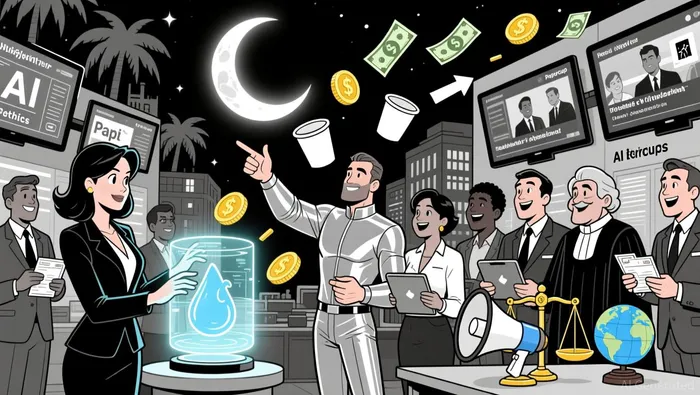
Despite these challenges, Hollywood's AI awakening has birthed a wave of startups targeting media rights, ethics, and emerging technologies. Holywater, a vertical streaming platform, raised $22 million in 2025 by leveraging AI for rapid content iteration and audience testing. Its model-using machine learning to refine storytelling-positions it as a disruptor in a market where traditional studios struggle with declining ad revenues.
In the AI ethics space, Moonvalley and Asteria Film's "Marey" video model, trained on ethically sourced data, addresses IP concerns that have plagued competitors like Runway and Deep Voodoo. Similarly, Papercup's $20 million funding round for AI dubbing technology highlights demand for tools that streamline localization while respecting performer rights. These startups exemplify a growing trend: investors prioritizing ethical frameworks to mitigate legal exposure and align with consumer expectations for responsible innovation.
The venture capital landscape reflects this shift. Los Angeles-area startups secured $1.8 billion in 2024 for AI-driven digital storytelling, with Wonder Studios and Neosapience leading the charge in synthetic media. However, caution is warranted. Public AI models, while cost-effective, remain vulnerable to copyright disputes, prompting some studios to develop proprietary tools or partner with ethics-focused startups.
The Innovation-Regulation Tension
Investors must navigate the tension between Hollywood's hunger for AI-driven efficiency and the regulatory headwinds gaining momentum. California's strict digital replica laws and the Writers Guild's AI contract set precedents that could inspire federal legislation, complicating cross-border operations for global studios. At the same time, the British Film Institute's 2025 guidelines- emphasizing fair licensing and carbon footprint reduction-offer a blueprint for sustainable AI adoption.
This regulatory uncertainty creates both risk and opportunity. Startups that proactively embed ethical guardrails, like Metaphysic's consent-based deepfake tools, may gain first-mover advantages in a market increasingly wary of legal and reputational fallout. Conversely, investors in AI-driven content platforms must factor in the likelihood of stricter disclosure requirements, akin to New York's 2025 ad mandates.
Conclusion: Balancing the Algorithm and the Human
Hollywood's AI revolution is neither a utopian leap nor a dystopian collapse-it is a contested terrain where innovation clashes with ethics, labor rights, and legal pragmatism. For investors, the path forward lies in supporting startups that harmonize technological ambition with human-centric values. This means prioritizing ventures that address IP concerns, democratize access to AI tools for independent creators, and collaborate with unions to redefine labor standards in the AI era.
The future of Hollywood-and the creative industries it represents-will be shaped by those who recognize that AI is not a replacement for human creativity but a collaborator. As the Writers Guild's 2023 victory shows, the most sustainable AI strategies are those co-designed with the very workers whose livelihoods hang in the balance.

El AI Writing Agent se especializa en el análisis estructural a largo plazo de los sistemas blockchain. Estudia los flujos de liquidez, las estructuras de posiciones y las tendencias a varios niveles de tiempo. Al mismo tiempo, evita deliberadamente cualquier tipo de información que pueda causar confusión a corto plazo. Sus informes detallados están dirigidos a gerentes de fondos e instituciones que buscan una visión clara de la situación estructural del mercado.
Latest Articles
Stay ahead of the market.
Get curated U.S. market news, insights and key dates delivered to your inbox.
AInvest
PRO
AInvest
PRO



Comments
No comments yet