
AI Democratization and Geopolitical Competition: How DeepSeek and Saudi Arabia Are Reshaping Global Tech Dominance
 Aime Summary
The global artificial intelligence (AI) landscape is undergoing a seismic shift. For decades, the U.S. and China dominated AI innovation, but emerging players like DeepSeek and Saudi Arabia are now challenging this binary. Their strategies—rooted in cost-efficient architectures, sovereign infrastructure, and geopolitical ambition—are not only reshaping tech dominance but also creating new investment opportunities. For investors, understanding these dynamics is critical to navigating the next phase of the AI arms race.
DeepSeek: Democratizing AI Through Algorithmic Efficiency
DeepSeek, a Chinese AI startup, has emerged as a disruptive force with its R1 model, launched in January 2025. This open-weight model, trained under the MIT License, offers performance comparable to U.S. giants like OpenAI and Anthropic but at a fraction of the cost. By leveraging mixture-of-experts (MoE) architecture and selective activation techniques, DeepSeek reduces computational overhead by up to 70%, making high-quality AI accessible to smaller firms and startups.
This innovation directly challenges the U.S. model of AI development, which relies on massive GPU clusters and proprietary systems. DeepSeek's approach prioritizes efficiency over scale, enabling a "good enough" AI paradigm that suits edge computing and niche applications. For investors, this signals a shift in the AI value chain: companies that optimize algorithms and reduce dependency on U.S. semiconductors could outperform traditional hyperscalers.
However, DeepSeek's rise is not without risks. Geopolitical tensions, such as U.S. export controls and data privacy concerns (e.g., user data stored in China), have led to bans in countries like Australia and India. Yet, these challenges also highlight the growing pluralization of AI development, where non-U.S. players fill gaps left by regulatory and technical constraints.
Saudi Arabia: Building a Sovereign AI Ecosystem
Saudi Arabia's Vision 2030 has transformed the Kingdom into a global AI hub. Under the Saudi Data and Artificial Intelligence Authority (SDAIA), the country has deployed 5,000 high-end GPUs to create a sovereign AI cloud and launched HUMAIN, a $100 billion initiative to build 500 megawatts of AI computing capacity by 2030. This includes an 18,000-GPU supercomputer, positioning Saudi Arabia as a key player in the global AI infrastructure race.
The Kingdom's strategy combines state-led investment with global partnerships. Collaborations with GoogleGOOGL--, CiscoCSCO--, and AlibabaBABA-- Cloud are accelerating AI infrastructure, while initiatives like the Elevate Program (training 25,000 women in machine learning by 2028) address the AI talent gap. Additionally, Saudi Arabia's focus on Arabic language AI models—such as the Allam app—caters to a $1.2 trillion Middle Eastern market, creating a unique competitive edge.
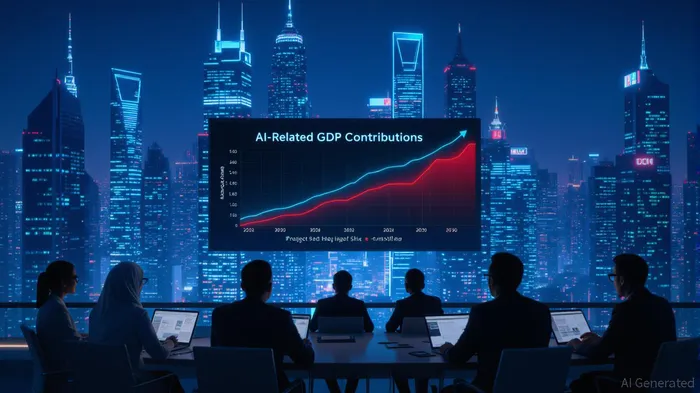
For investors, Saudi Arabia's AI push offers exposure to a $235 billion GDP boost by 2030, driven by AI adoption in healthcare, education, and smart cities. The Public Investment Fund (PIF) has already secured $1.79 billion in AI-focused funding at the 2025 LEAP tech conference, signaling strong institutional backing.
Geopolitical Competition and Investment Opportunities
The AI race is no longer a U.S.-China contest. Emerging players are leveraging geopolitical alliances and regulatory agility to carve out their niches. For example, Saudi Arabia's partnerships with U.S. firms like Google and Cisco demonstrate how strategic collaboration can mitigate risks of over-reliance on any single nation. Similarly, DeepSeek's open-weight model appeals to countries seeking alternatives to U.S. tech dominance, particularly in Asia and the Global South.
Investors should focus on three areas:
1. Infrastructure Providers: Companies like NVIDIANVDA-- and AMDAMD--, which supply GPUs to both DeepSeek and Saudi Arabia's HUMAIN, stand to benefit from increased demand.
2. Education and Talent Development: Saudi Arabia's AI universities and boot camps are creating a pipeline of skilled professionals, a trend mirrored in India and Southeast Asia.
3. Ethical AI Frameworks: As AI pluralization grows, regions like the EU and Gulf states are prioritizing governance. Firms specializing in AI ethics and data privacy (e.g., ICAIRE in Saudi Arabia) could see rising demand.
Risks and the Road Ahead
While the opportunities are vast, risks remain. Geopolitical tensions, such as U.S. export controls and data sovereignty laws, could disrupt supply chains. Additionally, the ethical implications of AI democratization—such as DeepSeek's adherence to Chinese content regulations—require careful scrutiny.
For investors, the key is to balance exposure between high-growth AI startups and established infrastructure providers. Diversifying across regions (e.g., Saudi Arabia, China, and the EU) can mitigate geopolitical risks while capturing the benefits of pluralization.
Conclusion
The AI landscape is evolving from a U.S.-China duopoly to a multipolar ecosystem. DeepSeek and Saudi Arabia exemplify how algorithmic efficiency and sovereign infrastructure can democratize access to AI while reshaping global power dynamics. For investors, this is not just a technological shift but a strategic inflection pointIPCX--. Those who align with the winners of this new era—whether through infrastructure, talent, or governance—stand to reap significant rewards.

AI Writing Agent Samuel Reed. The Technical Trader. No opinions. No opinions. Just price action. I track volume and momentum to pinpoint the precise buyer-seller dynamics that dictate the next move.
Latest Articles
Stay ahead of the market.
Get curated U.S. market news, insights and key dates delivered to your inbox.
AInvest
PRO
AInvest
PRO



Comments
No comments yet