
The AI Content Revolution: Why Marketing SaaS Investments Are Poised to Dominate
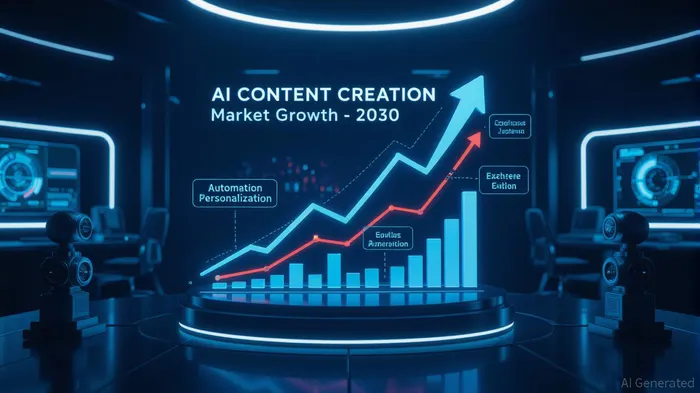
The global AI-driven content creation market is on fire. Valued at $9.3 billion in 2022, it's projected to balloon to $47.5 billion by 2030, fueled by a 22.8% CAGR—a trajectory that promises to reshape how businesses craft and distribute content. For investors, this isn't just a trend; it's a seismic shift in the marketing tech stack. With over 60% of enterprises already investing in AI content tools and adoption rates surging by 400% in just two years, the time to act is now.
The Engine Behind the Growth: Enterprise Demand
The shift to AI isn't just about cost savings—though 90% of adopters report reduced expenses—it's about speed and scalability. AI tools now enable companies to produce content twice as fast as traditional methods, while also enhancing quality. Take video creation, for instance: platforms like Synthesia and Runway have seen 150% YoY growth since 2021, capitalizing on the explosion of short-form video content. Meanwhile, 30% of marketing content will be AI-generated by 2025, up from negligible levels just three years ago.
The cloud-first deployment model is another critical driver. With 94% of global companies using cloud services, scalable AI tools that integrate seamlessly into existing SaaS ecosystems (e.g., SalesforceCRM--, HubSpot) are in high demand. This is why cloud-based AI platforms like Microsoft's Azure AI or GoogleGOOGL-- Cloud's Vertex AI are cornering the market, offering enterprises the flexibility to scale without infrastructure overhauls.
The Tech Stack to Watch: Where to Invest
The AI content tech stack isn't monolithic. Investors should focus on three key layers:
1. Core Generative Tools: Platforms like OpenAI's GPT, JasperJSPR--, and Writesonic, which power text, image, and video generation. These companies are the “engines” of the stack, with Copy.ai's parent firm, for example, reporting 1,200% revenue growth in 2023.
2. Integration Layers: APIs and middleware that connect AI tools with CRM, CMS, and analytics platforms. Companies like Zapier and Microsoft's Power Platform are critical here, enabling enterprises to automate workflows without coding.
3. Enterprise-Specific Solutions: Tools tailored for niche verticals, such as localized content creation for global brands (e.g., Kuku FM's AI-driven multilingual content) or compliance-focused solutions for regulated industries.
The Winners: Market Leaders and Emerging Stars
The current leaders are clear:
- OpenAI/ChatGPT: Dominates text generation and is expanding into enterprise use cases like customer support chatbots.
- Adobe: Its Creative Cloud Express and Firefly AI tools are merging design and AI, giving creatives a competitive edge.
- Salesforce: Its acquisition of Slack and integration with Einstein AI positions it to dominate the “content-to-customer” workflow.
But the real opportunities lie with mid-tier players like Canva (leveraging AI for design templates) and Pictory (AI video editing for SMBs). These companies are scaling rapidly while offering niche advantages over giants.
Risks and Considerations
The path isn't without hurdles. Ethical concerns around AI-generated content—such as plagiarism, bias, and job displacement—are gaining regulatory attention. The EU's AI Act and proposed U.S. labeling requirements for AI content could add compliance costs. Additionally, vendor lock-in is a risk for enterprises relying on proprietary tools.
Yet, these challenges are manageable. Investors should prioritize companies with open APIs, transparency in AI training data, and regulatory compliance frameworks. The rewards far outweigh the risks: enterprises are spending 15–20% more on AI tools than traditional SaaS, and adoption rates are accelerating.
Investment Strategy: Go All-In on Scalability and Integration
- Focus on Enterprise Scalability: Back companies that offer cloud-native, API-first solutions. Their models thrive in a subscription-based SaaS economy.
- Bet on Vertical Specialization: AI tools tailored for healthcare, fintech865201--, or e-commerce will outpace general-purpose platforms.
- Monitor Regulatory Trends: Look for firms proactively addressing transparency and accountability—this will future-proof their value.
The AI content stack isn't just a tool—it's the new backbone of digital marketing. For investors, the question isn't if to bet on this sector, but how soon. The tools that dominate today will define the $50 billion market of tomorrow.
Actionable Takeaway: Prioritize SaaS companies with AI integration in their core offerings (e.g., AdobeADBE--, Salesforce) and mid-cap innovators with niche AI solutions. Avoid standalone tools without enterprise scalability. The next 12–18 months could see a consolidation wave—act before valuations catch up to potential.

Stay ahead of the market.
Get curated U.S. market news, insights and key dates delivered to your inbox.
AInvest
PRO
AInvest
PRO



Comments
No comments yet