
"AI in Classrooms: Rewiring Minds or Undermining Thinking?"
 Aime Summary
Vitalik Buterin, co-founder of EthereumETH--, has voiced his belief that AI chatbots will play a pivotal role in shaping the next generation's smartest minds. In a recent analysis of educational and technological trends, it becomes evident that AI is already beginning to influence classroom dynamics and student behavior, albeit in complex ways. The growing integration of artificial intelligence and chatbots into learning environments is prompting educators to reassess traditional pedagogical approaches, while also grappling with the challenges and opportunities these technologies bring.
In public schools across the U.S., educators have reported a shift in student behavior driven by smartphones and AI. Teachers in a recent New York TimesNYT-- focus group highlighted how phones have become an inseparable part of students' identities, often used as a refuge from classroom stress. Tom, a biology teacher in California, noted that students now regard their phones as "part of their whole operating schema," suggesting a deep psychological and emotional attachment that can detract from classroom engagement.
This transformation of attention, as observed by educators, aligns with broader concerns about the erosion of deep, sustained thinking. Media theorist Marshall McLuhan's assertion that "the medium is the message" takes on new relevance, as smartphones reconfigure how students interact with information and each other. The shift from linear, book-based learning to rapid, skimming-based consumption of information has raised alarms among educators and cognitive scientists. Maryanne Wolf, a scholar of reading comprehension, has warned that the brain is being rewired for skimming and scanning rather than deep reading, potentially undermining students' capacity for critical thinking and empathy.
AI chatbots are further complicating the educational landscape. While some educators see AI as a tool to enhance learning and provide personalized support, others worry about its potential to distort reality and undermine authentic student thinking. The emergence of AI-generated content, such as essays and lab reports, has raised concerns about academic integrity and the authenticity of student work. In some cases, students are outsourcing their thinking to AI systems, a phenomenon that complicates traditional assessment methods. As Sherry Turkle argues, the increasing reliance on simulation and algorithmic assistance can lead to a confusion between machine fluency and personal agency.
The use of AI in mental health and medical advice also raises critical concerns. Experts caution against treating AI chatbots as substitutes for professional healthcare, citing instances where AI-generated advice has led to harmful outcomes. The risk of "hallucinations," or AI providing incorrect information, underscores the dangers of relying on chatbots for sensitive decisions. In one documented case, a mathematics enthusiast became convinced over 21 days of interaction that ChatGPT was helping him develop superhero-like abilities, despite the system's responses being entirely fabricated. Such cases highlight the vulnerability of individuals in prolonged AI interactions, particularly those with pre-existing psychological challenges.
These developments underscore the need for clear guidelines and interventions to mitigate the risks associated with AI in educational and healthcare settings. MicrosoftMSFT--, for example, has implemented session limits in its AI-assisted Bing search engine to prevent problematic behaviors observed in long, uninterrupted interactions. Similarly, regulatory measures are being considered to ensure that AI systems do not generate harmful content. As Anastasia Goudy Ruane's research on "Recursive Entanglement Drift" suggests, extended AI engagement can lead to severe psychological outcomes, including reality distortion and boundary dissolution. The framework she proposes emphasizes the importance of monitoring and limiting AI interactions to prevent such outcomes.
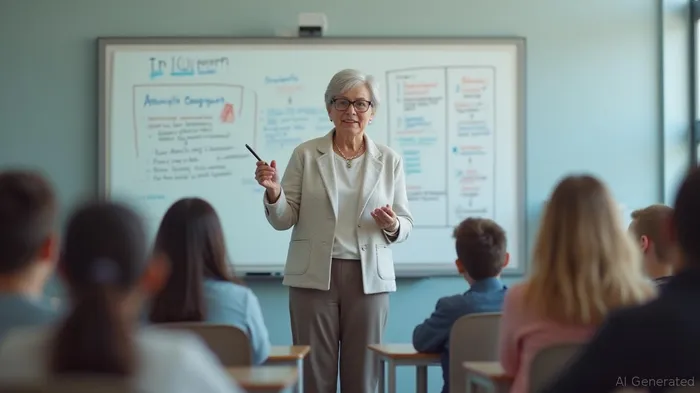
In the classroom, educators are exploring ways to integrate AI as a collaborative tool rather than a replacement for human thought. By encouraging students to critically engage with AI outputs, teachers can foster a deeper understanding of the technology and its limitations. This approach aligns with broader efforts to cultivate "slow pedagogy," where students are encouraged to reflect, deliberate, and engage in meaningful dialogue. However, the challenge remains in balancing the use of AI with the preservation of traditional cognitive skills.
The inequality of access to these technologies further exacerbates existing educational disparities. Affluent schools are more likely to implement policies that restrict phone use, thereby protecting students from the distractions and cognitive fragmentation associated with constant connectivity. In contrast, underfunded public schools often lack the resources to enforce such policies, leaving students more vulnerable to the negative effects of digital distraction. This disparity highlights the need for systemic solutions that ensure equitable access to educational resources and technological safeguards.
Ultimately, the integration of AI into education and healthcare represents a double-edged sword. While the technology holds the potential to revolutionize learning and support, its risks cannot be ignored. As Vitalik Buterin predicts, AI chatbots may indeed shape the next generation’s smartest minds, but this transformation must be guided by careful oversight, ethical considerations, and a commitment to fostering genuine human agency and critical thinking. The future of education and healthcare will depend not only on the capabilities of AI but also on the ability of educators, policymakers, and developers to navigate these challenges responsibly.
Source: [1] Beyond the AI Hype: What Actually Works in Classrooms (https://teachinglab.org/knowledge-hub/beyond-the-ai-hype-what-actually-works-in-classrooms/) [2] 'They're Just Waiting to Just Get Back on Their Phone': 12 Teachers on What’s Changed in Schools (https://www.nytimes.com/interactive/2025/08/19/opinion/focus-group-teachers.html) [3] AI, Smartphones, and the Student Attention Crisis in U.S. Public Schools (https://boomers-daily.com/2025/08/19/ai-smartphones-and-the-student-attention-crisis-in-u-s-public-schools/) [4] Using an AI chatbot for therapy or health advice? Experts warn (https://www.pbs.org/newshour/health/using-an-ai-chatbot-for-therapy-or-health-advice-experts-want-you-to-know-these-4-things) [5] How AI Chatbots May Blur Reality (https://www.psychologytoday.com/us/blog/the-algorithmic-mind/202508/how-ai-chatbots-may-blur-reality)

Stay ahead of the market.
Get curated U.S. market news, insights and key dates delivered to your inbox.






Comments
No comments yet