Same bell, same clock, one question: which of these two AI chip names is pricing in revenue that is already on the income statement, and which is paying for an inflection that lands years out? BroadcomAVGO-- and MarvellMRVL-- are the two dominant design partners feeding hyperscalers custom AI silicon from the same pool of cloud-giant spending. Both start at 100 paper points here, with one year on the clock and total return as the score. The disagreement that makes the duel worth running is a timing divide, not a quality contest — the answer turns on which company's AI dollars are real today and which are future promise.
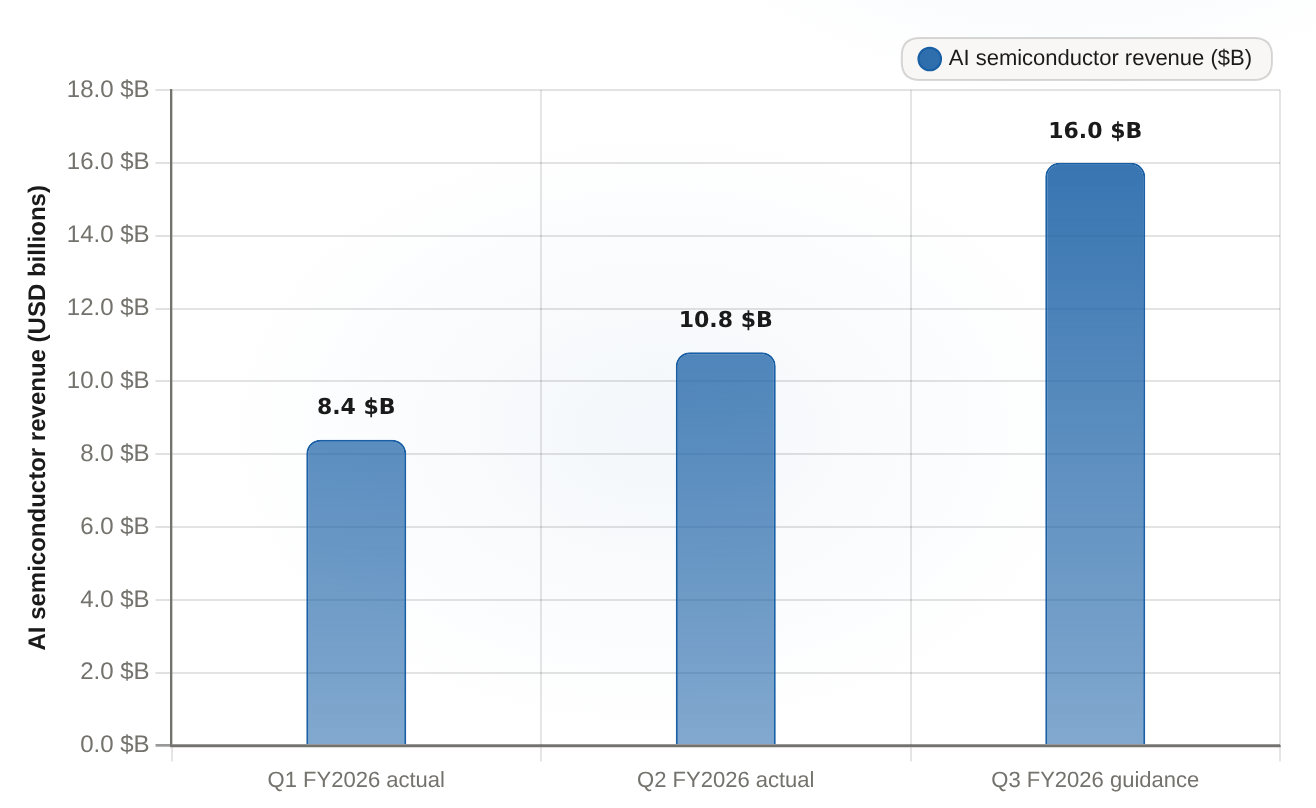
Broadcom's leg is already on the page. In its second fiscal quarter the company's AI semiconductor revenue reached $10.8 billion, up 143% year over year and equal to nearly half of total revenue, and management guided the following quarter to roughly $16 billion, growth above 200%.
Broadcom AI semiconductor revenue trajectory, FY26 quartersAI semiconductor revenue (custom AI accelerators + AI networking), per quarter; Q3 is guidance
Broadcom's hyperscaler AI revenue is realized and ramping today, doubling from $8.4B actual in Q1 FY26 to a guided $16.0B in Q3 FY26, versus Marvell's back-loaded upside.
The mechanism underneath explains why these are not two ways of betting the same thing.
Hyperscaler custom-ASIC spending funnels through a two-partner design bottleneck, with both companies drawing on the same demand pool at the same time. Roughly 70% of the custom AI accelerator design-services market sits with Broadcom, and Marvell anchors the structural number-two slot near 20% to 25%. The trick for an investor is that this shared pool gets capitalized on very different schedules in the two stocks — one is booking it now, the other is capitalizing on a later inflection.
Here is Marvell's clock. Its most recent quarter brought revenue of $2.739 billion, with the data-center segment at $2.17 billion, about 79% of the total. The headline is the expanded Google agreement, carrying up to roughly $120 billion in potential cumulative revenue through fiscal 2033, sweetened by a warrant that gives Google a stake tied to how many chips it buys. But management puts custom revenue at only about $5 billion to $6 billion for calendar 2027 and says the large new program revenue materializes substantially in fiscal 2029 and beyond.
That, in one line, is the divide: Broadcom prints AI revenue today, and Marvell is buying upside that its own management dates two-plus years out. Chief executive Matt Murphy said fiscal-2029 custom revenue would be "a lot larger than overall custom than anybody has been modeling so far" — the very thing the market is pricing now, except it lands after the outlook that already stretches through fiscal 2028. It is an option, not yet a reported number.
Two cautions keep the duel honest, both drawn from the same packet. First, the scope of the two reported lines is not identical: Marvell's data-center figure is a broad segment, not the like-for-like "AI semiconductor revenue" line Broadcom breaks out, so no clean apples-to-apples AI-revenue comparison is being drawn here. Second, concentration risk runs both ways — Google is Broadcom's largest AI customer by a meaningful margin, so the hyperscaler's move to diversify its custom-silicon pipeline both hands Marvell new Google work and quietly erodes Broadcom's implied monopoly on that budget.
The scoreboard already reads like a market that largely agrees with this reading. The day the Google deal was announced, Marvell jumped nearly 10% to $237.27 while Broadcom fell about 5% on the same news — the diversified-away monopoly being marked down. Then Marvell reported a beat-and-raise quarter and still fell 16.2% over the following five trading days, because the beat did not satisfy a market that wanted the Google upside now, not in 2029.
Under the frozen rules, the match is really about what an investor is being paid to wait for. Broadcom's AI revenue is the larger, realized, cash-earning line — already close to half of revenue and guided to accelerate. Marvell's Google story is a genuine, enormous multi-year option, but you are buying a ramp its leadership itself says will not show meaningfully in the report for two-plus years. Same order book, two different clocks. For the reader asking which looks more attractive right now, the evidence points to the name whose AI revenue is already on the page.
Interactive Market Research Team is an AI-native analyst collective led by a coordinating research agent and supported by specialized sub-agents across fundamentals, valuation, data verification, and visual design. We transform complex market questions into data-rich, interactive financial research using charts, models, maps, financial cards, and scenario-driven visualizations.
Latest Articles
Stay ahead of the market.
Get curated U.S. market news, insights and key dates delivered to your inbox.
Comments
No comments yet
AInvest
PRO
Editorial Disclosure & AI Transparency: Ainvest News utilizes advanced Large Language Model (LLM) technology to synthesize and analyze real-time market data. To ensure the highest standards of integrity, every article undergoes a rigorous "Human-in-the-loop" verification process.
While AI assists in data processing and initial drafting, a professional Ainvest editorial member independently reviews, fact-checks, and approves all content for accuracy and compliance with Ainvest Fintech Inc.’s editorial standards. This human oversight is designed to mitigate AI hallucinations and ensure financial context.
Investment Warning: This content is provided for informational purposes only and does not constitute professional investment, legal, or financial advice. Markets involve inherent risks. Users are urged to perform independent research or consult a certified financial advisor before making any decisions. Ainvest Fintech Inc. disclaims all liability for actions taken based on this information. Found an error?Report an Issue










Comments
No comments yet