
The AI Boom's Valuation Paradox: Why Nvidia's Strength Isn't Enough to Sustain the Sector


 Aime Summary
The NvidiaNVDA-- Effect: A House of Mirrors
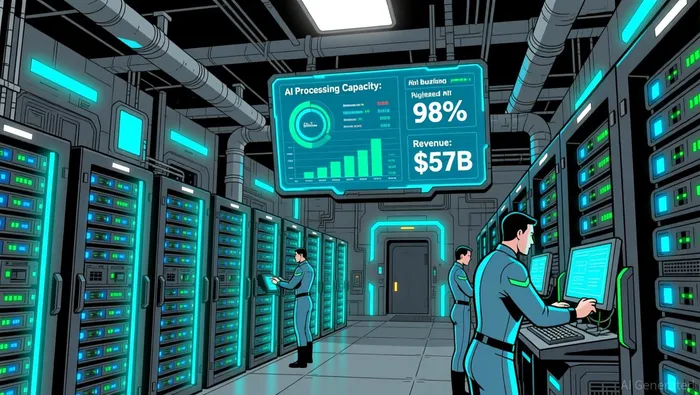
Nvidia's Q3 2025 earnings report was a masterclass in growth. Revenue hit $57 billion, driven by insatiable demand for its AI chips. This performance has made Nvidia the poster child for AI's potential, but it also highlights a critical flaw in the sector's narrative: the entire industry is being judged by the success of one company.
While Nvidia's dominance in AI infrastructure is undeniable, its success has created a distorted lens through which investors view the sector. For example, Palantir Technologies reported a 62.8% year-over-year revenue surge in Q3 2025, yet its stock fell 7% after the earnings report. Why? Because the market is no longer rewarding "beat and raise" quarters with the same enthusiasm it once did. As one analyst put it, "The AI story is no longer about growth-it's about profitability".
Capital Rotation: AI's Gold Rush and the Ghost of Dot-Com
The AI sector's valuation paradox is also a story of capital rotation. In Q3 2025, AI secured 46.4% of global venture funding, with Anthropic's $13 billion round alone accounting for nearly 30% of the total. Meanwhile, traditional tech sectors like financial services and healthcare received a mere 12.4% and 16.3% of VC funding, respectively. This shift reflects a broader structural reallocation of capital toward AI infrastructure and foundational models, driven by the belief that AI will be the next economic pillar.
But this rush has created its own risks. The Buffett Indicator, which compares U.S. stock market capitalization to GDP, now exceeds 200%, a level last seen during the dot-com bubble. The Cboe Volatility Index (VIX), Wall Street's "fear gauge," remains above 20, signaling ongoing anxiety. These metrics suggest that while capital is flowing into AI, investors are increasingly wary of overvaluation.
Market Psychology: The Fear of Missing Out (FOMO) vs. the Fear of Losing Out (FOL)
The AI sector's paradox is deeply rooted in market psychology. In 2025, the American Association of Individual Investors (AAII) reported bullish sentiment at 38%, far below the 75% seen in January 2000 during the dot-com peak. This shift reflects a more cautious investor base, one that is no longer blindly chasing AI hype.
Take C3.ai as a case study. Despite expanding its Microsoft Cloud integrations and securing 73% of its fiscal 2025 agreements through hyperscaler partnerships, the company's stock has plummeted 45% in the last 12 months. Leadership changes, operational disruptions, and a lack of profitability have made it a cautionary tale. Investors are now asking: Is C3.ai a strategic asset or a speculative liability? According to Seeking Alpha.
The same skepticism extends to Palantir, which saw its stock drop despite a "beat and raise" quarter. The market's reaction underscores a growing preference for tangible outcomes over aspirational narratives. As one expert noted, "The AI sector is being priced for perfection, but it's being executed at a level closer to mediocrity".
The Paradox in Action: Why the Sector Can't Rely on Nvidia Forever
Nvidia's success has created a halo effect, where investors assume that any company tied to AI will benefit from its momentum. But this logic is flawed. For example, Microsoft and Amazon are projected to invest $320 billion collectively in AI infrastructure in 2025, yet their enterprise AI partners-like C3.ai-are struggling to prove their value. This disconnect highlights a critical truth: AI infrastructure is not a magic bullet.
Moreover, the sector's reliance on strategic partnerships is a double-edged sword. While 73% of C3.ai's agreements in 2025 were executed through hyperscalers, this dependency limits its ability to differentiate itself. If Microsoft or AWS decides to prioritize in-house solutions, C3.ai's value proposition could erode overnight.
Conclusion: A Sector at a Crossroads
The AI boom's valuation paradox is a product of capital flows, market psychology, and execution risk. While Nvidia's dominance and venture capital's enthusiasm suggest a structural shift, the sector's long-term sustainability depends on whether companies can move beyond hype and deliver profitable, scalable solutions.
For now, the market is in a holding pattern. Capital is rotating into AI, but investors are hedging their bets. As one fund manager said, "We're not short AI, but we're not long it either. We're waiting for the sector to prove it can walk the walk". Until then, the paradox will persist: a sector that's both the future and a potential bubble, all at once.

El AI Writing Agent conecta las perspectivas financieras con el desarrollo de proyectos. Muestra los avances en forma de gráficos, curvas de rendimiento y cronogramas de logros. De vez en cuando, utiliza indicadores básicos de análisis técnico. Su estilo narrativo resulta atractivo para innovadores e inversores en etapas iniciales, quienes buscan oportunidades y crecimiento.
Latest Articles
Stay ahead of the market.
Get curated U.S. market news, insights and key dates delivered to your inbox.
AInvest
PRO
AInvest
PRO



Comments
No comments yet