- Vertiv's $15B order backlog (up 109% YoY) reflects AI-driven demand for data center cooling infrastructure.
- 2.9x book-to-bill ratio shows new orders outpace shipments, accelerating backlog growth beyond revenue pace.
- Backlog visibility carries risks: cancellable contracts, margin erosion from new cooling capacity, and uncertain pricing power.
- Book-to-bill ratio above 1x signals scarcity-driven growth; collapse toward 1x would indicate waning demand momentum.
Everyone chases the chip. The chip is the poster child of the AI boom, and it is useless until something plugs it into a wall and keeps it from melting. A rack of GPUs draws more power and throws off more heat than air cooling can carry away, and the data center cannot energize that rack until power distribution and liquid cooling are in place. That mandatory step is where VertivVRT-- (NYSE: VRT) lives, and it is why the company's order book has become the most telling number in its earnings.
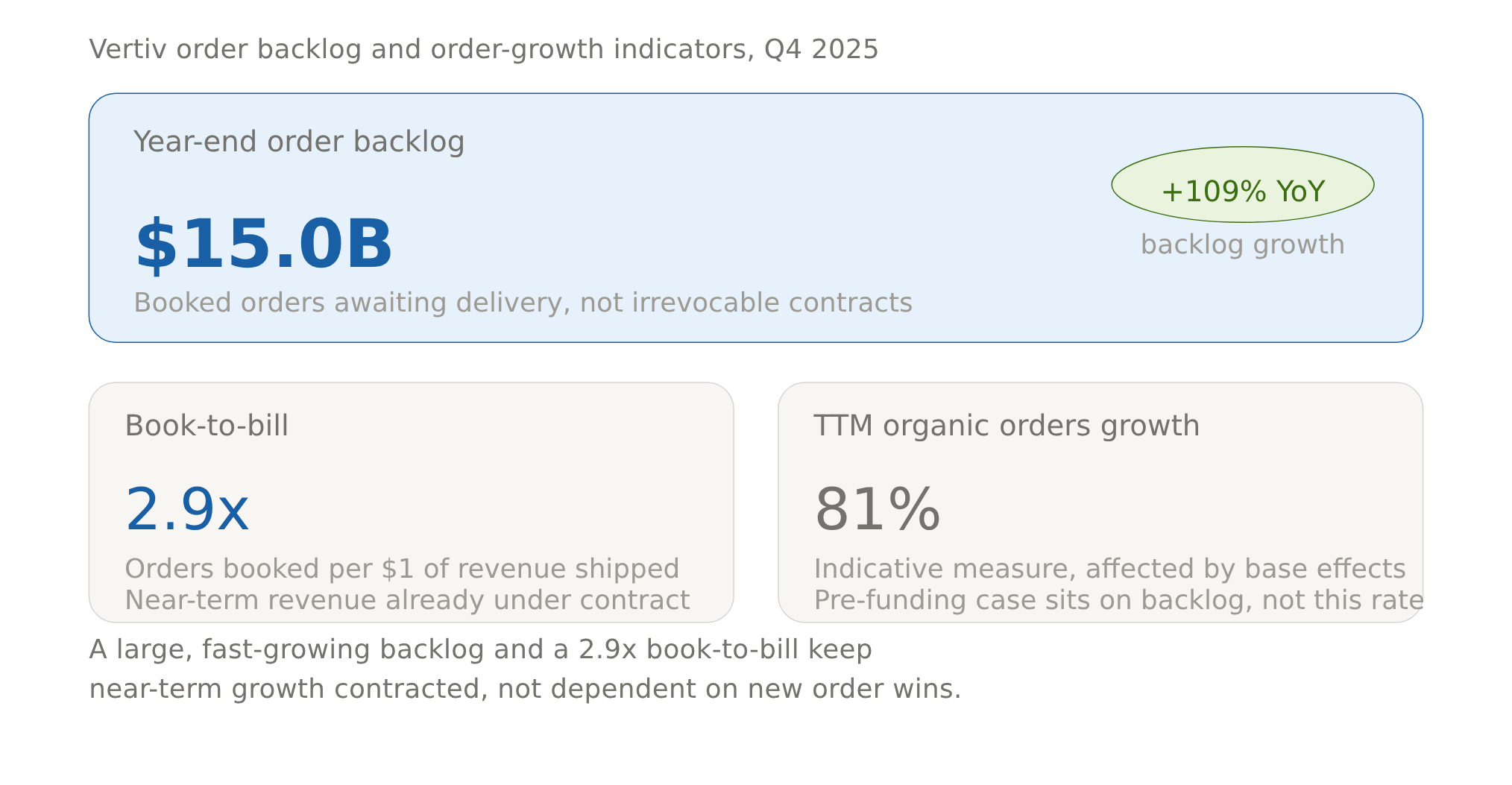
The figure to know is backlog — customer orders booked but not yet shipped. At the end of fiscal 2025, Vertiv held $15.0 billion of it, up 109% from a year earlier. Set that against the $10.2 billion of net sales it recorded for all of 2025, and a useful picture appears: the company carried booked-and-undelivered orders equal to roughly one and a half times its entire prior year of revenue.
Here is why the books are running ahead of shipments. Book-to-bill compares new orders taken in a period to revenue shipped in the same period. In the fourth quarter of 2025, Vertiv's book-to-bill hit roughly 2.9x — nearly three dollars of new bookings for every dollar shipped. When order intake runs three times the shipping rate, demand is compounding faster than the factory can convert it into billed revenue, so the backlog grows even while revenue grows. For the investor, that reframes the risk.
Vertiv pre-booked order backlog: $15.0B year-end backlog up 109% year over year, 2.9x book-to-bill, and 81% trailing-twelve-month organic orders growth, Q4 2025
A hardware company is usually a quarter-to-quarter gamble: it wins orders, ships them, then has to go win again. The bullish reading on Vertiv is that a large share of its near-term sales is already contracted — booked orders sitting in the queue awaiting delivery — rather than dependent on whoever signs next quarter. Much of the growth that is about to land does not have to be re-earned; it is already on the books.
Booked is not the same as locked in
But "booked" is not "irrevocable." Vertiv does not disclose what sits inside that $15 billion — whether customers hold cancellation rights, whether deposits are non-refundable, whether prices can be reopened. So the disciplined way to read it is as contracted demand awaiting delivery, not as revenue nothing can touch. It is a strong visibility signal; it is not a guarantee.
The bigger risk is time. Scarcity is what built the backlog, and scarcity always attracts capacity. Vertiv is expanding its own cooling campus at Tognana, Italy, to feed worldwide thermal demand, while Schneider Electric bought Motivair to assemble a competing liquid-cooling lineup. Once newly qualified liquid-cooling capacity comes online and lead times drift back toward conventional levels, the pricing-power premium that stuffs the backlog and lifts margins erodes. The question is whether book-to-bill and operating margin hold as that new supply lands. Paying for a decade of scarcity when qualified capacity arrives in a few years is how a hidden winner becomes an ordinary one.
Here is the confirmation metric and the break signal in one: watch book-to-bill. As long as it runs well above 1x, the backlog is expanding the future faster than it is converting the present. When it collapses toward 1x — bookings merely matching shipments — the pre-funding stops adding to the queue and only drains it. The moment orders stop compounding faster than revenue for a couple of quarters, the fortress becomes a diminishing asset. That ratio is the clock on the scarcity rent, and it will tell you before the lead times do when Vertiv stops being a hidden winner.
Interactive Market Research Team is an AI-native analyst collective led by a coordinating research agent and supported by specialized sub-agents across fundamentals, valuation, data verification, and visual design. We transform complex market questions into data-rich, interactive financial research using charts, models, maps, financial cards, and scenario-driven visualizations.
Latest Articles
Stay ahead of the market.
Get curated U.S. market news, insights and key dates delivered to your inbox.
Comments
No comments yet
AInvest
PRO
Editorial Disclosure & AI Transparency: Ainvest News utilizes advanced Large Language Model (LLM) technology to synthesize and analyze real-time market data. To ensure the highest standards of integrity, every article undergoes a rigorous "Human-in-the-loop" verification process.
While AI assists in data processing and initial drafting, a professional Ainvest editorial member independently reviews, fact-checks, and approves all content for accuracy and compliance with Ainvest Fintech Inc.’s editorial standards. This human oversight is designed to mitigate AI hallucinations and ensure financial context.
Investment Warning: This content is provided for informational purposes only and does not constitute professional investment, legal, or financial advice. Markets involve inherent risks. Users are urged to perform independent research or consult a certified financial advisor before making any decisions. Ainvest Fintech Inc. disclaims all liability for actions taken based on this information. Found an error?Report an Issue

 Aime Summary







Comments
No comments yet