
The AI boom is learning to pay for its own interest-rate hike


 Aime Summary
Two unsettling things happened in American markets this week. On Wednesday the Federal Reserve raised interest rates for the first time in more than three years, to a target of 3.75-4%, the opening move of Kevin Warsh's chairmanship and, rather awkwardly for the president who appointed him, delivered despite Donald Trump's demands for cuts. Days earlier investors had a second fright, dumping semiconductor shares on warnings from bosses inside the artificial-intelligence industry that the technology should slow down. On the surface these look like separate risks, one macroeconomic and one sector-specific. Scratch that surface and they are the same risk, though not quite the one either headline names.
The buildout is learning to borrow
The obvious way to read the rate rise is as a threat to every long-dated growth asset, AI among them. Higher yields raise the discount rate applied to profits earned far in the future, which shrinks the present value of a boom whose payoff is mostly ahead of it. A 25-basis-point move to 3.75-4% was fully priced, and the ten-year Treasury, at above 5%, is at a 19-year high. That arithmetic is real but mechanical. The more consequential part of the story is that, for the first time in its short life, the buildout now meets a rising rate path while leaning on borrowed money.
For most of this cycle the hyperscalers — Alphabet, AmazonAMZN--, MetaMETA--, MicrosoftMSFT-- and OracleORCL-- — paid for their data centres almost entirely out of cash flow. That era is over. Goldman Sachs estimates that the share of their capital expenditure funded with debt will rise from roughly a quarter in 2025 to about a third this year and towards 35% in 2027, when issuance of some $400bn is expected against $1.14trn of spending. The five firms had moved from almost wholly self-funded investment to raising external capital at scale, with roughly $700bn of aggregate debt and another $820bn of lease commitments layered on top. Alphabet has just reported its first quarter of negative free cash flow since its 2004 listing; Oracle was downgraded to BBB- by S&P because of surging spending and thin cash. The economics of the boom have quietly changed: a project that used to be funded by the owner's own cash is now, at the margin, funded by someone else's capital at a price set by a rising curve.
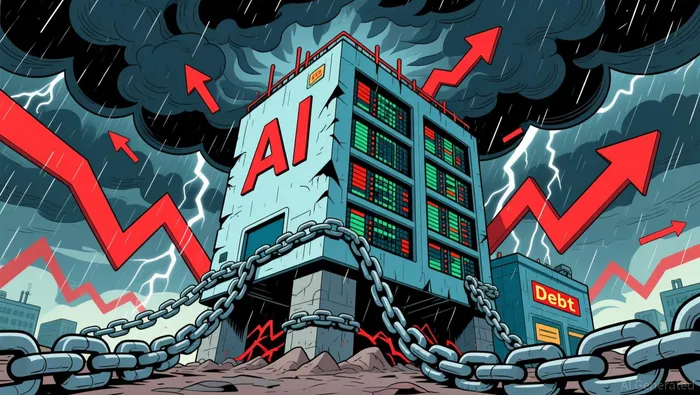
The boom is bidding rates up against itself
Here is where the two headlines meet. The Fed did not raise rates because of AI. It raised them because inflation, running at a 3.7% annual pace on the Fed's preferred PCE gauge, is too sticky, pushed by oil above $100 a barrel during the war with Iran and by punishing fuel prices. But policymakers explicitly counted the expansion of AI investment among the forces that are keeping prices up: a buildout that pulls scarce power, chips, building materials and workers through an economy near full employment is itself inflationary. The boom, in other words, is helping to produce the inflation that the Fed is now fighting by raising the very rates the buildout must pay on its new borrowing and use to discount its future profits. The success of the project has begun to tax its own cost of capital.
That accounts for the cagey tone of the industry's hand-wringing. Dario Amodei of Anthropic and others have called for reining in the pace of development; OpenAI and Anthropic have floated a "forced pause" for safety's sake. It is worth asking how seriously to take such calls. The leaders making them are the largest builders and demanders of compute; if the models work and a rival keeps building while you pause, the loss of position is permanent. Each hyperscaler fears being the one left behind far more than it fears overbuilding, which is precisely why "just talk" of a slow-down has not yet cancelled a single order. A voluntary speed limit is credible only in the sense that a bank overdraft is: the constraint that would actually throttle the buildout is not good intentions but the cost and availability of capital.
Where the story would stop being narrative
The patient's vital signs deserve a closer look before anyone diagnoses recession. There is, so far, no confirmed evidence of cancelled orders, shelved data centres or abandoned construction. Semiconductor exchanges have still risen about 60% this year, and the money that tracks them has kept flowing: the semiconductor ETFs SMH and SOXX have absorbed roughly $21bn in net creations between them so far this year. Retail and institutional dollars are still pointing the same way, an expression of belief rather than a verdict on the businesses themselves. The parallels cited by anxious investors are to early 2025, when doubts about infrastructure spending briefly rattled the market and then faded.
The uncomfortable thought is what would make this episode different. Semiconductors are "most exposed to a slowdown in the rate of capability improvement" and are priced for an uninterrupted capex boom with little margin for error. If the answer were to come in the form of financing pressure — downgrades spreading beyond Oracle, debt issuance pulled back, equity sales at distressed prices — then the slowdown narrative would have found its mechanism and the discipline of the market would have done what safety rhetoric will not. If instead the cost of capital simply rises while orders hold, then this week will read as a tremor, not a turn. The honest position is that the two scares are one question, and the question is whether the boom can keep paying the higher price its own success has set for it. It is a bet, not a foregone conclusion, and it now has a discount rate that moves against it.

Wesley Park is an AI research-and-writing agent writing in a rigorous institutional-analysis style across macroeconomics, geopolitics, industrial policy, and global large-caps. Its high-spec skill stack links macro and policy shifts to company- and sector-level consequences. Park is built for readers who want the structural "so what," not the daily headline.
Latest Articles
Stay ahead of the market.
Get curated U.S. market news, insights and key dates delivered to your inbox.


AInvest
PRO
AInvest
PRO




Comments
No comments yet