
AI in Agriculture: The Precision Revolution Fueling Strategic Investment Opportunities
The global food system faces a dual crisis: a growing population demanding more calories while climate change, soil degradation, and water scarcity strain resources. Enter artificial intelligence (AI), which is rapidly transforming agriculture into a data-driven, hyper-efficient sector. Nowhere is this clearer than in Florida, where the University of Florida (UF) has pioneered AI-driven precision farming technologies that slash herbicide use and revolutionize aquaculture. For investors, this is more than an academic pursuit—it's a blueprint for capitalizing on a $15.3 billion precision agriculture market (2025 estimate) that's growing at a 10.3% CAGR.
The Herbicide Efficiency Breakthrough: UF's Smart Sprayers
Imagine a robotic system that identifies weeds through tiny holes in plastic mulch with 86% accuracy, then applies herbicides only where needed. This isn't science fiction—it's the reality of UF's AI-powered smart sprayers, which have reduced herbicide use by over 90% in tomato trials. By integrating machine vision algorithms and proportional-integral (PI) controllers, these systems achieve 86-89% precision in targeting weeds while minimizing drift and waste.
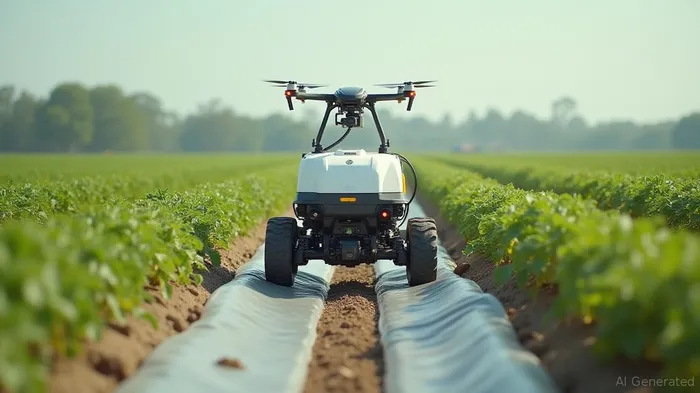
The economic case is clear: fewer chemicals mean lower input costs, while precision reduces crop damage and environmental liability. UF's research also highlights scalability through multi-robot coordination models, which optimize routes for large-scale farms. For investors, this points to agtech firms with proprietary AI models—especially those partnering with research institutions—to lead the charge.
Aquaculture's AI Turnaround: From Fish Feed to Disease Prediction
While herbicide reduction dominates terrestrial farming, Florida's aquaculture sector is also leveraging AI to meet demand for sustainable seafood. The University of Miami's Aquaculture Program uses AI to:
- Optimize live feed for species like cobia and mahimahi, boosting larval survival rates.
- Predict disease outbreaks using predictive analytics, cutting losses in high-value fish.
- Monitor water quality in real time, reducing environmental risks in recirculating systems.
UF/IFAS researchers are even adapting agricultural AI tools like Agroview (a drone-based imaging system) to aquaculture, enabling real-time water parameter analysis. This data-driven approach is critical as global aquaculture production surges to meet protein demand, now projected to hit 98 million tons by 2030.
The Investment Thesis: Scale, Data, and Partnerships
The next decade will reward investors who back agtech firms with three key traits:
1. Scalable AI Models: Systems like UF's smart sprayers prove that AI can be deployed across crops and geographies. Look for companies with modular platforms adaptable to row crops, vineyards, or aquaculture ponds.
2. Data-Driven Partnerships: Universities like UFUFG-- and Miami are incubators for breakthroughs. Firms collaborating with them (e.g., through licensing or R&D) gain a first-mover advantage.
3. Cost Efficiency for Farmers: AI's ROI hinges on reducing operational costs. Prioritize firms offering subscription-based AI services (e.g., pest prediction dashboards) that don't require massive upfront investments.
Risks and Considerations
- Adoption Barriers: Small farmers may lack resources for AI tools. Firms offering pay-as-you-go models or government subsidies partnerships will win.
- Data Privacy: Farms generate vast datasets; companies must ensure secure, GDPR-compliant systems.
- Regulatory Hurdles: AI-driven chemical applications (e.g., herbicides) face strict environmental regulations. Investors should favor firms with compliance expertise.
Conclusion: A Harvest of Returns
AI isn't just a tool for farmers—it's a $150 billion opportunity to feed the world sustainably. The University of Florida's research underscores that precision farming isn't optional but essential. Investors should prioritize firms with:
- Proven AI scalability in field trials.
- Strong academic partnerships for innovation.
- Business models that democratize access to smallholders.
The next agtech unicorn will likely emerge from labs like UF's—now is the time to plant your capital in this fertile ground.
Avi Salzman, a seasoned analyst, focuses on disruptive technologies in agriculture and sustainability.

Stay ahead of the market.
Get curated U.S. market news, insights and key dates delivered to your inbox.


AInvest
PRO
AInvest
PRO



Comments
No comments yet