
AI Agents Reshape Crypto Trading and Finance, Boosting Security and Automation
 Aime Summary
AI agents are reshaping the trading and finance landscape by integrating with blockchain and real-time market systems, enabling secure and automated decision-making. Companies such as MoonPay and Toobit are pioneering this shift by launching tools that connect AI models directly to trading platforms and secure hardware wallets, ensuring both autonomy and safety. NvidiaNVDA-- is projecting the AI chip market could reach $1 trillion by 2027, highlighting the growing infrastructure demand for real-time AI processing. China's strategic focus on cost-effective AI adoption and open-source model development is also driving global competition in the space. Academic research is beginning to explore how AI agents can be applied across financial services, including portfolio management and market prediction, while raising important regulatory and ethical questions.
AI agents are no longer a futuristic concept—they're reshaping how we trade, invest, and manage capital in real time. From securing crypto transactions to enabling autonomous arbitrage, the latest advancements suggest we are at the dawn of a new era in finance. This isn't just about convenience; it's about redefining trust, control, and efficiency in a world where AI can execute trades faster than human traders and with greater precision. The implications for investors are huge, and the market is already responding.
What Is an AI Agent in Finance and How Is It Changing Trading Security?
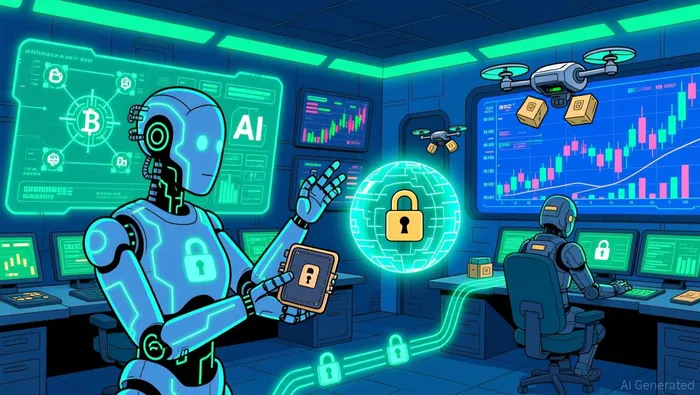
An AI agent is an autonomous or semi-autonomous system that can interact with a financial or trading environment, make decisions based on data, and execute transactions. In the case of crypto, security has long been a barrier to fully autonomous trading. Now, with tools like MoonPay Agents, AI agents can securely sign transactions using hardware wallets like Ledger signers, ensuring private keys are never exposed to the cloud or external networks.
This development is a game-changer. Previously, AI-driven trading required users to compromise on security—either by storing private keys on insecure servers or limiting the AI's ability to act independently. Now, users can delegate complex tasks like portfolio rebalancing or multi-chain trading to AI agents while maintaining full control over transaction approvals. This hybrid model—autonomous yet secure—could become the new standard in crypto finance.
Meanwhile, platforms like Toobit are making it easier for developers and traders to create custom AI trading agents. Their AI Agent Trade Kit is an open-source framework that links large language models (LLMs) like ChatGPT and Claude directly to exchange APIs, enabling real-time trading and portfolio management. The toolkit includes 66 modular tools for price monitoring, order execution, and asset tracking—all operating locally to protect sensitive data. This kind of accessibility is accelerating AI adoption across both individual and institutional trading.
How AI Agents and Infrastructure Demand Are Shaping the $1 Trillion Opportunity
The infrastructure side of AI is just as important as the applications. Nvidia, the chipmaker powering most of today's AI systems, sees a massive revenue opportunity ahead. CEO Jensen Huang has noted a surge in demand from enterprises and startups for AI computing power, citing the rapid growth of token processing and real-time AI execution. The company is investing heavily in its GPU line for large-scale AI operations and is positioning itself as a leader in the agentic AI market.
But it's not just about the chips. China is also making strategic moves in the AI space. Rather than focusing solely on high-end models, the country is prioritizing mass adoption, open-source development, and industry integration. DeepSeek's recent R-1 model, which outperformed many U.S. models, is a case in point. The Chinese government is also investing in power grids and data centers to support AI growth, giving it a unique advantage in scalability and cost efficiency.
For investors, these trends point to a broader transformation. The real AI winners may not just be the tech giants but also the infrastructure and security companies enabling these systems. For example, companies that develop secure AI transaction protocols, AI-driven portfolio tools, or AI-focused data centers could all benefit from this shift.
What to Watch for as AI Agents Move Into Mainstream Finance
As AI agents begin to shape trading and portfolio management, there are several key developments to track. First, regulatory responses will play a major role in determining how quickly these systems are adopted. Governments and financial watchdogs are already looking at how to monitor autonomous trading agents to prevent manipulation or misuse.
Second, hardware integration is critical. The MoonPay-Ledger partnership is a prime example of how security concerns can be addressed through physical signers. Similar partnerships could emerge in the stock or futures markets, enabling secure AI trading across asset classes.
Lastly, there's the question of adoption. While large institutional players are already experimenting with AI agents, the real growth will come from smaller traders and startups. Open-source frameworks like Toobit's AI Agent Trade Kit are lowering the barrier to entry, and this could lead to a surge in innovation—and competition.
As the AI investor landscape evolves, investors should stay informed, explore real-world use cases, and look for companies that are not only building AI but also securing and scaling it. The future of finance is being written by the AI agents we build today.

Stay ahead of the market.
Get curated U.S. market news, insights and key dates delivered to your inbox.


AInvest
PRO
AInvest
PRO



Comments
No comments yet