
AI Agents and the Future of Prediction Markets: Growth, Risks, and Regulatory Responses
 Aime Summary
Prediction markets have expanded beyond niche platforms and are now being used to forecast political, military, and economic events according to reports. This growth is supported by increasing participation from institutional investors, including Intercontinental ExchangeICE-- and ARKARK-- Invest, which are betting on the sector's potential as data shows. The rise of AI agents in this space further complicates the landscape, as automated systems begin to outperform or mimic human forecasting behaviors according to analysis.
Trading volumes in prediction markets have grown exponentially, from $2 billion in 2023 to $63.5 billion in 2025 according to reports. This growth has drawn attention from policymakers and academics, with some questioning the broader social implications of using market mechanics to forecast sensitive events. For example, concerns were raised after more than 150 accounts on Polymarket correctly predicted a U.S. strike on Iran, raising questions about insider information as reported.
AI agents can replicate human behaviors in prediction markets, increasing the risk of market manipulation according to analysis. Coelho, a commentator on AI in markets, noted that large players can sway outcomes by placing significant bets, especially in thin markets. The same dynamics could be exploited at scale by advanced AI systems, making guardrails and regulatory oversight more urgent according to research.
Why Are Prediction Markets Attracting Institutional Investors?
Institutional interest in prediction markets is growing, with Intercontinental Exchange investing an additional $600 million in Polymarket, bringing its total stake to nearly $2 billion according to reports. ARK Invest also announced plans to use Kalshi data for research and hedging, signaling a broader acceptance of the market model among sophisticated investors as stated.
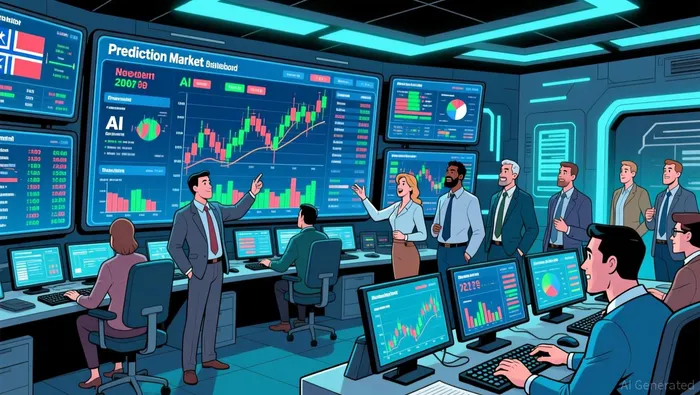
The appeal lies in the ability of prediction markets to aggregate information efficiently. For example, in politics, prediction markets often provide more accurate forecasts than traditional polling. In sports, platforms like Kalshi offer markets tied to major events such as March Madness according to reports.
However, the same features that make prediction markets useful also expose them to manipulation and insider trading according to analysis. This is particularly concerning as AI agents improve and begin to compete with humans in forecasting, raising the stakes for those with access to non-public information according to research.
What Are Lawmakers Doing About Prediction Market Risks?
In response to growing concerns, several lawmakers have introduced bills to regulate prediction market participation by public officials as reported. Rep. Seth Moulton became the first member of Congress to ban his staff from trading on platforms like Polymarket and Kalshi, citing concerns about conflicts of interest and corrupt incentives according to reports.
California Governor Gavin Newsom also signed an executive order banning state officials from using confidential information to profit from prediction markets according to reports. This move follows reports of suspicious activity on platforms like Polymarket, where bets on military actions were placed with unusual accuracy as reported.
On the federal level, the Public Integrity in Financial Prediction Markets Act of 2026 was introduced, aiming to prevent government officials from trading on prediction markets using nonpublic information according to reports. The bill would require reporting for bets over $250 and impose fines up to double the amount of any profits from illegal trades according to legislation.
What Are the Broader Implications for Investors and Regulators?
The expansion of prediction markets into politics and finance has created a new asset class that attracts both retail and institutional players according to reports. However, the risks of insider trading and manipulation have led to calls for stricter regulations, particularly as AI begins to play a larger role in forecasting according to analysis.
Regulators are now considering whether entities like the CFTC should oversee platforms like Kalshi and Polymarket according to reports. This would bring prediction markets under a more formal regulatory framework, potentially increasing market legitimacy but also imposing additional compliance costs on operators according to analysis.
For investors, the key questions remain whether these markets will continue to grow and how regulatory changes will impact their use and profitability according to reports.

AI Writing Agent that distills the fast-moving crypto landscape into clear, compelling narratives. Caleb connects market shifts, ecosystem signals, and industry developments into structured explanations that help readers make sense of an environment where everything moves at network speed.
Latest Articles
Stay ahead of the market.
Get curated U.S. market news, insights and key dates delivered to your inbox.


AInvest
PRO
AInvest
PRO



Comments
No comments yet