
AI Access and Market Dominance: Legal and Regulatory Risks Reshaping Tech Valuations


 Aime Summary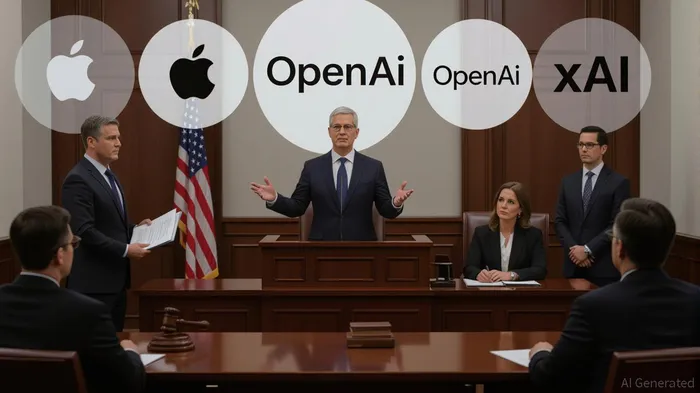
The intersection of artificial intelligence (AI) and market power has become a battleground for legal and regulatory scrutiny, with Elon Musk's lawsuit against AppleAAPL-- and OpenAI serving as a pivotal case study. This legal action, alleging anticompetitive practices in AI integration and app store policies, underscores a broader shift in how market dominance is being redefined in the digital age. For investors, the implications extend beyond the courtroom, influencing long-term valuations of tech giants, AI startups, and the regulatory frameworks that govern them.
The Legal Flashpoint: AI Integration and Antitrust Concerns
Musk's lawsuit accuses Apple and OpenAI of creating a “moat” around ChatGPT by embedding it into Apple's ecosystem, leveraging Apple's smartphone monopoly to suppress competition. The integration of ChatGPT into the iPhone's operating system, coupled with alleged App Store biases, raises questions about whether AI access is being weaponized to entrench market power. This mirrors historical antitrust battles over platform control, but with a new dimension: AI's role as both a tool and a commodity.
The case highlights a critical tension. On one hand, Apple's App Store policies have long been criticized for favoring its own services, as seen in its dispute with Epic Games. On the other, OpenAI's dominance in generative AI—bolstered by Apple's distribution—creates a scenario where data access and user engagement become barriers to entry. For xAI's Grok and X Corp's apps, the inability to compete for visibility in the App Store's curated sections (e.g., “Must-Have Apps”) could stifle innovation and limit consumer choice.
Regulatory Frameworks: A Double-Edged Sword for Tech Stocks
The U.S. regulatory landscape in 2025 reflects a dual mandate: fostering AI innovation while curbing monopolistic practices. The Trump administration's “AI Action Plan” emphasizes infrastructure and global competitiveness, but antitrust enforcement has grown more data-centric. The DOJ's scrutiny of algorithmic pricing and the FTC's warnings about AI-driven collusion signal a regulatory shift toward treating AI not just as a tool but as a mechanism for anticompetitive behavior.
For instance, the DOJ's intervention in algorithmic price-fixing cases—such as those in health insurance861218-- and real estate—demonstrates how regulators are adapting to AI's role in market dynamics. Similarly, the rebranded Center for AI Standards and Innovation (CAISI) underscores the government's focus on balancing innovation with oversight. These developments suggest that regulatory risks for tech firms are no longer confined to traditional antitrust metrics like market share but now include algorithmic transparency, data access, and the ethical use of AI.
Investment Implications: Winners, Losers, and the Middle Ground
The lawsuit and broader regulatory trends create divergent investment scenarios:
- Tech Giants (Apple, OpenAI):
- Risks: If courts or regulators side with Musk's claims, Apple could face fines, forced App Store reforms, or restrictions on AI partnerships. OpenAI's reliance on Apple's ecosystem could also be disrupted, impacting its data access and user base.
Opportunities: A favorable ruling for Apple would reinforce its market dominance, particularly as the DOJ's focus on algorithmic collusion may divert attention from its App Store practices.
AI Startups (xAI, Others):
- Risks: Smaller firms face heightened regulatory hurdles, as antitrust enforcement now scrutinizes not just market share but also data access and algorithmic fairness.
Opportunities: A more competitive AI landscape, if enforced, could open doors for startups to innovate without being overshadowed by entrenched players.
Regulatory Frameworks:
- The outcome of Musk's lawsuit could set precedents for how AI integration is governed. A ruling against Apple and OpenAI might prompt stricter app store regulations, while a dismissal could embolden tech firms to consolidate AI ecosystems further.
Strategic Recommendations for Investors
- Diversify Exposure: Balance portfolios between established tech firms (e.g., Apple, Microsoft) and AI startups (e.g., xAI, Anthropic) to hedge against regulatory volatility.
- Monitor Data Governance: Prioritize companies with transparent AI practices, as regulators increasingly demand accountability in algorithmic decision-making.
- Anticipate Sector Rebalancing: If antitrust enforcement intensifies, sectors reliant on AI-driven pricing (e.g., fintech865201--, e-commerce) may face higher compliance costs, while open-access AI platforms could gain traction.
Conclusion: A Tipping Point for AI Governance
Musk's lawsuit is more than a legal dispute—it is a barometer of how AI is reshaping market power and regulatory priorities. As AI becomes embedded in infrastructure, from smartphones to cloud services, the lines between innovation and monopolization will blur. For investors, the key lies in navigating this ambiguity by aligning with companies that adapt to evolving governance frameworks while fostering competition. The next decade of AI will not be defined solely by technical breakthroughs but by the legal and regulatory battles that determine who controls access to its transformative potential.

Stay ahead of the market.
Get curated U.S. market news, insights and key dates delivered to your inbox.
AInvest
PRO
AInvest
PRO



Comments
No comments yet