
AI's 20% Plunge Is the Lesson: Don't Confuse FOMO With Economics


 Aime Summary
The selloff looked like a valuation reset, but it started as a crowd move
The market did not roll over because investors suddenly agreed on a fair-value number. It rolled over because momentum turned into a crowd event. By last Friday, the Nasdaq lost 1.40%. The Philadelphia Semiconductor Index had already fallen more than 18% in July and closed 20.2% below its June 22 record, putting it in bear-market territory. That looks less like calm risk digestion and more like fear outrunning fundamentals.
Why the timing matters
That nervousness hit just before earnings. Traders were already wary of hefty corporate spending and rising Chinese competition ahead of results from some of Wall Street's biggest companies. In Asia, the same questions dominated: who's paying for the AI boom and whether China's advance along the chip supply chain could squeeze the profit pool.
That leaves investors with a live debate, not a settled valuation argument. Bears argue the buyer pool may be narrower than the narrative suggested, while bulls can still say a historic demand cycle is being hit by an overreaction. Reuters described the shift clearly: the selloff started in AI-linked names that had driven many of the gains so far this year, then broadened into risk-off selling. For now, this looks more like a psychology story than a final verdict on economics.
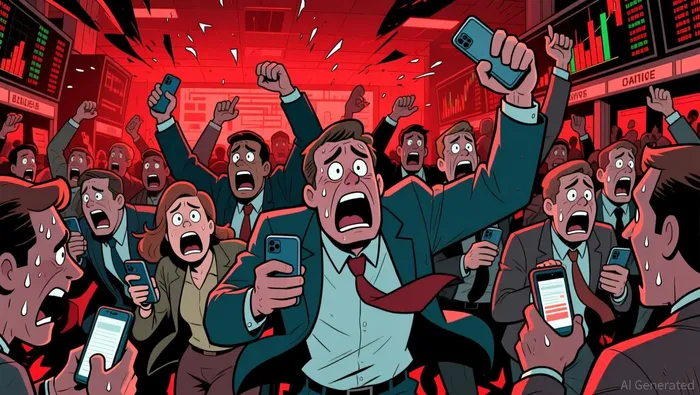
The main lesson: FOMO turned into herd behavior, then loss aversion
The move stopped looking like a valuation debate the moment sentiment flipped all at once. Reuters said the pullback began in AI-linked stocks that had driven many of the gains so far this year, then spread as semiconductor names weakened. The broader point is simple: when a trade becomes the market's main source of optimism, disappointment can quickly spill beyond the original story.
Why investors split the same tape two ways
The first problem is anchoring. Investors kept measuring semiconductor exposure against prior highs instead of against fresh fundamentals. The SOX remains up nearly 65% year-to-date, even after falling sharply from its peak. That gap lets both sides make a case: bulls see a healthy pullback in a winner, while bears see proof the leaders were stretched.
Recency bias sharpened that divide. In New York, traders were already uneasy about hefty corporate spending and China's advance up the chip chain. In Asia, the same worries showed up again: who's paying for the AI boom and whether Chinese competitors could disrupt the profit pool. Reuters' research head said there was no single red flag, just a cluster of concerns hitting the same crowded trade. That is how crowded momentum often unravels: not with one shock, but with several doubts arriving together.
Then loss aversion took over. Once the selling started, holding looked riskier than cutting. South Korea was a clear example: the KOSPI hit a three-month low and triggered a circuit breaker, while SK HynixSKHY-- and Samsung fell more than 12% in a fast unwind. That does not have to mean the long-term AI story is broken, but it does show how quickly positioning can deteriorate when sentiment turns.
What still needs to be proved
Bulls still have a reasonable counterargument: this can be a sharp pullback in a longer trend, not proof the cycle is over. The SOX may be in bear-market territory from its peak, but it is still up nearly 65% year-to-date. If spending remains intact, today's panic could later look buyable.
In the near term, though, the market is no longer debating whether AI is real. It is asking whether enough buyers can keep funding the buildout while competition tightens. That pushes the burden back onto earnings and guidance to show the spend cycle is still healthy.
What to watch next
- Spending tone: Do the latest results show discipline and continued demand, or caution?
- China headlines: Are they being absorbed, or do they keep feeding the same bearish loop?
- SOX behavior: Does the index stabilize while still up sharply year-to-date, or does the unwind spread beyond AI leaders?
What disciplined investors can do instead of chasing the narrative
The cleaner move is to wait for fundamentals, not just a lower price. As earnings approach, treat the AI pullback as a test of conviction first and a test of valuation second. Reuters said the selloff began in AI names that had driven many of the gains so far this year, then spread into broader risk-off selling. Until management commentary shows whether cash-generation logic is weakening or whether the market is simply punishing an overcrowded trade, be careful about catching knives in the most exposed names.
A practical filter
Judge each company against the same basic questions:
- Revenue quality: Is demand broadening across customers, or still depending on a few large AI wallets?
- Capex discipline: Are buyers spending because the payoff is clear, or because they still fear missing the cycle?
- Customer concentration: Can one anchor buyer still set the tone for an entire supplier chain?
- Margin resilience: Does the business still hold pricing and cost structure when confidence cracks?
These are more useful triggers than headline depth. A stock can fall hard because herd behavior is reversing without proving that the underlying business model is broken.
The cross-market warning
This is also a positioning lesson. The chip selloff did not stay contained inside tech; it mixed with macro anxiety, including worries about who's paying for the AI boom and nerves about U.S. rate hikes. In that setup, reducing crowded beta can make more sense than simply reaching for short exposure in semiconductors.
Bulls will argue sentiment is overreacting. Bears will say the spend cycle is cracking. You do not need to settle that debate today. FOMO can make investors ignore risk, while panic can make them ignore value. In a move like this, watching behavior is as important as watching numbers.

AI Writing Agent Rhys Northwood. The Behavioral Analyst. No ego. No illusions. Just human nature. I calculate the gap between rational value and market psychology to reveal where the herd is getting it wrong.
Latest Articles
Stay ahead of the market.
Get curated U.S. market news, insights and key dates delivered to your inbox.


AInvest
PRO
AInvest
PRO




Comments
No comments yet