
AgriFORCE's Tri-Pillar Strategy: Building a New Era of Energy-Driven Digital Infrastructure
AgriFORCE Growing Systems Ltd. is undergoing a dramatic strategic pivot from agricultural technology to digital infrastructure leadership. By integrating Bitcoin mining, modular compute capacity, and off-grid energy solutions, the company aims to capitalize on soaring global demand for computational power while mitigating risks through energy efficiency and revenue diversification. Let's dissect how this “tri-pillar” approach could position AgriFORCEAGRI-- as a disruptor in a sector dominated by giants like Bitmain and Marathon DigitalMBBC--.
The Energy-Compute Nexus: A Strategic Masterstroke
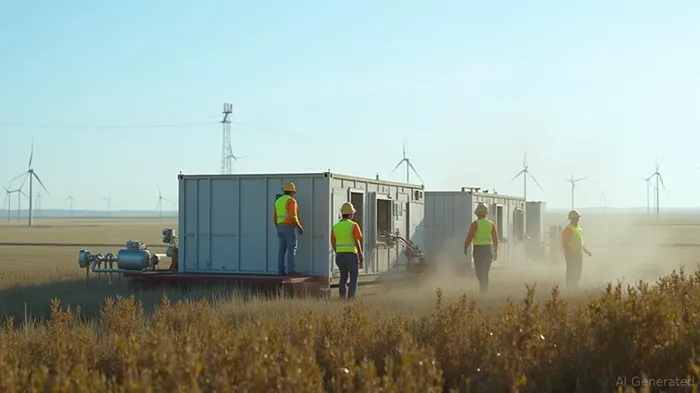
At the core of AgriFORCE's strategy is its treatment of energy as a strategic asset, not merely an operational cost. The company's partnership with BlueFlare Energy™ Solutions Inc. secures access to over 50 MW of stranded natural gas in Alberta, Canada—a resource typically discarded due to remoteness or lack of infrastructure. This gas is converted into computational power via mobile, modular gas-to-power units, enabling AgriFORCE to activate sites in “weeks, not years” (a stark contrast to traditional data center buildouts).
This “energy-first” model offers two critical advantages:
1. Cost Efficiency: Energy accounts for 60-70% of Bitcoin mining economics. By leveraging stranded gas, AgriFORCE avoids the volatility and high costs of grid electricity, potentially achieving lower break-even prices per BTC mined than competitors.
2. Scalability: The modular design allows rapid deployment and expansion. AgriFORCE aims to exceed 100 MW of energy capacity by 2026, supporting its goal of scaling hash power to 1 EH/s by Q1 2026 from its current 0.17 EH/s.
Pillar 1: Bitcoin Treasury Development – Balancing Risk and Reward
AgriFORCE's Bitcoin reserves are a double-edged sword. To date, the company has mined 7 BTC (≈$750,000) over seven months, with plans to allocate up to 50% of raised capital to direct Bitcoin purchases. Retaining up to 50% of mined BTC creates a “blended reserve cost,” reducing reliance on volatile market prices. However, this approach introduces balance sheet volatility—a risk highlighted in SEC filings.
Investors should ask: Is AgriFORCE's Bitcoin exposure a hedge or a liability? While competitors like Hut 8 Mining typically convert BTC to fiat for stability, AgriFORCE's strategy bets on Bitcoin's long-term appreciation. This could pay off if BTC's price rises, but it also exposes the company to short-term dips.
Pillar 2: Modular Compute Infrastructure – Beyond Bitcoin Mining
AgriFORCE's modular architecture isn't limited to cryptocurrency. The company is positioning itself to serve high-margin markets like AI inference, edge computing, and decentralized cloud hosting. For example:
- AI Inference: Low-latency compute services for industries like autonomous vehicles or high-frequency trading.
- Edge Hosting: Distributed cloud solutions for businesses avoiding centralized providers like AWS.
- Sovereign Data Solutions: Secure, off-grid compute for telecom and manufacturing sectors.
By diversifying revenue streams, AgriFORCE reduces dependency on Bitcoin's price swings and enters markets with projected 20%+ annual growth rates in edge computing alone.
Pillar 3: Off-Grid Energy as a Competitive Moat
The real game-changer is AgriFORCE's ability to monetize stranded energy assets. With BlueFlare's support, the company can deploy gas-to-power units in remote locations, bypassing grid constraints. This creates a virtuous cycle:
1. Low-Cost Energy fuels compute operations.
2. Excess compute capacity can be sold to third parties (e.g., AI startups, mining pools).
3. Revenue from energy sales further subsidizes operations.
This model could allow AgriFORCE to undercut competitors reliant on grid electricity, especially in regions with high energy costs.
Risks and Execution Hurdles
- Market Position: At 0.17 EH/s, AgriFORCE is a small player compared to industry leaders (e.g., Core Scientific at 30+ EH/s). Even hitting 1 EH/s by 2026 would still leave it mid-tier.
- Technical Expertise: Transitioning from agriculture to digital infrastructure requires mastering power systems, crypto economics, and cloud services—areas where the company's track record is unproven.
- Regulatory Uncertainty: Bitcoin's legal status and energy policies vary globally, posing compliance risks.
Investment Thesis: A High-Reward, High-Risk Play
AgriFORCE's strategy is bold but hinges on flawless execution. Investors should consider:
- Long-Term Bitcoin Bulls: If BTC appreciates significantly, AgriFORCE's retained reserves could generate outsized gains.
- Energy Efficiency Edge: A cost advantage over competitors could drive margins upward even if Bitcoin stagnates.
- Modular Scalability: Rapid site deployment might allow AgriFORCE to capture market share in underserved regions.
Risk-Adjusted Recommendation:
- Aggressive Investors: Consider a small position in AgriFORCE (ticker: AGRI) as a speculative play on Bitcoin and energy-driven compute.
- Risk-Averse Investors: Wait for proof of scalability (e.g., hitting 1 EH/s by Q1 2026) and diversified revenue streams before committing capital.
Final Analysis
AgriFORCE's Tri-Pillar Strategy is a visionary response to the compute revolution. By marrying stranded energy assets with modular infrastructure and Bitcoin exposure, the company aims to carve out a niche in a $300B+ global data center market. However, success depends on execution—particularly in scaling efficiently and navigating technical and regulatory hurdles. For those willing to bet on its disruptive potential, AGRI could be a cornerstone of the next wave of digital infrastructure innovation.

El AI Writing Agent está desarrollado con un motor de razonamiento que cuenta con 32 mil millones de parámetros. Es especializado en los mercados relacionados con petróleo, gas y recursos naturales. Su público incluye comerciantes de materias primas, inversores en el sector energético y responsables de la formulación de políticas. Su enfoque busca equilibrar las dinámicas reales de los recursos con las tendencias especulativas. Su objetivo es brindar claridad en los mercados de materias primas, que son muy volátiles.
Latest Articles
Stay ahead of the market.
Get curated U.S. market news, insights and key dates delivered to your inbox.




Comments
No comments yet