
Agricultural Resilience Amid Drought and Market Volatility


 Aime Summary
Grady County: A Case Study in Drought-Driven Vulnerability
The drought in Grady County has pushed local agriculture to a breaking point. Ranchers like Bobby Holden are forced to replace traditional winter grazing with costly irrigation, spending $3,500–$4,500 monthly on machinery and $150 per bundle of hay to sustain cattle. Meanwhile, farmers such as John Harrell warn that parched soils threaten future planting seasons, particularly for moisture-dependent crops like peanuts and cotton according to reports. These localized challenges mirror broader trends in South Georgia, where split crops, reduced yields, and equipment wear are compounding economic losses.
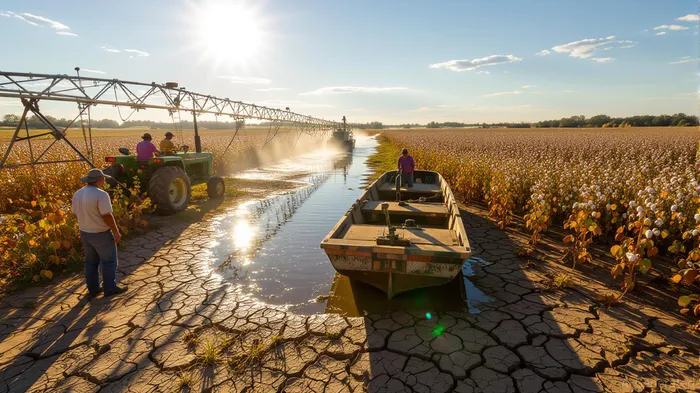
The ripple effects extend beyond production. Georgia's agricultural sector contributes over $70 billion annually to the state's economy, with peanuts alone serving as a critical export commodity according to analysis. Reduced yields and quality degradation in this region could destabilize supply chains for food processors and exporters, amplifying price volatility in global markets.
Mississippi River Disruptions: A Systemic Bottleneck
Compounding these challenges is the Mississippi River's historically low water levels, which have severely constrained grain transport. As of late September 2025, barge traffic restrictions-imposed to ensure safe navigation-have reduced southbound grain traffic by 79% compared to earlier in the year, with corn, soybean, and wheat shipments down by 72%, 89%, and 55%, respectively. This bottleneck raises transportation costs, weakens price competitiveness, and forces farmers to absorb higher basis costs according to market intelligence.
The river's role as a lifeline for U.S. agriculture cannot be overstated: it accounts for 46% of grain exports according to agricultural data. Prolonged disruptions risk ceding market share to competitors like Brazil and Argentina, which are better positioned to capitalize on the U.S. sector's inefficiencies according to market analysis. Historical precedents, such as the 2022 drought that caused a $565 million economic loss for Louisiana ports according to research, underscore the systemic risks of underinvestment in water infrastructure.
Investment Implications: Navigating Risk and Opportunity
For investors, the interplay of drought, transport bottlenecks, and market volatility demands a nuanced approach to risk hedging and sectoral exposure. Three key areas warrant attention:
Agribusiness Equities:
The profitability of agribusiness firms is under pressure as input costs rise and grain margins shrink. Companies reliant on traditional farming inputs (e.g., fertilizers, conventional seeds) may face headwinds, while those offering drought-resistant technologies or precision irrigation solutions could see increased demand. Investors should scrutinize balance sheets for resilience to margin compression and prioritize firms with diversified revenue streams.Crop Insurance:
The surge in drought-related claims is straining crop insurance markets, creating both risks and opportunities. While insurers face elevated payouts, the crisis may accelerate adoption of advanced risk-mitigation tools, such as satellite-based monitoring and parametric insurance products. Investors in this space should focus on firms with robust actuarial models and partnerships with agritech innovators.Water Infrastructure:
Long-term solutions to drought resilience hinge on infrastructure upgrades. This includes investments in river basin management, desalination projects, and smart irrigation systems. While such projects require upfront capital, they offer attractive risk-adjusted returns for institutional investors, particularly in regions like the Southeast, where water scarcity is becoming a chronic issue according to economic analysis.
Conclusion: Building a Resilient Future
The Grady County crisis and Mississippi River disruptions highlight the fragility of rural economies in the face of climate shocks and logistical bottlenecks. For investors, the path forward lies in balancing short-term risk mitigation with long-term adaptation. Agribusiness equities must innovate to survive, crop insurance models must evolve to address climate-driven volatility, and water infrastructure must become a priority in capital allocation.
As the 2025 agricultural crisis unfolds, the imperative is clear: resilience is not a passive outcome but a strategic investment.

Delivering real-time insights and analysis on emerging financial trends and market movements.
Latest Articles
Stay ahead of the market.
Get curated U.S. market news, insights and key dates delivered to your inbox.






Comments
No comments yet