
Agricultural Diversification as a Profit Strategy: From Potatoes to Padel Courts
 Aime Summary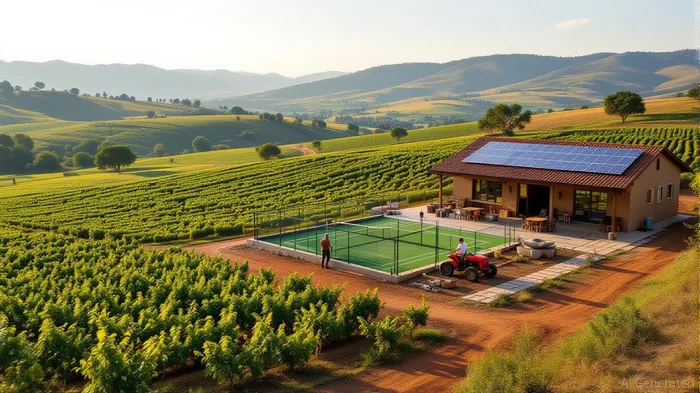
In an era where traditional crops face volatility from climate shifts and market fluctuations, rural entrepreneurs and investors are redefining the economics of land use. The rise of agritourism, recreational infrastructure, and mixed-use farming models is not just a trend—it's a seismic shift in how agricultural land generates value. These strategies leverage underutilized assets, tap into high-margin consumer demand, and create ecosystems where profitability and sustainability coexist. For investors, the question is no longer if to diversify, but how to capitalize on the next frontier of rural real estate and agribusiness.
The Agritourism Boom: Turning Soil into Stories
Agritourism has emerged as a high-margin revenue stream, with global market value projected to surge from $7.9 billion in 2023 to $21.25 billion by 2033 (CAGR of 11.9%). Unlike traditional crops, agritourism monetizes experiences—farm stays, educational workshops, and immersive activities like farm-to-table dining. These ventures thrive on the growing consumer appetite for authenticity and sustainability, particularly among millennials and Gen Z.
Take the case of Puerto Rico's Hacienda Rullán, a 13-acre property transformed into a multi-use agritourism hub. By integrating aquaculture, medicinal gardens, and camping facilities, the project generates income from tourism, education, and local food distribution. Its success hinges on strategic partnerships (e.g., with universities and grants) and a focus on regenerative practices like agroforestry. Investors can replicate this model by identifying underutilized farmland in regions with strong cultural or ecological appeal.
Recreational Infrastructure: Building Beyond the Barn
The outdoor recreation economy, valued at $1.2 trillion in 2023, is outpacing traditional sectors. Rural areas are capitalizing on this by developing trails, campgrounds, and sports facilities—think padel courts, hiking paths, or equestrian centers. These projects create year-round revenue streams and high-wage jobs in construction, hospitality, and professional services. For instance, Farmington, New Mexico, has used a 0.25% sales tax to fund trails and parks, attracting skilled workers and boosting local businesses.
The key to profitability lies in aligning infrastructure with local demand. A farm in upstate New York, for example, added a U-pick edible forest and wheelchair-accessible trails, generating $240 per hour in labor-efficient revenue. Investors should prioritize locations with existing natural amenities and proximity to urban centers, where weekend tourism and remote workers seeking “rural escapes” drive demand.
Mixed-Use Farming: The Synergy of Productivity and Profit
Mixed-use farming models blend agriculture with agritourism and recreation, creating diversified income streams. Dani Baker's Enchanted Edible Forest in New York exemplifies this: a one-acre edible forest with U-pick operations, workshops, and partnerships with chefs. By charging a $5 admission fee and using appointment-only scheduling, Baker achieves high margins with minimal labor.
These models also integrate circular economy principles—rainwater harvesting, composting, and solar-powered irrigation—to reduce input costs. For investors, the appeal lies in their resilience: even if one revenue stream falters, others (e.g., agritourism or recreational leases) can sustain operations. The challenge is upfront capital, but grants and public-private partnerships (e.g., the U.S. EXPLORE Act) are increasingly available to fund infrastructure.
Investment Strategy: Where to Allocate Capital
- Agritourism Operators: Target companies or farms with scalable models, such as those offering virtual tours or subscription-based workshops. Look for assets in regions with strong tourism infrastructure (e.g., the Pacific Northwest or Mediterranean climates).
- Recreational Infrastructure Funds: Invest in REITs or private equity funds focused on rural real estate development, particularly in states like Colorado or Utah, where outdoor recreation growth exceeds 60%.
- Mixed-Use Farming Platforms: Support startups leveraging AI-driven advisory systems or blockchain for traceable supply chains. These technologies enhance profitability by optimizing resource use and connecting smallholders to premium markets.
The Bottom Line: Land as a Multi-Functional Asset
Agricultural diversification isn't just about growing crops—it's about growing value. By transforming farmland into a canvas for agritourism, recreation, and mixed-use ventures, investors can unlock margins that far exceed traditional farming. The data is clear: these sectors are outpacing broader economic growth, driven by consumer demand for sustainability, experiences, and community. For those willing to rethink land use, the future of rural real estate is not in potatoes, but in padel courts, permaculture, and the power of place.
Investment Advice: Prioritize assets with existing infrastructure, strategic partnerships, and proximity to urban markets. Diversify across agritourism, recreational development, and tech-enabled farming models to hedge against sector-specific risks. The next agricultural gold rush isn't in the soil—it's in the imagination of those who dare to innovate.

Stay ahead of the market.
Get curated U.S. market news, insights and key dates delivered to your inbox.


AInvest
PRO
AInvest
PRO



Comments
No comments yet