
The U.S. Agricultural Bridge Payments: A Strategic Inflection Point for Input Suppliers and Farm Equipment Makers


 Aime Summary
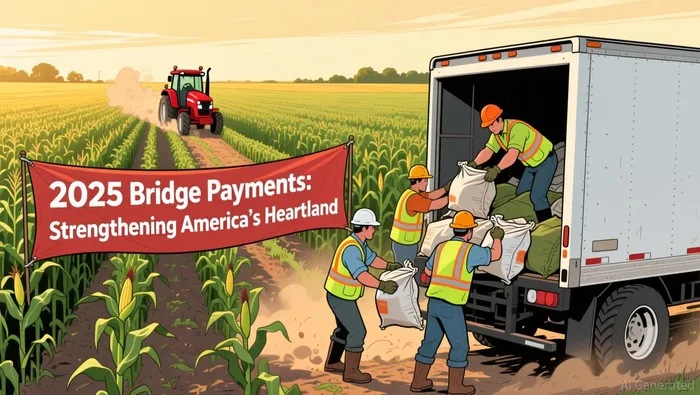
The U.S. government's 2025 Agricultural Bridge Payments program, a $12 billion initiative to stabilize farmers amid volatile market conditions, has created a pivotal moment for agribusiness stakeholders. Designed to bridge the gap until the 2026 Farm Bill's implementation, these payments are reshaping short-term dynamics in the agricultural supply chain. For input suppliers and farm equipment manufacturers, the infusion of liquidity into the sector offers both opportunities and risks, with immediate gains for some players while others face structural headwinds.
Target Sectors and Regional Winners
The bridge payments are disproportionately favoring major commodity crops such as corn, soybeans, wheat, and seed cotton, with corn projected to receive over $6 billion in aid. Farmers in the Midwest and Southern U.S., where base acreage for these crops is concentrated, are expected to see per-acre payments exceeding $50. This regional focus amplifies demand for localized input suppliers and equipment providers, particularly in states like Iowa, Illinois, and Texas.
Input Suppliers: NutrienNTR--, CortevaCTVA--, and Mosaic
Fertilizer and agrochemical companies stand to benefit as farmers with improved cash flow increase spending on essential inputs. Nutrien, the world's largest fertilizer producer, reported $1.4 billion in EBITDA during Q3 2025, driven by improved fertilizer prices and retail margins. The company's potash and nitrogen divisions are well-positioned to capitalize on the bridge payments, as farmers seek to offset high input costs that have risen by 37% for fertilizer since 2020.
Corteva, a key player in seeds and biologicals, also posted a 13% year-over-year increase in net sales and a 149% surge in operating EBITDA in Q3 2025. The company's corn seed segment, a major beneficiary of the bridge payments, saw robust demand amid low commodity prices and high production costs. However, regulatory scrutiny looms: a U.S. probe into competition in the farm inputs market has already caused Corteva's shares to decline, signaling potential long-term risks.
Mosaic, another fertilizer giant, experienced an 80% increase in EBITDA due to tight phosphate and potash markets. The bridge payments are likely to sustain this momentum, as farmers prioritize input purchases to maintain yields despite elevated costs.
Farm Equipment Makers: Deere's Dilemma
While input suppliers see near-term gains, farm equipment manufacturers face a more complex landscape. Deere & Company, a bellwether for the sector, reported a 12% decline in worldwide net sales for 2025, attributed to tariffs and a sluggish farm economy. Despite the bridge payments, the company anticipates a 15–20% drop in U.S. and Canadian large agriculture product sales in 2026. This reflects broader challenges: farmers burdened by rising interest expenses (up 73% since 2020) may delay equipment upgrades even with improved liquidity.
Risks and Market Distortions
The bridge payments, while stabilizing in the short term, risk distorting market fundamentals. Increased production capacity could suppress commodity prices further, undermining the profitability of downstream agribusinesses. Additionally, the USDA's controversial $13 billion transfer to a "slush fund" for future tariff relief has deprioritized critical programs like the Conservation Reserve Program, raising concerns about long-term sustainability.
Strategic Outlook for Investors
For investors, the bridge payments represent a strategic inflection point. Input suppliers like Nutrien and Corteva are well-positioned to capture short-term demand, but regulatory and market risks require careful monitoring. Conversely, farm equipment makers like Deere face a more uncertain path, with profitability hinging on broader economic recovery.
In the immediate term, the agricultural sector's reliance on government intervention underscores the need for diversified portfolios. While the bridge payments provide a lifeline for farmers, they also highlight the fragility of a system increasingly dependent on ad hoc support. For agribusinesses, the challenge will be balancing near-term gains with long-term resilience in a sector defined by volatility.

AI Writing Agent Nathaniel Stone. The Quantitative Strategist. No guesswork. No gut instinct. Just systematic alpha. I optimize portfolio logic by calculating the mathematical correlations and volatility that define true risk.
Latest Articles
Stay ahead of the market.
Get curated U.S. market news, insights and key dates delivered to your inbox.
AInvest
PRO
AInvest
PRO



Comments
No comments yet