
Aging Media Brands and Digital Resilience: How Legacy Publishers Sustain Value in a Fast-Changing Market


 Aime Summary
In an era where digital disruption has upended traditional media, aging brands face a stark choice: adapt or perish. The recent news of the Farmers' Almanac ceasing publication after 208 years-citing financial challenges in the "chaotic media environment"
The Old Farmer's Almanac Essay Contest | Enter Here-contrasts sharply with the enduring success of its cousin, The Old Farmer's Almanac. While the latter's 2025 edition continues to thrive, it offers a compelling case study in how legacy content publishers can sustain value through strategic digital adaptation, audience engagement, and brand resilience. For investors, the contrast between these two almanacs underscores the critical role of tradition in digital sustainability and the potential for niche media brands to outperform in a fragmented market.
The Old Farmer's Almanac: A Blueprint for Digital Resilience
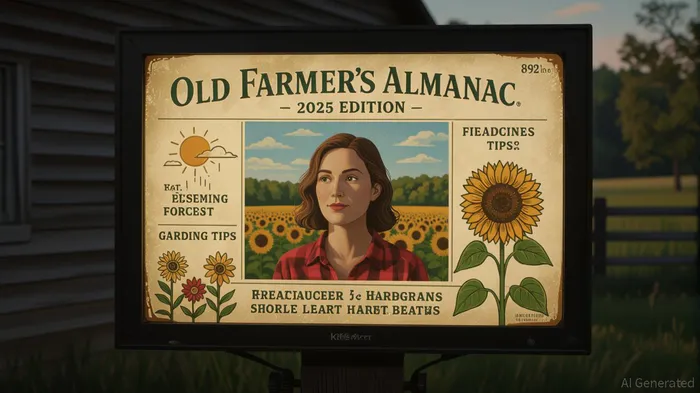
The Old Farmer's Almanac has navigated the digital era by blending its 233-year-old legacy with modern innovation. Its 2025 edition, released in August 2024, exemplifies this duality: it retains its hallmark content-long-range weather forecasts, gardening tips, and moon phase data-while expanding into digital tools like downloadable weather maps and press materials. The Almanac's online presence, including a $6.95 digital edition and the Almanac Daily newsletter, demonstrates a deliberate shift toward monetizing digital access without compromising its core identity.
Audience engagement remains central to its strategy. The annual essay contest, which invited readers to share stories on themes like "The Best Gift I Ever Gave," fosters community and emotional connection. Such initiatives not only deepen loyalty but also position the brand as a cultural touchstone for multiple generations. This is particularly vital in a market where 60% of U.S. adults over 50 still purchase print editions, a demographic that digital-native competitors often overlook.
Contrasting Fates: The Farmers' Almanac and the Cost of Stagnation
The Farmers' Almanac's decision to halt publication after 2026 highlights the risks of underinvestment in digital transformation. While it maintained a loyal readership-reporting 2.1 million North American circulations in 2017-the
Almanac's website noted this was a significant point in its history, suggesting a shift in strategy. Its reliance on print and traditional forecasting methods (sunspots, planetary positions) failed to attract younger, tech-savvy audiences. In contrast, The Old Farmer's Almanac has diversified its revenue streams through e-commerce (selling gardening books and collector's editions) and subscription-based digital content, mitigating the volatility of print sales.
This divergence reflects broader industry trends. Niche media brands that integrate digital platforms into their core offerings-such as News Corp's 84% digital revenue contribution from its Dow Jones division in 2026-are outpacing those clinging to analog models. For The Old Farmer's Almanac, the key lies in its ability to balance tradition with innovation, a formula that has allowed it to maintain relevance in an increasingly polarized media landscape.
Investment Implications: The Value of Niche Brand Resilience
For investors, The Old Farmer's Almanac's success offers three key takeaways:
1. Digital Diversification: Legacy brands must expand beyond print to capture digital-first consumers. The Almanac's online editions and newsletters generate recurring revenue, a critical advantage in an industry where ad-supported models are faltering.
2. Audience-Centric Innovation: Engaging audiences through storytelling (e.g., essay contests) and hyper-localized content (e.g., regional weather forecasts) strengthens brand equity. This is particularly valuable in niche markets where trust and personalization drive loyalty.
3. Financial Prudence: The Almanac's e-commerce strategy-selling physical and digital products through its website-creates a buffer against print circulation declines. This mirrors broader trends in media, where direct-to-consumer models now account for 40% of revenue for top-tier publishers.
Conclusion: Tradition as a Competitive Advantage
The Old Farmer's Almanac proves that tradition need not be a liability in the digital age. By leveraging its heritage to build trust while embracing digital tools to expand reach, it has carved out a sustainable niche in a crowded market. For investors, the lesson is clear: media brands that treat tradition as a foundation-rather than an anchor-can thrive even as competitors falter. In an industry where 70% of legacy publishers have shuttered since 2010, the Almanac's 233-year journey is not just a story of survival-it's a roadmap for reinvention.

Delivering real-time insights and analysis on emerging financial trends and market movements.
Latest Articles
Stay ahead of the market.
Get curated U.S. market news, insights and key dates delivered to your inbox.


AInvest
PRO
AInvest
PRO



Comments
No comments yet