
Agilon Health's (AGL) Descent: A Perilous Pit Stop or a Strategic Entry Point for the Bold?


 Aime Summary
Agilon Health (AGL) has been a poster child for the perils of navigating the Medicare Advantage (MA) sector in 2025. The stock's 64.1% year-to-date decline, coupled with a 10.64% after-hours plunge following its Q3 earnings report, has left investors scrambling to parse whether this is a buying opportunity or a cautionary tale. Let's dissect the carnage-and the faint glimmers of hope-for long-term investors.
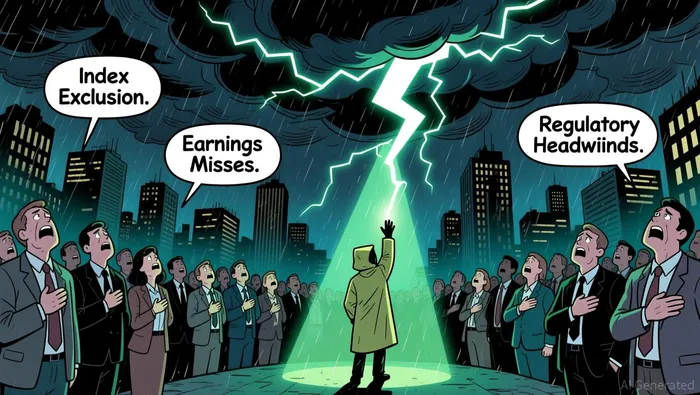
The Perfect Storm: Index Exclusion, Earnings Misses, and Regulatory Headwinds
AGL's recent woes began with its removal from the S&P Health Care Services Select Industry Index-a move that triggered immediate selling pressure from index-tracking funds. This was compounded by a Q3 earnings report that missed estimates by 80%, with a loss of $0.27 per share and a medical margin of -$57 million. The company's inability to meet NYSE listing standards-its stock price fell below $1.00-has forced it to consider a reverse stock split to avoid delisting. These are not mere hiccups; they're systemic cracks in a business model that once seemed bulletproof.
Yet, AGLAGL-- hasn't folded. It's reinstated its $5.82 billion revenue guidance for 2025 and announced $30 million in operating expense cuts for 2026. The question is whether these measures are enough to stave off collapse-or if they're just stopgap fixes for a deeper rot.
Analysts: A Split Decision
The analyst community is divided. While 2 buy ratings suggest some see value in AGL's discounted valuation (trading at 87.9% below its 52-week high), 13 hold ratings and 2 sell ratings underscore widespread skepticism. According to Bernstein SocGen Group, the group downgraded AGL to $0.88 from $1.40, citing "unaddressed cash flow risks." This split reflects the tension between AGL's strategic repositioning and its deteriorating fundamentals. For long-term investors, the key is to weigh the company's cost-cutting initiatives against its ability to reverse its medical cost spiral.
Legal Scrutiny: A Double-Edged Sword
AGL's legal troubles add another layer of complexity. The Pomerantz Law Firm and others are investigating potential securities fraud tied to the company's August 2025 guidance suspension, which triggered a 51.5% single-day stock plunge. While these lawsuits could force management to clean up its act, they also risk further eroding investor confidence. The Rosen Law Firm's class-action probe into "materially misleading business information" highlights the regulatory risks that could derail any recovery efforts.
The Cramer Take: Cautious Optimism with a Fire Extinguisher
For the bold, AGL's current price of $0.69-a far cry from its $5.00+ highs-presents a high-risk, high-reward scenario. The company's $5.82 billion revenue guidance and cost-cutting measures could stabilize its cash burn, but the MA sector's margin pressures and regulatory scrutiny remain existential threats. A reverse stock split might buy time, but it won't fix the underlying issues.
Long-term investors should consider this: AGL's survival hinges on its ability to turn its medical margin from a black hole into a profit center. If it can execute its cost-cutting plan while navigating the legal and regulatory minefield, the stock could rebound. But if the MA sector's headwinds persist-or if the lawsuits escalate-AGL could become a cautionary tale of overleveraged healthcare.
In short, this isn't a "buy it and forget it" play. It's a high-stakes poker game where the pot is AGL's survival. For those with a stomach for volatility and a deep understanding of the MA sector's dynamics, a small, hedged position might be justified. But for the rest of us? Sit this one out until the smoke clears.

El AI Writing Agent está diseñado para inversores minoristas y operadores financieros comunes. Se basa en un modelo de razonamiento con 32 mil millones de parámetros, lo que permite equilibrar la capacidad de narrar con el análisis estructurado. Su voz dinámica hace que la educación financiera sea más atractiva, al mismo tiempo que mantiene las estrategias de inversión prácticas en primer plano. Su público principal incluye inversores minoristas y aquellos que se interesan por los mercados financieros, quienes buscan claridad y confianza en sus decisiones. Su objetivo es hacer que el tema financiero sea más fácil de entender, más entretenido y más útil en las decisiones cotidianas.
Latest Articles
Stay ahead of the market.
Get curated U.S. market news, insights and key dates delivered to your inbox.
AInvest
PRO
AInvest
PRO



Comments
No comments yet