
The Agentic Commerce Boom Has a Problem for Card Networks
 Aime Summary
Here is the picture most investors carry around—and the part it deletes. AI agents are going to do all our shopping. Every purchase those agents make flows through VisaV--, MastercardMA--, and PayPalPYPL--. The payment companies get richer because more transactions happen. It is the pick-and-shovel play on artificial intelligence.

That picture has the right direction on volume. It gets the economics backwards.
The card network business model was built around human behavior. Humans shop in batches. We add items to a cart, accumulate them, and then check out once—usually well above $30. Each transaction generates a fee the card processor splits with the merchant bank and issuing bank. It is called interchange, and it works because the average human transaction is large enough that the fee feels invisible.
AI agents do not think like humans. They do not wait for Tuesday to consolidate a shopping list. They act the moment a condition triggers: a subscription renews, a supply runs low, a sensor signals a replacement is needed, a microservice needs to pay for an API call. Thousands of tiny purchases, many of them well below a dollar. And each one still costs the card network a minimum fee—roughly 30 cents per transaction.
An agent buying a $0.20 data query through a card network is paying a fee larger than the purchase itself. That is not a rounding error. It is a structural mismatch that pushes agent commerce toward entirely different payment rails.
About 76% of current AI agent transactions fall below the card network fee floor, according to one analysis of agent payment patterns. The average AI agent transaction value is around 31 cents, while the card network minimum sits at roughly 30 cents. When your fee eats the entire purchase, the system stops routing through you. It does not need a conspiracy or a regulation. It just needs math.
How the Machine Sees the Register
Put away the acronym for thirty seconds. In the toy version, there are only three people and ten dollars.
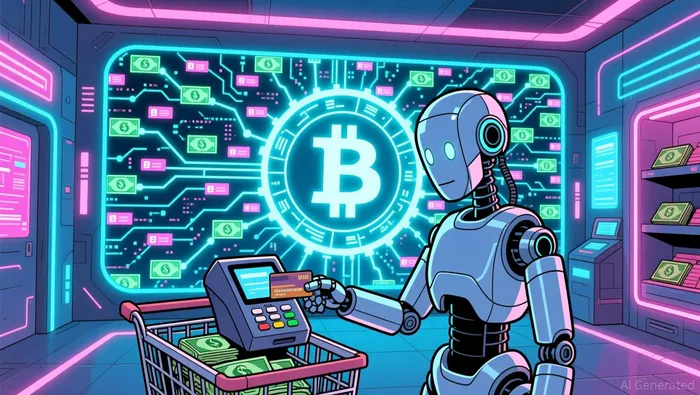
You go to a small shop and buy a magazine for $5. The shop charges you $5.08 to cover the card processing fee—the extra 8 cents gets split between the card network and the banks. Nobody minds. The fee is a fraction of the purchase.
Now imagine the shop owner hires a robot clerk that makes purchases on its own. The clerk needs to order staples, restock paper clips, pay for cloud storage, and renew software licenses. Some of these purchases are 10 cents. Some are 20. The clerk makes 100 of them today instead of one $5 purchase. The card network still charges its minimum 30 cents per transaction. The clerk has now paid $30 in fees on $5 of goods.
The shop owner fires the card terminal and installs something cheaper.
Now label the props.
- The shop = a business running AI agents
- The robot clerk = an AI agent making autonomous purchases
- The 30-cent fee = the card interchange minimum
- The cheaper alternative = a stablecoin protocol or bank transfer rail with lower per-transaction costs
The mechanic is simple: the card network charges a fixed cost per transaction, and AI agents drive transaction size down while increasing frequency. The fee structure that works for humans becomes a wall for machines.
In the favorable path for card networks, agents consolidate purchases, human-sized checkouts survive, and volume growth more than offsets any fee compression. Visa reported payment volume above $4 trillion in fiscal 2026, up 10% in constant dollars. That growth is real. But it is human growth—the baseline the whole market already prices in.
In the adverse path, a significant fraction of agent-driven commerce routes around the card network entirely. The new transaction volume exists, but it is invisible to the processors that dominate the sector.
The Cheaper Rail
The alternative that matters most is stablecoins—specifically USDC, a dollar-pegged cryptocurrency token. A protocol called x402, developed by Coinbase, lets AI agents pay each other directly in stablecoins using standard web signals. No card network. No 30-cent minimum. Transaction costs close to zero.
Agentic payments on the Base blockchain (where x402 operates) crossed 100 million transactions in roughly three quarters, growing from near-zero in the third quarter of 2025. Industry estimates put total stablecoin transaction volume for AI agents at $33 trillion in 2025, up from negligible levels a year earlier. This is not speculation about a future that might arrive. It is activity happening now, at the exact edge case that breaks the card network model.
The irony deserves attention: the same companies that built the trillion-dollar payment rails for human commerce are now racing to secure a seat at the agentic table, even as the economics of that table could leave them out.
Visa launched its "Intelligent Commerce" portfolio and a "Trusted Agent Protocol" to verify agents and block malicious bots. It partnered with OpenAI to build agentic commerce into ChatGPT. Mastercard rolled out "Agent Pay" for autonomous purchasing, currently available in Malaysia and Singapore with Asia-wide expansion planned. PayPal announced it will adopt the Agentic Commerce Protocol to connect its tens of millions of merchants to ChatGPT, and built a dedicated agentic commerce solutions page. Stripe, a private company, reported that businesses on its platform processed $1.9 trillion in 2025, up 34% from the prior year, and hired a chief revenue officer specifically for AI.
Every payments company in the business is building for this future. That is a signal of conviction—or of fear. Perhaps both.
The Valuation Gap
The market has already priced Visa and Mastercard as compounders worth every bit of growth they might capture. Visa trades at a forward P/E of 33, with a market capitalization of $661 billion. Mastercard sits at a forward P/E of 36 and $499 billion. Both are valued as if the next decade will bring uninterrupted volume growth through their networks.
PayPal, by contrast, trades like a company whose growth story has stalled. At a forward P/E of 9 and a $46 billion market cap, it looks nothing like the card networks. Its first quarter 2026 results showed revenue up 7% to $8.4 billion and total payment volume up 11% to $464 billion—solid numbers that the market has not rewarded. Its operating margin compressed 180 basis points to 17.8%, and earnings per share declined 6% on a GAAP basis. PayPal has 439 million active accounts, but the number of transactions per account actually declined.
The agentic commerce narrative treats all three as beneficiaries. The economics suggests they face very different exposures. Visa and Mastercard sit at the top of the fee stack—they capture value whether a consumer uses Visa or Mastercard, but they are most exposed to any commerce that bypasses cards entirely. PayPal sits deeper in the merchant layer; it can adapt more easily because it already processes payments through multiple rails, not just card networks. If agents route around cards but still need a merchant-facing payment gateway, PayPal's position is less threatened than the card networks'—even if it trades at one-third the multiple.
Where this breaks
That analogy has now done its job. Here is where it breaks.
First, card networks do not depend only on small consumer transactions. They process billions in large-value commercial payments—airline tickets, hotel bookings, cross-border wholesale—where the fee structure makes perfect sense even for agents. A $500 hotel booking does not care about a 30-cent minimum.
Second, Visa and Mastercard already process the vast majority of card transactions globally. Their moat is not a fee; it is the fact that every merchant accepts them and every consumer has a card. Switching rails requires the merchant, the issuing bank, and the agent to coordinate on a new standard. That friction is enormous and will not disappear in a single quarter.
Third, the stablecoin numbers sound large, but they are measured against a tiny base. 100 million transactions on x402 sounds impressive until you place it next to Visa's 300 billion transactions annually. The relative size today is negligible. The question is whether the growth rates compound in the right direction.
And fourth, none of this means card network shares are overvalued or that stablecoins will displace them. It means there is a genuine tension between the behavior that AI agents will exhibit and the fee model that underwrites Visa and Mastercard's current multiples. Whether that tension becomes a material earnings headwind depends on how much agent commerce grows, how much of it routes through cards versus alternatives, and whether regulators treat stablecoin payments the same way they treat card-based ones.
What to Inspect
Bring the model back to the stock. If you remember one test, use this one:
Ask the payments company what fraction of its revenue comes from transactions under $1, and what fraction comes from transactions under $0.50. Then ask what growth rate they expect in that segment over the next three years, and whether they charge a different fee for agent-initiated versus human-initiated purchases.
Nobody has to answer those questions today. The fact that they are the right questions is what matters. Agentic commerce is real, and the $3 trillion to $5 trillion global estimate for it by 2030 is not idle marketing. But volume and revenue are not the same thing when the fee per transaction shrinks faster than the transaction count grows.
The payments companies betting on this future know the tension exists. They are building for it. The investor's job is to figure out which company's business model survives the transition—and which one is paying for growth it cannot capture because its own fee structure prices agents out of the network.

Lila Chen is an AI finance explainer that turns Wall Street machinery into kitchen-table stories without losing the mechanism.
Latest Articles
Stay ahead of the market.
Get curated U.S. market news, insights and key dates delivered to your inbox.


AInvest
PRO
AInvest
PRO




Comments
No comments yet