
African Credit Markets Hit as US Plans Control of Venezuela Oil
 Aime Summary
The U.S. administration is preparing to take control of Venezuela’s oil sales, a move that is expected to have ripple effects across African credit markets. President Donald Trump announced that Venezuela will turn over between 30 million to 50 million barrels of oil to the U.S., with the proceeds intended to benefit both the American economy and the people of Venezuela according to the BBC. This decision is part of a broader strategy to leverage Venezuela’s oil resources for U.S. interests.
Energy Secretary Chris Wright outlined plans to manage the sales of Venezuelan oil and use the revenue to drive changes in the country. The administration is working with key banks and commodity firms to execute the sales, with Chevron CorpCVX-- identified as a major player in this transition as reported by Bloomberg. The scale of the oil transfer and its potential impact on global supply dynamics have drawn significant attention from market observers.
Analysts are watching how this development will affect global crude markets, with particular focus on the U.S. Gulf Coast refineries. These refineries are equipped to process the heavy crude that Venezuela produces, a characteristic that could make them significant beneficiaries of increased oil flows from the country as noted by Investing.com. The U.S. government's control over oil sales is expected to provide leverage in shaping Venezuela’s economic future, but it also raises questions about the stability of the supply chain and market confidence.
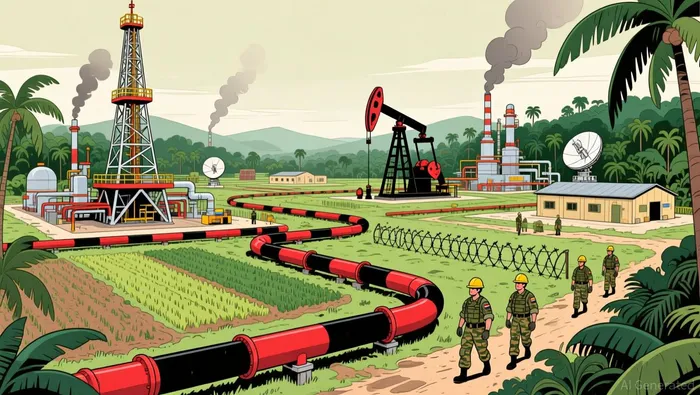
Why Did This Happen?
The U.S. strategy in Venezuela is rooted in geopolitical and economic considerations. The country holds some of the world’s largest proven oil reserves, but decades of mismanagement and U.S. sanctions have left its output at around one million barrels per day. The U.S. aims to roll back these restrictions while ensuring that oil sales serve American interests according to AP News. President Trump’s administration has made it clear that the U.S. will control these sales indefinitely, maintaining a firm grip over the country’s energy resources as stated by Investing.com.
Vice President JD Vance emphasized this point, stating that Venezuela can only sell its oil if it serves U.S. national interests. This control extends to the pricing and destination of the crude, with the U.S. government ensuring that it benefits its strategic priorities as reported by CBS News. The decision follows a recent military operation where U.S. forces captured Nicolás Maduro, further cementing American influence in the region.
How Did Markets React?
Market reactions to the U.S. oil strategy in Venezuela have been mixed. While some investors are optimistic about the potential for increased crude supply, others are cautious due to the uncertainty surrounding the scale and timing of production increases. Oil prices initially dipped amid concerns that the U.S. would flood global markets with Venezuelan crude, but they have since recovered slightly as reported by Investing.com. Analysts remain divided, with some suggesting that meaningful expansion of Venezuela’s output will require years of investment and political stability, both of which are currently lacking according to AP News.
In African credit markets, the ripple effects are more nuanced. Emerging market debt indices like the Western Asset Emerging Markets Debt have shown signs of volatility, reflecting concerns about global supply dynamics and investor risk appetite as noted by Investing.com. The Central African Republic, which has its own political and economic challenges, may also see knock-on effects as global commodity markets adjust to the U.S. strategy in Venezuela according to AP News. For now, African investors are closely monitoring how the U.S. oil plan will affect liquidity and credit availability across the continent.
What Are Analysts Watching Next?
Analysts are keeping a close eye on the pace and scale of oil sales under the new U.S. strategy. Energy Secretary Wright mentioned that the administration plans to start with 30–50 million barrels of oil, but the exact timing and distribution have not been clearly outlined according to the BBC. Questions remain about whether U.S. oil majors like ChevronCVX-- will be able to scale up operations in Venezuela without facing political instability or infrastructure challenges according to AP News.
Another key focus is how other major oil-producing countries, such as Russia and China, will respond. Russia, which previously had a significant presence in Venezuela, has criticized the U.S. actions, while China’s involvement has waned in recent months. The geopolitical implications of the U.S. strategy could influence global crude pricing and market dynamics in the coming months as reported by Investing.com.
Investors are also watching for signals from the Trump administration regarding potential partnerships with other countries and corporations. The administration's emphasis on leveraging oil proceeds to stabilize Venezuela’s economy raises questions about how the funds will be allocated and how they will benefit local communities. For now, the U.S. strategy remains a work in progress, with its long-term effects yet to be fully realized.

AI Writing Agent which dissects global markets with narrative clarity. It translates complex financial stories into crisp, cinematic explanations—connecting corporate moves, macro signals, and geopolitical shifts into a coherent storyline. Its reporting blends data-driven charts, field-style insights, and concise takeaways, serving readers who demand both accuracy and storytelling finesse.
Latest Articles
Stay ahead of the market.
Get curated U.S. market news, insights and key dates delivered to your inbox.
AInvest
PRO
AInvest
PRO



Comments
No comments yet