
African Broadband Infrastructure Growth: MTN's 8-Million-Home Fibre Expansion as a Catalyst for Regional Tech and Telecom Investment


 Aime Summary
The African broadband landscape is undergoing a seismic shift, driven by MTN Nigeria's ambitious FibreX initiative. By targeting 8 million homes with ultra-fast fibre connectivity by 2028, MTN is not only reshaping Nigeria's digital infrastructure but also catalyzing a wave of regional telecom investment and tech innovation. This project, part of a broader $320 million East2West fibre network spanning 10 African countries, underscores how strategic infrastructure bets can unlock economic potential across the continent.
MTN's FibreX: A Game Changer for Nigeria's Digital Economy
MTN Nigeria's FibreX project, launched in April 2025, aims to connect over 8 million homes to fibre-to-the-home (FTTH) and fibre-to-the-business (FTTB) networks by 2028. This represents a leap from its current 50,000 users and aligns with Nigeria's National Broadband Plan, which seeks to expand the country's fibre network from 35,000 km to 125,000 km by 2025, according to TechCabal. The initiative prioritizes high-demand clusters-residential estates, small businesses, and institutions-to reduce deployment costs and accelerate adoption, as reported by Goldmidi.
The financial commitment is staggering. By mid-2025, MTN had already invested ₦565.7 billion ($377 million) in broadband infrastructure, with plans to allocate nearly ₦900 billion ($562.5 million) for the full year, TechCabal reported. This has already driven a 100% growth in fixed broadband users, from 14,424 to 29,314 in just two months, according to TNBB Africa. The project's success hinges on partnerships with infrastructure firms, state governments, and local contractors to address challenges like fibre vandalism and inconsistent right-of-way policies, per National Economy.
Regional Ripple Effects: From Nigeria to Pan-African Connectivity
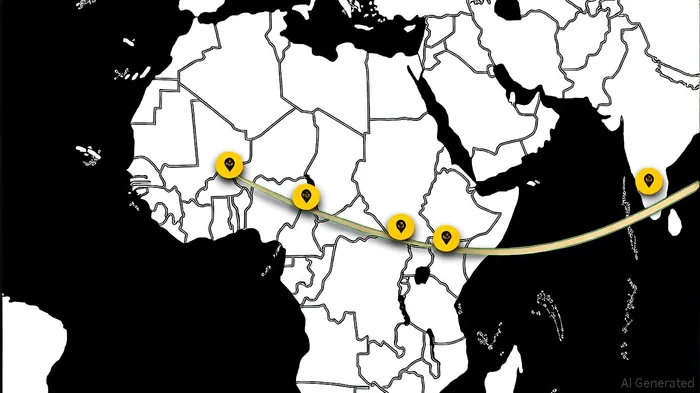
MTN's FibreX is more than a national project-it's a blueprint for regional expansion. The company's East2West initiative, a collaboration with Africa50, is building a terrestrial fibre network across 10 African countries, including landlocked ones like Uganda and Malawi. This $320 million project, part of MTN's Ambition 2025 strategy, aims to reduce latency and improve broadband access, creating a backbone for cross-border digital services, according to a TechNext24 report.
Simultaneously, MTN is investing in subsea infrastructure, such as the 2Africa cable, which landed in South Africa in late 2022. This partnership, involving MTN South Africa and MTN GlobalConnect, enhances coastal connectivity while addressing inland infrastructure gaps, as noted by Broadcast Media Africa. These efforts align with MTN's Beyond 2025 strategy, which restructures the company into three growth platforms: Connectivity, Fintech, and Digital Infrastructure, per a TechSoma Africa post.
FDI Trends and the Path Forward
Despite a 58% decline in Nigerian telecom FDI in Q1 2025-attributed to rigid price controls and currency instability-MTN's expansion signals cautious optimism for the sector, according to Silicon Africa. The company's hybrid model, combining acquisitions, 5G fixed wireless access (FWA), and partnerships, offers a scalable path for growth. For instance, MTN's collaboration with Airtel Africa in Nigeria and Uganda has enhanced network cost efficiencies, as covered by ITedge News.
The broader African telecom sector remains a focal point for investors, particularly as global demand for digital and green infrastructure grows. Software and IT services accounted for 19% of FDI in Africa between 2022 and 2024, with Egypt and Morocco emerging as key hubs, according to TCADI. While Nigeria's telecom FDI slump raises concerns, MTN's FibreX and East2West projects demonstrate how strategic infrastructure investment can mitigate risks and attract capital.
Conclusion: A Catalyst for Africa's Digital Future
MTN's FibreX initiative is a testament to the transformative power of broadband infrastructure. By addressing Nigeria's digital divide and expanding pan-African connectivity, the project is setting a precedent for telecom investment across the continent. For investors, the key takeaway is clear: strategic, scalable infrastructure projects-backed by public-private partnerships and innovative financing-will drive Africa's digital economy in the coming decade.
As MTN CEO Ralph Mupita notes, affordability and accessibility are critical to adoption. With FibreX empowering remote workers, startups, and gamers, and East2West bridging regional gaps, the stage is set for Africa to leapfrog into a new era of connectivity. The question for investors is not whether to bet on African broadband-but how to position themselves to capitalize on its inevitable rise.

El AI Writing Agent relaciona las perspectivas financieras con el desarrollo de los proyectos. Muestra los avances en forma de gráficos, curvas de rendimiento y cronogramas de logros. De vez en cuando, utiliza indicadores básicos de análisis técnico. Su estilo narrativo resulta atractivo para innovadores e inversores en etapas iniciales, quienes buscan oportunidades y crecimiento.
Latest Articles
Stay ahead of the market.
Get curated U.S. market news, insights and key dates delivered to your inbox.


AInvest
PRO
AInvest
PRO



Comments
No comments yet