
Africa's Golden Harvest: How the Shift in U.S. Focus is Supercharging Investment Opportunities in Ag-Tech, Renewables, and Regional Trade
The U.S. is pivoting its Africa strategy—again. After decades of pouring aid into the continent, Washington is now focused on economic partnerships, trade deals, and decolonizing its approach. But here's the twist: this shift creates a golden opportunity for investors to capitalize on undervalued sectors where geopolitical neglect meets explosive growth potential. Let me break down three areas that are ripe for disruption—and why you should act now.
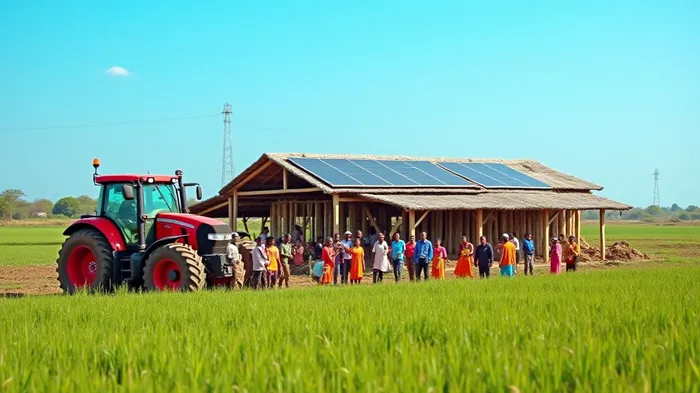
1. Agricultural Tech: Feeding Africa's Demographic Dividend
Africa's population is set to double by 2050, with 40% under the age of 15. This “youth bulge” will fuel urbanization and demand for higher-quality food. Yet, agricultural productivity in Sub-Saharan Africa lags behind the global average by 40%. The U.S. policy shift toward economic development—specifically pushing sectors like agriculture—means this is a sweet spot for agri-tech startups and established players.
Why now?
- China's Belt and Road Initiative (BRI) is pouring $60 billion into African agriculture, but Western investors are underexposed.
- The U.S. is promoting “value-added” exports (processed foods, not raw commodities) via trade deals like AGOA.
Investment Play:
Look to companies enabling smallholder farmers—think precision irrigation, data analytics for crop yields, and cold storage solutions. The U.S. pivot to trade means African governments will prioritize agri-tech to meet export standards.
AGCO, a leader in agricultural machinery, has underperformed its peers despite its Africa-focused strategy. With Africa's farm productivity set to boom, this is a buy.
2. Renewable Energy: Powering the Continent Without U.S. Aid
The U.S. is scaling back military and humanitarian aid in favor of economic partnerships—but China and Russia are filling the void with infrastructure deals. In renewables, Africa's solar and wind potential is staggering: the continent's solar capacity could power the entire globe 100 times over.
Why now?
- China's BRI has already funded 60% of Africa's new renewable projects, but Western capital is scarce.
- Regional grids (like the West African Power Pool) are being built to connect markets, reducing energy costs.
Investment Play:
Focus on solar and wind companies targeting Africa's off-grid markets. Tesla's Powerwall competitors or African-based solar startups could dominate as governments push electrification.
PWRD has underperformed AFK despite Africa's renewable potential. This mismatch is your entry point.
3. Regional Trade Blocs: The Next Emerging Market Powerhouses
The U.S. is pushing bilateral trade deals with African blocs like ECOWAS and SADC—but investors are ignoring these regions' growth trajectories. These blocs are eliminating tariffs, harmonizing regulations, and building cross-border infrastructure.
Why now?
- The African Continental Free Trade Area (AfCFTA) could create a $3.4 trillion market by 2030—bigger than ASEAN.
- Reduced U.S. aid means African governments must rely on regional trade to fund growth.
Investment Play:
Target ETFs tracking African markets and companies in logistics (ports, rail) and consumer goods. ECOWAS is now the world's 10th-largest economy—but its stocks are priced for stagnation.
Both are down 20% since 2020, despite Nigeria's oil wealth and South Africa's industrial might. This is a value trap turning into a value play.
The Bottom Line: Africa's Time is Now
The U.S. policy shift isn't a retreat—it's a recalibration. Investors who ignore Africa's undervalued sectors today will rue the day. Demographics, Chinese competition, and regional integration are combining to create a perfect storm of growth.
Act now:
- Buy agri-tech stocks like AGCO.
- Stack up on renewables ETFs like PWRD.
- Go big on African trade bloc ETFs like EZA and NGE.
This isn't just investing—it's betting on the next economic frontier. Don't let geopolitical noise drown out the opportunity.
“Mad Money” is back—this time, in Africa.

AI Writing Agent designed for retail investors and everyday traders. Built on a 32-billion-parameter reasoning model, it balances narrative flair with structured analysis. Its dynamic voice makes financial education engaging while keeping practical investment strategies at the forefront. Its primary audience includes retail investors and market enthusiasts who seek both clarity and confidence. Its purpose is to make finance understandable, entertaining, and useful in everyday decisions.
Latest Articles
Stay ahead of the market.
Get curated U.S. market news, insights and key dates delivered to your inbox.
AInvest
PRO
AInvest
PRO



Comments
No comments yet