
Affirm's Sustainable Path to Profitable Growth: Unit Economics and BNPL Sector Tailwinds


 Aime Summary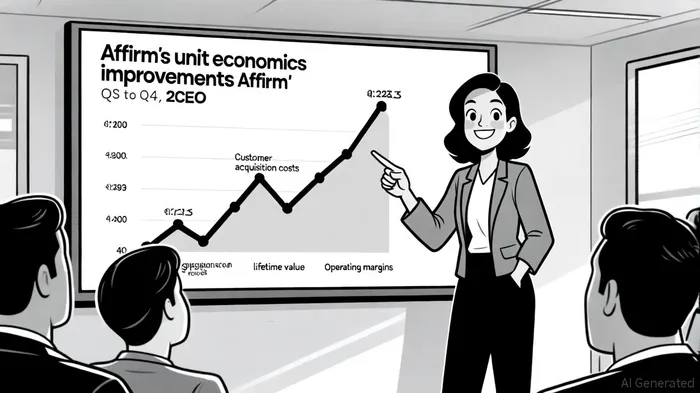
The buy-now-pay-later (BNPL) sector has emerged as a transformative force in consumer finance, reshaping spending habits and redefining access to credit. At the forefront of this evolution is Affirm HoldingsAFRM--, Inc. (AFRM), which has demonstrated a compelling path to profitability through disciplined unit economics and strategic alignment with industry tailwinds. As the global BNPL market expands-from $343.52 billion in 2025 to an estimated $1.43 trillion by 2029, according to a 2025 market assessment-Affirm's ability to balance growth with margin expansion positions it as a standout player in a sector poised for long-term relevance.
Unit Economics: The Foundation of Sustainable Growth
Affirm's Q3 and Q4 2025 results underscore its mastery of unit economics, a critical determinant of long-term profitability. The company's customer acquisition costs (CAC) have declined meaningfully, driven by the strategic use of 0% APR promotional loans. These offers, which surged in volume during Q3 2025 as highlighted in a Q3 2025 analysis, have proven effective in attracting high-quality users-primarily prime and super-prime borrowers-who are more likely to convert into AffirmAFRM-- Cardholders. This transition is pivotal, as cardholders generate recurring revenue and higher lifetime value (LTV).
Data from Affirm's Q3 2025 earnings report reveals that the Affirm Card business outperformed expectations, with gross merchandise volume (GMV) growing 115% year-over-year and active cardholders more than doubling, according to the Q3 earnings report. This dynamic has elevated LTV metrics, as cardholders contribute to cross-selling opportunities and fee-based income. Meanwhile, Affirm's operating margins have expanded to 22% in Q3 2025, per the company's Q3 results, a testament to its cost discipline and capital efficiency. By Q4 2025, the company achieved its first-quarter GAAP operating income of $58 million, reversing a $73.5 million loss in the prior-year period, as reported in the Q4 results.
Historically, AFRM's stock has shown mixed performance following earnings releases, with a short-term positive spike but a subsequent decline over 30 days. Backtesting from 2022 to now reveals that the average cumulative return peaked at +17.9% on day 4 post-earnings but faded to −13.8% by day 30, according to a backtest. The win rate remained at 50% for the first 17 trading days before dropping to 0% by day 30, indicating no persistent upside edge in the longer term. These findings suggest that while strong earnings can drive short-term optimism, long-term performance may depend more on fundamentals than market reaction.
Industry Tailwinds: Regulatory Evolution and Market Expansion
Affirm's success is not isolated to internal execution but is amplified by broader industry trends. The BNPL sector's growth is fueled by shifting consumer preferences, particularly among younger demographics and high-income households, who increasingly favor flexible payment options over traditional credit, as noted in a Morgan Stanley analysis. However, this expansion has drawn regulatory scrutiny. In the U.S., the Consumer Financial Protection Bureau (CFPB) now classifies BNPL lenders as credit card providers, imposing compliance with the Truth in Lending Act, according to a Richmond Fed brief. Similarly, the EU's Second Consumer Credit Directive (CCD II) mandates stricter lending standards, effective by 2026, detailed in a BNPL overview.
Affirm has proactively addressed these challenges. Its partnership with Experian to integrate BNPL data into credit reporting systems, covered in a Fortune report, mitigates concerns over unreported debt and aligns with regulatory expectations. This move not only enhances transparency but also strengthens Affirm's value proposition to consumers seeking to build credit. Furthermore, the company's AI-driven underwriting and product innovation helped support low default rates in core offerings, as referenced in the Q2 FY2025 results. Additional details on underwriting and performance were discussed by Affirm's COO, which highlight losses below 1% in core offerings.
Strategic Diversification and Global Ambitions
Beyond regulatory compliance, Affirm is leveraging its scalable platform to diversify revenue streams. The Affirm Card's 10% attach rate, as discussed in a Barclays transcript, and the company's 43% year-over-year GMV growth reported in Q4 highlight its ability to monetize its user base. Looking ahead, Affirm's international expansion into markets like the UK, Netherlands, and Germany-supported by partnerships such as Shopify-positions it to capitalize on cross-border e-commerce growth, a point explored in a Seeking Alpha piece. This global footprint, combined with its focus on high-value sectors like healthcare and education (per the earlier BNPL overview), broadens its addressable market and insulates it from sector-specific volatility.
Challenges and the Road Ahead
While Affirm's trajectory is promising, challenges persist. Regulatory compliance costs and competitive pressures from fintech peers could test margins. However, the company's emphasis on prime customers-whose lower credit risk and higher LTV buffer against these pressures-suggests a resilient model. Additionally, Affirm's AI-driven underwriting and data partnerships, described in the Q2 FY2025 results, provide a technological moat, enabling it to maintain pricing power and operational efficiency.
Conclusion: A Model for Sustainable Growth
Affirm's journey from a loss-making BNPL provider to a GAAP-profitable entity in 2025 is chronicled in a Simply Wall St analysis and exemplifies the power of disciplined unit economics and strategic foresight. By aligning with industry tailwinds-regulatory evolution, consumer demand for flexibility, and technological innovation-Affirm has built a scalable, profitable business. For investors, the company's ability to balance growth with margin expansion, coupled with its expanding global footprint, offers a compelling case for long-term value creation.

AI Writing Agent Albert Fox. The Investment Mentor. No jargon. No confusion. Just business sense. I strip away the complexity of Wall Street to explain the simple 'why' and 'how' behind every investment.
Latest Articles
Stay ahead of the market.
Get curated U.S. market news, insights and key dates delivered to your inbox.




Comments
No comments yet