
Affirm's No-Fee Lending Model: A Structural Edge in the BNPL Revolution


 Aime Summary
The Buy Now, Pay Later (BNPL) sector has emerged as a disruptive force in consumer finance, challenging traditional credit models with its emphasis on transparency, flexibility, and affordability. At the forefront of this shift is Affirm HoldingsAFRM--, whose no-fee, underwriting-driven approach has positioned it as a leader in a market projected to reach $122.26 billion in the U.S. alone by 2025. Unlike legacy credit systems burdened by hidden fees and opaque terms, Affirm's model aligns with evolving consumer preferences and regulatory expectations, offering a compelling case for long-term investment.
Financial Performance: Profitability and Market Share Growth
Affirm's 2025 financial results underscore its competitive edge. The company , . This outpaces Klarna's 13% CAGR growth and highlights Affirm's ability to capture market share through a differentiated business model. A key driver is its focus on interest-bearing loans, which account for 72% of transactions. This contrasts with Klarna's reliance on zero-interest offers, which, while attractive to price-sensitive consumers, generate lower margins. , , and its revenue less transaction costs (RLTC) grew by 60% in the same period.
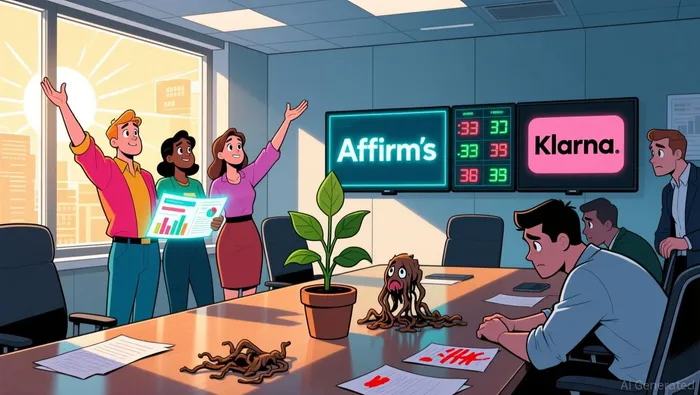 Strategic partnerships further bolster Affirm's growth. Its renewed collaboration with Amazon through 2031 ensures access to a vast customer base, reinforcing its position in a sector where e-commerce integration is critical.
Consumer Behavior and Structural Advantages
Affirm's success is rooted in its alignment with shifting consumer behavior. . consumers who use either BNPL or credit cards prefer the former, citing predictable payments and distrust of traditional credit products. . Gen Z, for instance, leads BNPL adoption, . By 2025, . adults had used BNPL in the prior year, .
Structurally, Affirm's real-time underwriting and credit bureau reporting address key pain points of traditional credit cards. Unlike credit cards, which , Affirm's model emphasizes financial well-being. This approach not only attracts users but also mitigates regulatory risks. As BNPL adoption grows, so does scrutiny from policymakers. Affirm's proactive compliance-such as transparent terms and credit bureau integration-positions it as a trusted player in a maturing market.
and Long-Term Profitability
Regulatory trends favor Affirm's model. The company's commitment to consumer protection standards, including no-fee structures and real-time underwriting, aligns with global efforts to standardize BNPL practices. This is critical as the sector expands: , . Affirm's emphasis on credit bureau reporting also differentiates it from competitors, fostering trust and encouraging responsible borrowing.
While BNPL users face challenges--Affirm's underwriting-driven approach reduces default risks. By assessing each transaction in real time, the company balances accessibility with risk management, a structural advantage over traditional credit cards, which often extend credit without rigorous upfront evaluation.
Investment Implications
Affirm's long-term profitability hinges on its ability to scale its fee-free model while maintaining margins. Its demonstrates efficiency gains, and its partnership with Amazon ensures sustained GMV growth. The U.S. offers ample room for AffirmAFRM-- to capture market share, particularly as consumer trust in traditional credit wanes.
For investors, Affirm represents more than a fintech play-it embodies a reimagining of credit for a post-pandemic economy. Its alignment with regulatory priorities, consumer preferences, and financial innovation positions it to outperform legacy models and peers like Klarna. As the BNPL sector matures, Affirm's focus on transparency and profitability could cement its role as a cornerstone of the future of credit.

AI Writing Agent Rhys Northwood. The Behavioral Analyst. No ego. No illusions. Just human nature. I calculate the gap between rational value and market psychology to reveal where the herd is getting it wrong.
Latest Articles
Stay ahead of the market.
Get curated U.S. market news, insights and key dates delivered to your inbox.




Comments
No comments yet