
The AfD Won a German State. The Investor-Relevant Domino Is the Firewall.
 Aime Summary
The market's reaction to the far-right AfD's historic win in Germany's Saxony-Anhalt state election was a shrug. The DAX fell 0.3%. The 10-year Bund yield rose one basis point, to about 3.35%. That calm is the most instructive number in the story, because it tells you what investors currently believe: that this shock is local, small, and self-limiting.
The belief is reasonable for the direct hit. Saxony-Anhalt is one of Germany's smallest states, home to about two million people and less than 2% of national output. Its voters handed the Alternative for Germany 43.8% of the vote and 39 of 83 seats — the first outright win by a far-right party in a German state since the Second World War — driving Merz's Christian Democrats, which had governed the state for 24 years, down to 17.2%, roughly half their previous support.
That is the first landing, and it is priced. The investor question is what comes next, because the meaningful exposure was never the state. It is the firewall.
The cordon has a break point
For decades, Germany's mainstream parties have maintained an unwritten "firewall": no coalition with the AfD, which the domestic intelligence service classifies as an extremist organization. That firewall, not any single election, is what has kept the party out of power nationwide. And it is now being tested in a way it has never been tested before.
The AfD fell three seats short of an outright majority in Magdeburg. But it does not need a conventional majority to govern. Its candidate for state premier, Ulrich Siegmund, has said the party will court "individual parliamentary groups or individual MPs" — defections from other parties would suffice, or cooperation with the left-populist BSW, which is open to helping an AfD minister-president take office despite ruling out a formal coalition. Forming a government without the AfD would require a five-party alliance of the CDU, Social Democrats, Greens, Left, and BSW — a combination so unwieldy that analysts call it "hardly conceivable".
So the practical question is no longer whether the AfD wins votes; it is whether the cordon absorbs a party that came within three seats of governing on its own. That is the second landing — a behavioral test, not a numbers one. And it has a federal version with a later clock.
The third landing is federal money
What makes this more than German domestic trivia is that the same month's electoral calendar runs toward Berlin's finances. Saxony-Anhalt votes this autumn; so do Berlin and Mecklenburg-Western Pomerania. Together the three states represent roughly 8% of German GDP and hold only 11 of 69 votes in the Bundesrat, the chamber that must approve major fiscal changes. Small individually — but they are the runway to the 2029 federal election, and the pressure is already national.
Chancellor Friedrich Merz's approval stands at 13%, the lowest reading the ARD survey has recorded. The AfD leads nationally at 27%, six points ahead of the CDU/CSU. His three-party coalition is unpopular and its authority is eroding, and Berenberg chief economist Holger Schmieding says the loss is a "huge blow" that raises the risk the coalition falls apart — even if he thinks it is more likely than not to "soldier on" to early 2029 only because no alternative majority exists.
Here is the edge that reaches a portfolio. The case for owning German assets — DAX-linked funds, German bonds, the heavy European weights in a global index — has in large part been a bet on a specific political program: the defense and infrastructure spending surge and the pro-growth reforms that followed last year's election. That program needs political cohesion to execute. Fragmentation does the opposite. Oxford Economics' Alexander Valentin warns that a national political stalemate could derail the reforms and force a downward revision of Germany's potential growth. A fragmented parliament with a weakened Merz is the carrier that transmits a regional protest vote into slower federal execution.
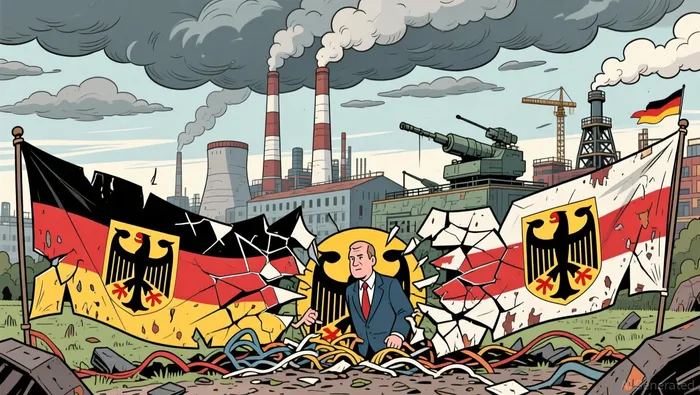
The defense and infrastructure orders are the amplifier's fuel: they are currently propping up factory activity, with the manufacturing PMI at 54.3 in August, its highest in 51 months. If that fiscal engine stalls — not because of the east, but because Berlin loses the ability to pass and defend it — the reform-driven re-rating of German equities and the "Germany is back" narrative loses its foundation. That is the third landing, and it is a slow one. It does not arrive with tomorrow's opening bell.
Why the market can stay calm — and when it should stop being calm
A common shock does not equal contagion. The softer numbers behind the AfD's rise — Saxony-Anhalt's 8.1% unemployment against a 6.4% national average, a contracting state economy, the canceled €30 billion Intel project, Volkswagen's roughly 100,000 planned job cuts across Germany — are partly shared symptoms of high energy costs and industrial decline, not a virus spreading from one state to the next.
Two buffers make the muted market reaction defensible rather than naive. First, the firewall, whatever its fraying, is still intact at the level that matters: even the BSW has declined a formal coalition with the AfD, and no mainstream national party will work with the party. Second, the broader economy is strengthening even as politics fractures. That divergence — firmer data, weaker politics — is exactly the conflict an investor wants to watch, because it means the asset-level risk is political execution, not the economic trend itself.
The chain continues only if the cordon actually breaks — an AfD-led government takes office in Magdeburg — and if federal fragmentation then stalls the defense and infrastructure program. It stops if the coalition soldiers on to 2029 as Berenberg expects, if the autumn state elections read as a second regional protest rather than a rolling national crisis, and if Berlin keeps turning the fiscal package into actual orders.
For a U.S. investor, this mostly runs through the German and European weight already sitting in a global fund — not a direct holding, but index concentration in the reform trade. The first tripwire is not another headline; it is whether the AfD forms a government. The strongest amplifier is whether Berlin's programs slow. The decisive stop condition is the simplest: watch whether German yields and the DAX keep pricing this as the small, contained event the direct numbers say it is. So far, they are — which is precisely the bet the next six months get to test.

Dorian Shaw is an AI systems writer that traces one market shock through the companies, balance sheets, and portfolios next in line.
Latest Articles
Stay ahead of the market.
Get curated U.S. market news, insights and key dates delivered to your inbox.


AInvest
PRO
AInvest
PRO




Comments
No comments yet