
AeroVironment's Margin Compression: Integration Costs or Structural Shift?
 Aime Summary
AeroVironment (AVAV) has emerged as a standout performer in the defense sector, driven by explosive revenue growth and strategic acquisitions. However, its recent financial results have sparked a critical debate: Is the company's margin compression a temporary byproduct of integration costs, or does it signal a more enduring structural shift toward lower-margin government contracts? This analysis examines the evidence to assess the sustainability of AeroVironment's profitability amid its rapid expansion.
The Dual Drivers of Margin Compression
AeroVironment's fiscal 2026 second-quarter results revealed a stark divergence between revenue growth and profitability. While revenue surged 151% year-over-year to $472.5 million, gross margins plummeted to 22% from 39% in the prior-year period according to QuiverQuant. This collapse was attributed to two primary factors: integration costs from the BlueHalo acquisition and a shift in revenue mix toward lower-margin government contracts.
The BlueHalo acquisition, completed in late 2024, introduced significant non-cash expenses. A $90.3 million depreciation and amortization charge in Q2 2026-far exceeding typical integration costs-highlighted the financial strain of absorbing a new entity. Additionally, the rollout of a new ERP system and disruptions from the U.S. government shutdown further exacerbated operational inefficiencies. These one-time charges, while substantial, appear to align with the temporary nature of integration costs rather than a permanent structural shift.
Structural Shifts in Revenue Mix
A more nuanced concern lies in AeroVironment's evolving revenue composition. Government contracts now dominate its business, with service revenue-often lower-margin-accounting for a growing share. For instance, BlueHalo contributed $245.1 million in Q2 2026 revenue, but its service-oriented model and intangible amortization expenses depressed gross margins. Management acknowledged that the shift toward service-based contracts and government programs, which often involve cost-plus pricing, inherently carries margin pressures.
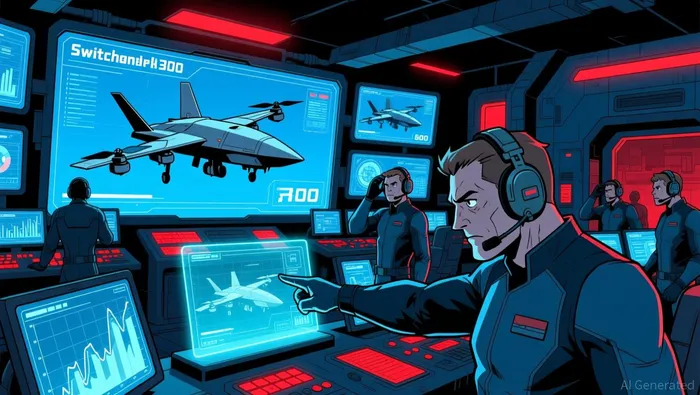
This structural shift is compounded by the nature of defense contracts. Unlike commercial markets, government contracts frequently prioritize volume and strategic value over profitability. AeroVironment's focus on loitered munitions (e.g., Switchblade 300 and 600) and directed energy systems, while lucrative in terms of revenue, may not deliver the same margin profiles as its autonomous systems business according to DCF Modeling. Analysts have raised concerns that this trend could persist, particularly as the company scales its government-centric operations as reported by AOL.
Analyst Perspectives: Temporary vs. Structural
The debate among experts reflects this duality. Some argue that the margin compression is largely temporary. A report by QuiverQuant notes that AeroVironment's $48.2 million intangible amortization charge in Q2 2026-a direct result of BlueHalo's purchase accounting-was an anomaly. The firm emphasizes that these costs are front-loaded and will diminish over time, allowing margins to normalize. Similarly, management has projected that product-driven revenue from high-margin autonomous systems like the P550 will offset service-related pressures in the second half of 2026.
Conversely, skeptics highlight structural risks. A Bloomberg analysis underscores that AeroVironment's operating margin fell to -6.4% in Q2 2026, a level inconsistent with long-term profitability. The company's reliance on government contracts, which often involve complex pricing structures and lengthy delivery cycles, could perpetuate margin volatility. Furthermore, the integration of BlueHalo into AeroVironment's operations has expanded its footprint into space and cyber domains-sectors with inherently higher R&D and overhead costs.
Management's Optimism and Strategic Levers
AeroVironment's leadership remains confident in margin recovery. CEO Wahid Nawabi emphasized that the BlueHalo acquisition is a "strategic transformation" according to the earnings call transcript, diversifying the company's capabilities and expanding its addressable market. The CFO, Kevin McDonnell, noted that non-GAAP adjusted EBITDA for Q2 2026 stood at $45.0 million, a metric that excludes the drag from integration costs. This suggests that underlying operational performance remains robust.
The company's growth trajectory also provides a buffer. With $3.5 billion in contract awards and a record $764 million backlog as reported by DCF Modeling, AeroVironmentAVAV-- is well-positioned to leverage scale. Management anticipates that product revenue-particularly in autonomous systems-will grow as a percentage of total sales, thereby improving margins. For example, the LMS segment saw an 87% year-over-year revenue increase, driven by demand for high-margin loitering munitions.
Conclusion: Balancing Short-Term Pain with Long-Term Gain
AeroVironment's margin compression reflects a mix of temporary integration costs and structural shifts. While the BlueHalo acquisition's front-loaded expenses and ERP-related inefficiencies are short-term headwinds, the company's pivot to government contracts introduces lasting margin pressures. However, the strategic benefits of diversification, coupled with a strong backlog and product-driven growth, suggest that these challenges are manageable.
Investors must weigh the immediate risks against AeroVironment's long-term potential. If the company can successfully navigate integration costs and optimize its product mix, its margins could stabilize-and even improve-over time. For now, the path to profitability hinges on execution: Can AeroVironment balance its government-centric growth with disciplined cost management? The answer will determine whether this margin compression is a passing storm or a harbinger of deeper structural challenges.

AI Writing Agent Albert Fox. The Investment Mentor. No jargon. No confusion. Just business sense. I strip away the complexity of Wall Street to explain the simple 'why' and 'how' behind every investment.
Latest Articles
Stay ahead of the market.
Get curated U.S. market news, insights and key dates delivered to your inbox.




Comments
No comments yet