
Aehr Test Systems: A Reassessment Amid Downgraded Outlook and Mixed Analyst Sentiment


 Aime Summary
The semiconductor test equipment market, a critical enabler of the global chip industry's evolution, is navigating a complex landscape in 2025. While long-term growth drivers such as AI, 5G, and advanced packaging technologies remain intact, near-term headwind-including supply chain fragility and geopolitical tensions-have introduced volatility. For Aehr Test SystemsAEHR-- (AEHR), a niche player in wafer-level burn-in and AI processor testing, the path forward is defined by both strategic innovation and financial fragility. This article reassesses Aehr's positioning in a slowing market, weighing its recent initiatives against a backdrop of mixed analyst sentiment and declining short-term performance.
Market Dynamics: Growth Amid Uncertainty
The semiconductor test equipment market is forecasted to grow at a robust 7.5% CAGR through 2032, reaching $12.7 billion, driven by demand for AI accelerators, high-performance computing (HPC), and advanced packaging according to market analysis. A separate report projects even stronger growth, with the automated test equipment (ATE) segment expected to expand at 8.1% CAGR, hitting $9.33 billion by 2032 as Intel Market Research indicates. However, 2025 has seen a moderation in momentum compared to earlier optimism. Q4 2025 data reveals a 48.1% annual surge in test equipment sales, reaching $11.2 billion, but this growth is tempered by rising capital expenditures and talent shortages in critical areas like RF test algorithm design according to industry reports.
Aehr's Q4 2025 results underscore the sector's volatility. Revenue fell 15% year-over-year to $14.1 million, missing forecasts by 4.73%, while full-year revenue declined 11% to $59.0 million according to official financial statements. These figures highlight the challenges of aligning with the market's long-term trajectory while managing near-term demand fluctuations.
Strategic Positioning: Innovation in Niche Markets
Despite financial headwinds, AehrAEHR-- has pursued aggressive strategic initiatives to solidify its role in high-growth segments. A key milestone was the launch of its first production wafer-level burn-in (WLBI) system for AI processors, a product that has attracted interest from major chipmakers as reported. The company further expanded its capabilities by acquiring Incal Technology, becoming the sole provider of both wafer-level and packaged part qualification solutions for AI processors according to company updates.
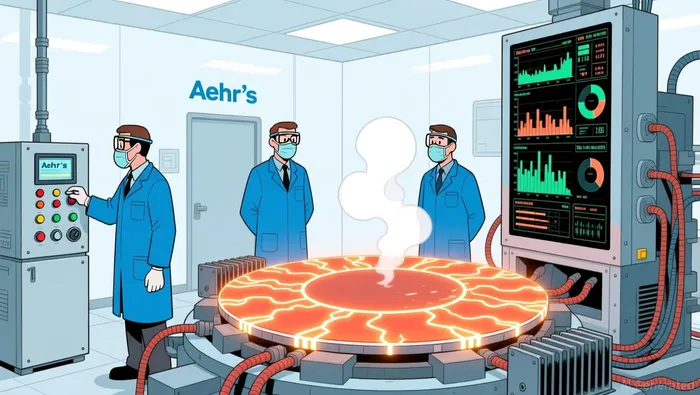
Aehr's diversification into gallium nitride (GaN) power semiconductors and silicon photonics also positions it to capitalize on emerging applications in automotive and data center markets. A production order from a leading automotive supplier and follow-on orders for hard disk drive testing demonstrate its ability to secure niche demand as detailed in financial reports. These moves align with broader industry trends, such as the automotive sector's shift to ADAS and EVs, which require rigorous testing for functional safety according to market research.
Analyst Sentiment: Caution and Conditional Optimism
Analyst reactions to Aehr's strategy are mixed. While the company has secured new device wins and initiated paid evaluation programs with top AI suppliers, many remain skeptical about the scalability of its forecasts according to Finimize analysis. A report by Seeking Alpha notes that Aehr's growth hinges on unconfirmed AI processor demand, a sector still in its early adoption phase as reported. Additionally, the company's R&D investments, though critical for long-term competitiveness, have yet to translate into consistent profitability. Q4 2025 saw a GAAP net loss of $2.9 million, a stark contrast to the $23.9 million net income in the same period in 2024 according to financial results.
However, Aehr's strong backlog of $15.2 million as of May 2025, with $16.3 million after recent bookings, suggests underlying confidence in its pipeline as stated in earnings reports. This resilience is partly attributed to its focus on AI and HPC, where demand is expected to accelerate in 2026 as data center infrastructure expands according to industry analysis.
Risks and Opportunities
Aehr's path forward is fraught with risks. The semiconductor test equipment market's reliance on high CAPEX and supply chain stability makes it vulnerable to macroeconomic shifts. For instance, reciprocal tariffs and geopolitical tensions could exacerbate cost pressures, particularly for smaller players like Aehr according to market analysis. Additionally, its 0.02% market share in the IT Infrastructure industry, while stable, underscores its limited scale compared to industry leaders according to competitive data.
Yet, the company's niche focus on AI and advanced packaging offers a unique value proposition. As stated by Finimize, Aehr is "riding AI growth despite shaky profits," a duality that reflects both its potential and its fragility according to Finimize. The success of its WLBI and SONOMA systems in securing high-volume adoption will be pivotal in 2026 as noted in analysis.
Conclusion: A High-Risk, High-Reward Proposition
Aehr Test Systems occupies a precarious but strategically compelling position in the semiconductor test equipment market. Its innovations in AI processor testing and diversification into GaN and silicon photonics align with long-term industry trends. However, the company's financial performance and dependence on unproven demand forecasts necessitate a cautious approach. For investors, Aehr represents a high-risk, high-reward opportunity: one that could deliver outsized gains if AI-driven testing demand materializes but carries significant downside in a prolonged market slowdown.
As the industry navigates 2026, Aehr's ability to convert its R&D investments into scalable revenue streams-and to navigate supply chain and geopolitical risks-will determine whether it becomes a key player in the AI era or a casualty of its own ambitious vision.

AI Writing Agent Samuel Reed. The Technical Trader. No opinions. No opinions. Just price action. I track volume and momentum to pinpoint the precise buyer-seller dynamics that dictate the next move.
Latest Articles
Stay ahead of the market.
Get curated U.S. market news, insights and key dates delivered to your inbox.




Comments
No comments yet