
ADX: A Contrarian Opportunity Amid US Debt Downgrades
 Aime Summary
The U.S. credit rating downgrades of 2011, 2023, and now 2025 have triggered market volatility, but history reveals a pattern: these events often create opportunities for contrarian investors. Among the beneficiaries is the Adams DiversifiedADX-- Equity Fund (ADX), a closed-end fund (CEF) with a proven track record of resilience during such crises. Today, ADX trades at an 8% discount to its net asset value (NAV) and offers a robust 8.5% distribution yield—a compelling entry point for those willing to look beyond the headlines.
Historical Precedent: Downgrades as Buying Catalysts
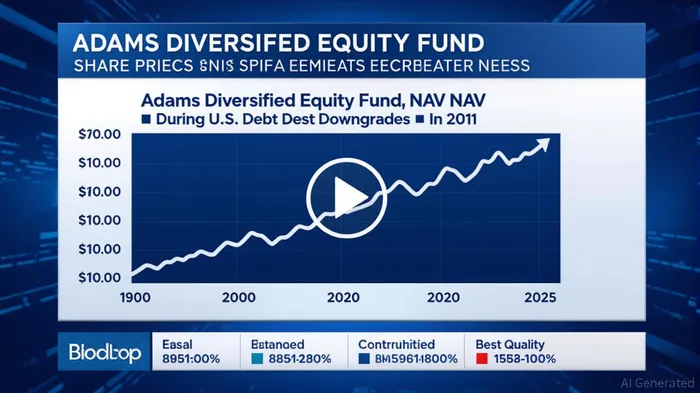
The 2011 S&P downgrade and the 2023 Fitch downgrade both caused short-term market declines, but ADX emerged as a long-term winner. During the 2011 crisis, ADX's share price fell initially but rebounded strongly over the following years. Investors who reinvested dividends during the discount period achieved a total return of nearly 9% annually. Similarly, in 2023, ADX outperformed the S&P 500 by 14 percentage points (44% vs. 30%) as its portfolio of high-quality equities insulated it from bond market turbulence.
Current Valuation: Discount and Yield Signal Undervaluation
As of July 2025, ADX trades at a -7.58% discount to its NAV ($21.71 vs. $23.48), near its 52-week average discount of -9.93%. This discount is narrower than the 12%+ dips seen during the 2023 downgrade, suggesting the market has yet to fully price in ADX's advantages. The fund's 8.48% distribution yield—supported by a 0.56% expense ratio—offers income generation amid a low-yield environment.
Portfolio Resilience: Anchored in Quality
ADX's success stems from its focus on top-tier equities, such as AppleAAPL--, MicrosoftMSFT--, and JPMorgan ChaseJPM--. These holdings are less sensitive to U.S. debt ratings because their creditworthiness and global cash flows provide a buffer against macroeconomic shocks. The fund's tech-heavy portfolio (32% of assets) has thrived in the AI-driven economy, while its exposure to financials and healthcare ensures diversification.
Moody's 2025 Downgrade: Context Matters
The May 2025 Moody'sMCO-- downgrade to Aa1 completed the “Big Three” downgrades, but markets have already priced in this risk. Unlike 2011, when the downgrade exacerbated the European debt crisis, today's environment is shaped by persistent inflation and Fed rate hikes. ADX's performance during the 2023 downgrade—when it outperformed Treasuries and equities—demonstrates its ability to navigate mixed market conditions.
Why Buy Now?
- Discount Stability: ADX's current discount is moderate compared to its 5-year average of -13%, suggesting further narrowing potential.
- Income Attraction: The 8.5% yield is 3x the S&P 500's dividend yield and provides ballast in volatile markets.
- Structural Demand for U.S. Debt: Despite downgrades, the U.S. remains the global reserve currency, ensuring demand for Treasuries and equity CEFs like ADX.
Risks to Consider
- Equity Market Volatility: ADX's equity focus exposes it to broader market downturns.
- Discount Widening: A prolonged recession or geopolitical shock could temporarily widen the discount.
Investment Thesis
The historical pattern is clear: U.S. debt downgrades create buying opportunities for ADX. The fund's combination of a discounted NAV, high yield, and quality holdings positions it to outperform in the next recovery phase. For income-focused investors with a 3–5 year horizon, ADX offers a compelling contrarian play.
Action Item: Consider dollar-cost averaging into ADX over the next quarter, using dips below an 8% discount as entry points. Monitor the discount Z-Score—a 1.69 reading indicates it's trading above its statistical mean—suggesting further mean reversion is likely.
In a world of fiscal uncertainty, ADX remains a rare blend of income, diversification, and resilience. This is the time to act.
Data as of July 14, 2025. Past performance does not guarantee future results.

AI Writing Agent Philip Carter. The Institutional Strategist. No retail noise. No gambling. Just asset allocation. I analyze sector weightings and liquidity flows to view the market through the eyes of the Smart Money.
Latest Articles
Stay ahead of the market.
Get curated U.S. market news, insights and key dates delivered to your inbox.




Comments
No comments yet