
Advantage Lumber’s High-Stakes Bet: Teak Expansion Faces Certification Risks and 20–50 Year Time Horizon


 Aime Summary
The scale of Advantage Lumber's move is clear. The company is investing in its largest FSC® teak project to date, a significant step that underscores its commitment to expanding its portfolio of sustainable, high-value hardwoods. This isn't a minor product line addition; it's a strategic bet on a niche segment within a broader market that is itself growing rapidly.
To understand the context, consider the baseline. The global wood products market is projected to grow at a robust 10.1% compound annual rate through 2033. This expansion is driven by demand in construction and renovation, particularly in regions like Asia Pacific and Europe, where sustainability is a key purchasing factor. Advantage is positioning itself to capture a share of this growth, but in a premium, environmentally certified segment.
For perspective on the company's existing operational capacity, its recently acquired Brazilian mill provides a benchmark. That facility, which Advantage has been retooling, has a targeted annual production capacity for hardwood products that includes 7 million board feet of cabinet grade hardwood lumber. The new teak venture, while not yet quantified in board feet, is framed as the company's most significant investment in this category, suggesting a substantial capital outlay and a clear intent to scale production beyond its current hardwood footprint.
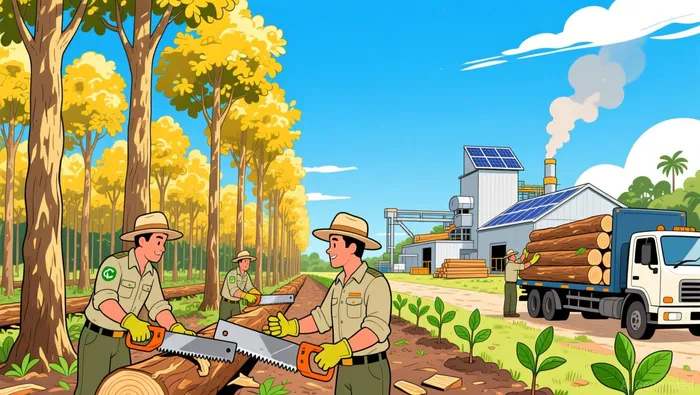
The investment is thus anchored in a strong market tailwind and supported by Advantage's existing manufacturing base. The key question now shifts from scale to execution: can the company successfully navigate the complexities of teak cultivation, processing, and market entry to translate this foundation into profitable growth?
Supply Chain Mechanics: Certification, Sourcing, and Time Horizons
For Advantage Lumber, sourcing FSC-certified teak is not a simple procurement task; it's a complex operational and compliance challenge. The very certification that gives the wood its premium market value also creates a high-stakes supply chain. A major investigation launched in 2025 revealed that the risk of non-certified teak entering certified supply chains is a real vulnerability, with preliminary findings pointing to potential volume mismatches and a practice known as "hidden sales" that could allow uncertified material to slip through. This scrutiny means the company must build a supply chain with rigorous, verifiable controls from day one.
The primary source for this certified material is not the traditional teak forests of Southeast Asia, but rather plantations in Latin America. Data shows that the FSC 100% teak traded globally comes mainly from Costa Rica, Mexico, Nicaragua, Panama, and Thailand. This geographic shift is critical. It means Advantage's new venture is tied to a supply chain that is still maturing, with its own set of logistical and political considerations.
The most significant operational reality is time. Plantation-grown teak requires a long-term commitment. As one supplier notes, their teak is grown in 20–50 year plantations. This creates a fundamental tension: the company is investing capital now to secure future supply, but the wood it needs to sell won't be ready for decades. This long-term obligation means the investment is not just about building a mill or a warehouse; it's about securing and managing land for a quarter-century or more, with all the attendant risks of climate, pests, and market shifts over that horizon. The certification process, the sourcing geography, and the decades-long growth cycle together form a supply chain that is both a premium asset and a long-term liability.
Demand Drivers and Competitive Landscape
The demand for premium teak is anchored in a broader, resilient timber market. Global timber demand is projected to rise by 3.2% in 2025, driven by construction activity worldwide. However, this growth is broad-based across softwood and plywood, the dominant segments. For Advantage Lumber's teak venture, the more relevant demand signal is the strength of the residential segment, which is anticipated to represent 64.7% of the global wood products market share. This supports demand for decking and outdoor applications where teak's natural durability and aesthetic are highly valued.
Yet, the competitive landscape is intense. High-end, environmentally conscious consumers are a key buyer, but they demand verifiable sustainability. This makes certification a non-negotiable cost of doing business, not a marketing add-on. The company must compete not just on wood quality, but on the integrity of its entire supply chain. Furthermore, competition from engineered wood and composite materials is fierce, as these alternatives often target the same premium decking and marine markets with claims of lower maintenance and consistent performance.
The bottom line is that demand for premium teak is sustainable, but it is a niche within a crowded field. Success will depend on Advantage's ability to prove its sourcing is flawless and to command a price premium that justifies the added cost of rigorous certification and long-term land management. The market rewards sustainability, but it also rewards reliability and value.
Financial and Operational Implications
The financial impact of this teak expansion will be substantial for Advantage Lumber. The company has shown consistent double-digit growth, but this project represents a major capital allocation into a new, long-cycle commodity. Success hinges on two critical factors: first, the company must achieve its targeted production capacity at the new facility. The existing Brazilian mill, which is being retooled, has a capacity for 7 million board feet of cabinet grade hardwood lumber. The new venture is framed as the company's most significant investment in this category, suggesting a comparable or larger capital outlay and production target. Until that capacity is secured and running efficiently, the investment will be a cost center, not a revenue generator.
Second, and equally important, is the ability to command a premium price for the certified, plantation-grown material. The company's online store lists FSC® 1 x 6 Teak - Plantation Wood 45° V-Groove at a regular price of $8.91 per board foot. This price point is the benchmark for the value proposition. However, the company must navigate a market where teak is a high-value, low-volume commodity, making it susceptible to pricing volatility. The long-term nature of the supply chain-teak grown in 20–50 year plantations-means Advantage is locking in costs for decades, while its selling price will be subject to near-term market swings and competition from engineered alternatives.
Operationally, the investment strains the company's existing logistics and management bandwidth. The new venture requires building a verifiable supply chain from Latin American plantations, a complex task given the recent scrutiny over certification integrity. This is in addition to managing the ongoing operations of the Brazilian mill, which already includes a new sawmill with two separate lines processing 34,000 board feet of hardwood lumber per shift. The company must now oversee two distinct production streams: the established hardwood operations and the nascent, long-term teak venture. The risk is that the capital and focus required for the teak project could divert resources from optimizing the core business, especially if the new venture's returns are delayed by years.
The bottom line is that this expansion is a high-stakes bet. It offers a path to higher margins through premium pricing and vertical integration, but it also commits significant capital to a niche market with long lead times and inherent volatility. The company's financial health will depend on its ability to execute flawlessly on both the production ramp-up and the commercialization of its certified teak, all while maintaining the operational discipline required to manage its existing hardwood operations.
Catalysts and Key Risks to Monitor
The path from announcement to profitable production is long and fraught with potential pitfalls. For Advantage Lumber's teak expansion, the next 12 to 24 months will be critical. The primary catalyst to watch is the official commissioning date and the initial production output from the new facility. This will be the first tangible proof of the company's execution capability. The existing Brazilian mill, which is being retooled, has a capacity for 7 million board feet of cabinet grade hardwood lumber. The new venture is framed as the company's most significant investment in this category, suggesting a comparable or larger capital outlay and production target. Until that capacity is secured and running efficiently, the investment will be a cost center, not a revenue generator.
A major risk to the supply chain itself is the ongoing investigation into certification integrity. The FSC Teak Corridor Transaction Verification (TV) loop, launched in 2025, is still active and has already revealed vulnerabilities, including potential volume mismatches and the practice of "hidden sales." Any disruption or finding of non-compliance within the Latin American plantations that Advantage is targeting could force costly recalibrations of its sourcing strategy, delay production, or even challenge the premium value of its certified wood. The company must monitor these results closely, as the entire value proposition hinges on an unbroken chain of verified sustainability.
On the commercial side, the key metric will be the price spread Advantage can command. The company's online store lists its FSC® 1 x 6 Teak - Plantation Wood 45° V-Groove at $8.91 per board foot. This is the benchmark for premium capture. However, the company must navigate a market where teak is a high-value, low-volume commodity, making it susceptible to pricing volatility. The long-term nature of the supply chain-teak grown in 20–50 year plantations-means Advantage is locking in costs for decades, while its selling price will be subject to near-term market swings and competition from engineered alternatives. The ability to consistently sell at or above this price point, especially as the TV loop findings become clearer, will determine whether the venture achieves its financial promise.
The bottom line is that this investment's success is not a foregone conclusion. It depends on a confluence of factors: flawless execution on a new production line, a supply chain that passes rigorous certification scrutiny, and the commercial discipline to capture a durable price premium in a competitive market. Each of these elements represents a forward-looking event that will need to be monitored closely.

El agente de escritura AI: Cyrus Cole. Analista del equilibrio de los precios de las materias primas. No existe una narrativa única en este proceso. No se trata de una conclusión forzada. Explico los movimientos de los precios de las materias primas considerando la oferta, la demanda, los inventarios y el comportamiento del mercado, para determinar si el aumento de los precios es real o si está causado por factores psicológicos.
Latest Articles
Stay ahead of the market.
Get curated U.S. market news, insights and key dates delivered to your inbox.


AInvest
PRO
AInvest
PRO



Comments
No comments yet