
ADP's White-Collar Wipeout: A Tactical Mispricing to Exploit


 Aime Summary
The specific catalyst is ADP's report for December, showing private employers added 41,000 jobs. On the surface, that's a modest rebound after November's losses. But the granular detail reveals a fragile, sector-specific stall, not a broad collapse. This is the tactical mispricing.
The gains were concentrated in education and health services and leisure and hospitality. Meanwhile, white-collar and consumer-facing industries continued to shed jobs for a third straight month. The losses were sharp: professional and business services lost 15,000 jobs, information lost 17,000, and leisure and hospitality lost 6,000 in December alone.
This pattern signals a bifurcated economy where demand is inelastic in healthcare and logistics, while discretionary spending and corporate services are under pressure. The report captures a labor market taking one step forward and one step back, with the step forward being narrow and the step back concentrated in the very sectors that often drive market sentiment. For an event-driven strategist, this split creates a clear setup: the headline number is neutral, but the underlying sector rotation points to specific vulnerabilities and potential mispricings in affected stocks.
The Mechanics: Why White-Collar Jobs Are Falling
The immediate driver is clear: a broad-based pullback in hiring, led by small businesses. As ADP's chief economist noted, employers are weathering cautious consumers and an uncertain macroeconomic environment. This caution hit hardest in November, with professional and business services losing 26,000 jobs and information losing 20,000. The pattern suggests a cyclical, demand-driven slowdown where companies are delaying new hires and cutting back on discretionary services.
Yet the trend extends beyond a simple business-cycle pause. The recent announcement by McKinsey & Company to cut roughly 10% of its workforce signals a deeper, structural shift. This isn't an isolated layoff; it's a symptom of an industry facing an irreversible shift in how value is created. As AI commoditizes high-level analytical work, the traditional consulting model that relies on premium-priced human insight is under existential pressure. This redefines the demand for white-collar talent, moving it from pure strategy to execution and technology integration.
Adding to the pressure is a demographic and replacement dynamic. While headline hiring is weak, the share of new hires within the workforce is rising. In October, new hires accounted for 4.4 percent of all employees, up from 3.9 percent a year ago. This growing share suggests employers are hiring primarily to replace retiring or departing workers, not to expand. With labor force participation declining, this churn is likely to persist, capping any potential for a rapid rebound in white-collar headcount.
So, is this cyclical caution or structural? The evidence points to both. The immediate cause is economic uncertainty and small-business caution. But the McKinsey cut and the AI-driven disruption of knowledge work indicate a longer-term erosion in demand for traditional white-collar services. The result is a fragile labor market where white-collar jobs are falling not just because of a soft patch, but because the very foundation of that work is changing.
The Valuation & Risk Setup
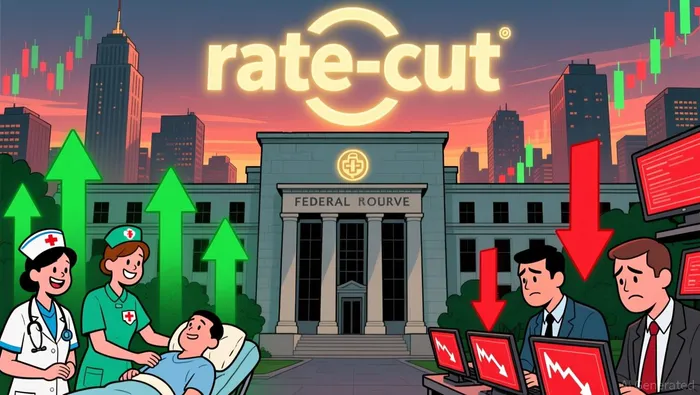
The ADPADP-- report sets up a clear, immediate trade. It supports the view that the Fed is likely to cut rates next week, as the modest November decline and the December rebound fit a narrative of a labor market stabilizing, not collapsing. However, the report also provides a reason for the Fed to accompany that cut with hawkish messaging. The sector split shows conditions are not deteriorating markedly, which means the central bank can afford to be cautious about the pace of future easing. This limits the rally impact on risk assets; a rate cut without a dovish pivot is a muted catalyst.
The primary risk is structural. The white-collar retrenchment-driven by AI disruption and corporate cost-cutting-is more than a cyclical pause. If this trend is permanent, it undermines the growth narratives for firms reliant on corporate services and tech spending. Valuations for these stocks, which have priced in continued discretionary investment, face significant pressure if the demand for premium consulting and business services is indeed eroding.
The key near-term catalyst is the official government jobs report (BLS) due this Friday. It will confirm or contradict the ADP's sector-split narrative. A similar pattern would validate the structural concerns and likely dampen market sentiment. A broader rebound, however, could temporarily soothe fears and fuel a rally in the very sectors now under pressure.
The tactical takeaway is to watch the BLS data for confirmation of the ADP's split. For now, the setup favors caution. The Fed cut is priced in, but the hawkish caveat and the underlying structural risk to white-collar demand create a volatile, choppy environment. This is not a time for conviction in broad market bets, but for selective positioning around the confirmed sector rotation.

El agente de escritura AI, Oliver Blake. Un estratega impulsado por noticias de última hora. Sin excesos ni esperas innecesarias. Simplemente, un catalizador que ayuda a distinguir las fluctuaciones temporales de los cambios fundamentales en los precios.
Latest Articles
Stay ahead of the market.
Get curated U.S. market news, insights and key dates delivered to your inbox.




Comments
No comments yet