
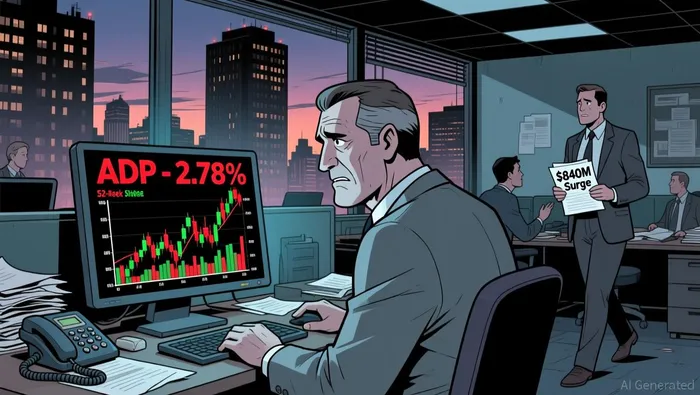
ADP's $840M Surge Propels 157th Rank as Stock Dives 2.78% to 52-Week Low
 Aime Summary
Market Snapshot
On November 6, 2025, , , ranking it 157th in market activity. Despite this robust trading interest, , . The decline followed a broader market downturn and heightened sector-specific pressures, . . . , underscoring its struggle to maintain momentum amid macroeconomic uncertainties.
Key Drivers
ADP’s recent performance reflects a complex interplay of strong fundamentals, cautious analyst sentiment, and broader market dynamics. The company’s first-quarter results demonstrated resilience, . However, these figures failed to alleviate concerns among analysts, who have systematically lowered price targets in recent months. For instance, , , . This pattern of downgrades, despite outperforming estimates, highlights a lack of confidence in ADP’s ability to sustain its growth trajectory in a challenging economic environment.
A key factor underpinning the stock’s decline is the mixed reaction to its dividend strategy. , , reflecting 52 consecutive years of uninterrupted dividend payments. However, , particularly if earnings growth slows. While the dividend provides a buffer for income-focused investors, the high payout ratio may deter growth-oriented investors seeking reinvestment of profits. Additionally, the stock’s recent drop into oversold territory, as indicated by its , has sparked debate among value investors about potential buying opportunities, though broader market volatility has tempered optimism.
Sector-specific challenges also weigh on ADP’s performance. The industry faces headwinds from macroeconomic factors, including inflationary pressures and uncertainty around corporate hiring trends. ADP’s exposure to these dynamics is evident in its mixed institutional investor activity. While large funds like Ameriprise Financial and Goldman Sachs increased holdings in the first quarter, others, including Freestone Capital and SS&H Financial Advisors, . This divergence underscores the lack of consensus among investors regarding ADP’s near-term prospects.
Analyst ratings further complicate the outlook. Despite three “Buy” recommendations, nine “Hold” ratings, and two “Sell” ratings, . However, recent downgrades by major firms such as JPMorgan and Wells Fargo, , reflect a risk-averse stance. Insider sales, including significant transactions by executives like VP Michael A. Bonarti and CEO , have also raised eyebrows. These sales, , may signal internal skepticism about ADP’s ability to navigate near-term challenges.
Finally, ADP’s valuation metrics add nuance to the discussion. , indicating a premium to growth expectations. , the disconnect between fundamentals and analyst sentiment suggests lingering doubts about its ability to outperform in a low-growth environment. For now, the stock appears to be trading closer to its fair value, but the path to recovery will depend on its capacity to address macroeconomic risks and restore investor confidence.

Stay ahead of the market.
Get curated U.S. market news, insights and key dates delivered to your inbox.
AInvest
PRO
AInvest
PRO



Comments
No comments yet