
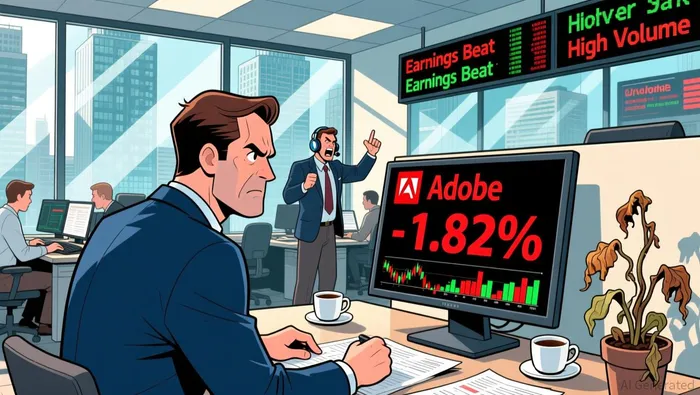
Adobe Shares Fall 1.82% Amid Earnings Beat and 84th-Ranked Trading Volume
 Aime Summary
Market Snapshot
Adobe (ADBE) closed 1.82% lower on November 17, 2025, with a trading volume of $1.08 billion, ranking 84th in market activity. The stock, which opened at $331.11, traded within its 52-week range of $323.03 to $557.90. Despite a recent earnings beat—reporting $5.31 EPS (vs. $5.18 est.) and $5.99 billion in revenue (up 10.7% YoY)—the stock’s decline suggests mixed sentiment. Institutional ownership remains robust at 81.79%, with new stakes from Symphony Financial ($58.56 million) and Raiffeisen Bank ($37.01 million) offsetting a 68.6% reduction by Y.D. More Investments. Analysts maintain a consensus “Hold” rating, with a $433.41 price target, though recent downgrades and revised estimates highlight uncertainty.
Key Drivers
Adobe’s earnings performance and guidance updates provided a foundational narrative. The company exceeded expectations in Q3 2025, reporting $5.31 EPS and $5.99 billion in revenue, with FY2025 EPS guidance set at $20.80–$20.85. However, the stock’s decline may reflect skepticism about sustaining this momentum, particularly as analysts revised price targets downward. UBS cut its objective to $375, and Piper Sandler reduced it to $470, citing macroeconomic concerns. Despite Adobe’s strong 10.7% YoY revenue growth, the market’s muted reaction suggests investors are factoring in broader tech sector headwinds, including AI-driven competition and shifting enterprise spending priorities.
Institutional activity underscored divergent views on Adobe’s valuation. Symphony Financial and Raiffeisen Bank significantly increased stakes in Q2, while Goldman Sachs and Paragon Capital added to their holdings. These moves signal confidence in Adobe’s long-term growth trajectory, particularly in cloud and AI-driven software. Conversely, Y.D. More Investments’ 68.6% reduction and insider sales, including CAO Jillian Forusz’s $50,344.12 transaction, indicate caution. The latter sale, representing a 4.17% reduction in Forusz’s holdings, may reflect strategic portfolio rebalancing or personal liquidity needs, though it could amplify short-term volatility.
Analyst sentiment remained fragmented, with a consensus “Hold” rating masking a spectrum of opinions. While DA Davidson and Oppenheimer maintained “Buy” and “Outperform” ratings, respectively, UBS, Citigroup, and Morgan Stanley downgraded or lowered price targets. This divergence reflects broader debates about Adobe’s ability to maintain its market leadership amid intensifying competition in digital media and AI tools. The company’s recent product launch—Premiere Pro for iPhone—was cited as a potential upside driver, but analysts remain cautious about monetization and user adoption rates.
Macro factors, including Fed policy uncertainty and sector-wide profit-taking, also influenced Adobe’s performance. The stock’s beta of 1.47 suggests higher volatility relative to the S&P 500, amplifying sensitivity to interest rate fluctuations and sector rotation. Additionally, Adobe’s elevated P/E ratio (20.63) and PEG ratio (1.51) highlight valuation concerns, particularly in a high-rate environment. While the company’s robust net margin (30.01%) and ROE (57.54%) support its premium pricing, investors may be reassessing risk-reward dynamics in light of broader market corrections.
Finally, Adobe’s institutional ownership concentration (81.79%) and limited insider ownership (0.16%) underscore the influence of large fund managers on its stock dynamics. Moves by entities like Goldman Sachs and Amundi—adding $1.75 billion and $1.78 billion in stakes, respectively—signal strategic positioning for long-term growth. However, these inflows must counterbalance short-term selling pressure and analyst skepticism to drive sustained momentum. The coming quarters will be critical in validating Adobe’s FY2025 guidance and its ability to navigate a competitive tech landscape.

Stay ahead of the market.
Get curated U.S. market news, insights and key dates delivered to your inbox.




Comments
No comments yet