
Adobe Shares Dip 1.68% Amid $1.69 Billion Volume Ranking 82nd in Liquidity as Investor Caution Builds Ahead of AWS AI Announcements
 Aime Summary
Market Snapshot
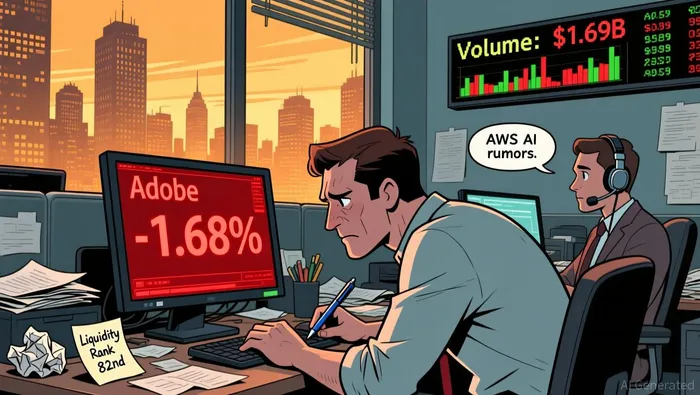
Adobe Inc. (ADBE) closed 1.68% lower on Monday, marking a decline in its stock price despite a trading volume of $1.69 billion, which ranked it 82nd among equities by liquidity. The drop follows a session of mixed market sentiment, with the broader tech sector under pressure amid anticipation of key AI-related announcements at AmazonAMZN-- Web Services’ (AMZN) re:Invent 2025 conference. While Adobe’s volume was robust, the price weakness suggests investor caution ahead of the event, where AWS is expected to unveil advancements in AI hardware and partnerships that could indirectly influence Adobe’s strategic positioning in the software ecosystem.
Key Drivers
Adobe’s inclusion in AWS’s re:Invent 2025 lineup, alongside industry peers such as Nike (NIKE), Netflix (NFLX), and Sony (SONY), signals growing cross-industry collaboration in AI-driven innovation. The conference, set for December 1–5 in Las Vegas, will feature a keynote by AWS CEO Matt Garman and highlight AWS’s latest Trainium3 AI accelerator, which boasts double the compute power and 50% higher energy efficiency compared to its predecessor. Although Adobe’s direct role in the event remains unspecified, its presence underscores the company’s alignment with AI infrastructure trends, a sector where AWS is expanding its influence through partnerships like its $38 billion compute agreement with OpenAI. This context may have prompted investors to reassess Adobe’s exposure to AI-driven workflows, particularly as the company’s Creative Cloud and Document Cloud platforms increasingly integrate generative AI tools.
The broader market reaction to AI infrastructure developments also played a role. Bank of America analysts noted that AWS’s Trainium3 rollout could accelerate competition in the AI chip space, particularly with Google’s (GOOG) TPUs and OpenAI’s Nova models. While AdobeADBE-- is not a chipmaker, its reliance on cloud-based AI services for creative tools positions it to benefit from or face challenges depending on AWS’s ecosystem strategies. For instance, AWS’s potential to expand its Bedrock platform with OpenAI’s frontier models could indirectly affect Adobe’s AI tooling stack, either through integration opportunities or heightened competition in AI-as-a-service offerings. The absence of immediate clarity on Adobe’s specific announcements at re:Invent may have contributed to short-term volatility, as investors weighed the implications of AWS’s AI roadmap on Adobe’s long-term growth trajectory.
Another factor was the broader tech sector’s sensitivity to macroeconomic signals. The Federal Reserve’s upcoming policy decisions and inflation data could influence risk appetite, with AI infrastructure projects often perceived as capital-intensive and cyclical. Adobe’s 1.68% decline aligns with a broader pullback in tech stocks, reflecting investor hedging ahead of macroeconomic updates. However, Adobe’s strong balance sheet and recurring revenue model from Creative Cloud provide a buffer against short-term volatility, as evidenced by its consistent performance in previous quarters despite market downturns.
The lack of direct news linking Adobe’s recent earnings or product launches to the stock’s decline further narrows the focus to external sector dynamics. While the company’s Q3 2025 results showed continued growth in its AI-enhanced tools, there were no immediate catalysts—such as new product announcements or regulatory developments—to explain Monday’s move. This suggests that the decline was more a reflection of macro trends and sector-specific speculation rather than company-specific fundamentals. Investors may be positioning for potential earnings revisions if AWS’s re:Invent announcements reshape AI infrastructure spending priorities, which could indirectly impact Adobe’s cloud computing costs or partner ecosystems.
In summary, Adobe’s stock performance on Monday was driven by a combination of sector-wide AI infrastructure speculation, macroeconomic uncertainties, and the strategic implications of AWS’s re:Invent 2025 agenda. While the company’s direct involvement in the event remains undefined, its presence in the lineup highlights the interconnectedness of AI advancements across industries. The coming weeks will be critical in determining whether AWS’s AI announcements translate into renewed momentum for Adobe’s AI-integrated platforms or introduce competitive pressures in the rapidly evolving AI-as-a-service landscape.

Stay ahead of the market.
Get curated U.S. market news, insights and key dates delivered to your inbox.
AInvest
PRO
AInvest
PRO



Comments
No comments yet