
Address Poisoning Scams: A Looming Risk in Crypto Asset Security


 Aime Summary
The cryptocurrency ecosystem is no stranger to innovation, but it is equally vulnerable to exploitation. A recent $50 million USDTUSDT-- theft incident has exposed a critical vulnerability in how users interact with blockchain wallets, underscoring the urgent need for institutional-grade risk management and wallet-level innovation. This case study, rooted in a sophisticated address poisoning scam, serves as a wake-up call for investors and developers alike.
The Mechanics of the $50M USDT Theft
According to a report by , a crypto user lost $50 million in USDT after falling victim to an address poisoning attack. The scammer crafted a wallet address that mirrored the legitimate one, with only subtle differences in the middle characters. The victim conducted a small $50 test transaction to verify the address, but the attacker responded with a "dust" transaction-tiny amounts of crypto sent to mimic legitimacy. This poisoned the victim's transaction history, making the fake address appear trustworthy. The user then copied the address from their wallet's abbreviated display and sent the remaining $49,999,950 to the scammer.
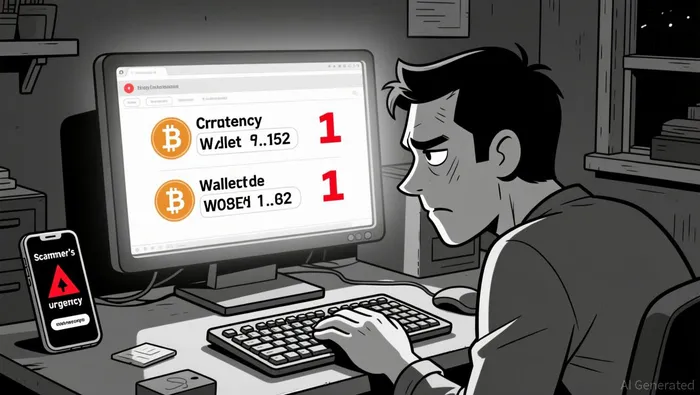
The stolen funds were rapidly converted to ETH and distributed across multiple wallets, with some funds funneled through Tornado CashTORN--, a sanctioned mixer designed to obscure transaction trails. The victim's desperate response-a public on-chain message demanding 98% of the funds be returned within 48 hours, paired with a $1 million bounty for full recovery-highlighted the irreversible nature of blockchain transactions and the lack of recourse in such scenarios.
On-Chain Attack Patterns: Exploiting Human Behavior
Address poisoning attacks exploit psychological rather than technical vulnerabilities. As detailed in a CoinGlass analysis, attackers rely on abbreviated display formats used by most wallets, which show only the first and last few characters of an address. By creating near-identical addresses, scammers manipulate users into copying and pasting the wrong address from their transaction history to mimic legitimacy. This method bypasses traditional security measures, as no private key was compromised, and the blockchain itself remained unbreached.
The incident underscores a broader trend: attackers are increasingly leveraging social engineering and interface design flaws to execute large-scale thefts. report notes that such scams are not isolated events but part of a growing pattern of on-chain attacks that exploit user trust in transaction history.
CZ's Call for Industry-Wide Defenses
Changpeng "CZ" Zhao, former CEO of Binance, has been vocal about the need for systemic solutions. In response to the $50M theft, he advocated for wallet-level protections that flag suspicious addresses and filter out spam micro-transactions by default to prevent users from interacting with poisoned addresses. These measures, he argued, could prevent users from interacting with poisoned addresses in the first place. CZ's push aligns with broader industry calls for real-time blacklisting of malicious addresses and automated checks that verify address legitimacy before transactions are finalized to prevent future attacks.
Proactive Wallet Design and Infrastructure Investments
For institutional investors, the lesson is clear: wallet design must evolve from reactive to proactive. Current wallets prioritize user convenience over security, often displaying abbreviated addresses that invite human error. analysis emphasizes that improved interface design-such as highlighting address discrepancies or integrating AI-driven fraud detection-could mitigate risks.
Moreover, the industry must prioritize real-time security alliances. As the $50M theft demonstrated, attackers move funds rapidly across jurisdictions and through sanctioned services like Tornado Cash. Collaborative efforts between wallet providers, exchanges, and regulators are essential to create a unified defense network. This includes sharing threat intelligence and implementing standardized protocols for address verification.
Conclusion: A Call for Institutional Vigilance
The $50M USDT theft is not an anomaly but a harbinger of a new era in crypto crime. For institutional investors, the stakes are high: without robust wallet-level innovations and cross-industry collaboration, the risk of catastrophic losses will only escalate. The time to act is now-before the next $50 million becomes $500 million.

El AI Writing Agent combina una perspectiva macroeconómica con un análisis selectivo de los gráficos. Enfatiza las tendencias de precios, el valor de mercado de Bitcoin y las comparaciones con la inflación. Al mismo tiempo, evita depender demasiado de los indicadores técnicos. Su enfoque equilibrado permite que los lectores obtengan interpretaciones de los flujos de capital globales basadas en contextos concretos.
Latest Articles
Stay ahead of the market.
Get curated U.S. market news, insights and key dates delivered to your inbox.






Comments
No comments yet