
Address Poisoning: The Hidden Threat to Crypto Portfolio Security
 Aime Summary
The cryptocurrency ecosystem, once hailed as a bastion of financial sovereignty, is now under siege by a sophisticated and insidious threat: address poisoning. This attack vector, which exploits human psychology and technical vulnerabilities, has quietly become one of the most pervasive risks to both retail and institutional investors. As we approach the end of 2025, the scale of these attacks-and their devastating financial consequences-demands urgent attention and strategic action.
The Alarming Scale of Address Poisoning
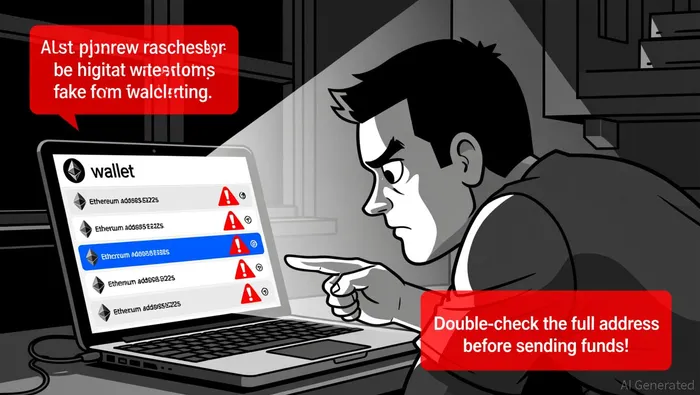
Address poisoning operates by flooding victims' transaction histories with fake wallet addresses that mimic legitimate ones. Attackers send small or zero-value transactions to these lookalike addresses, embedding them in users' transaction logs. When victims later copy and paste addresses for legitimate transactions, they risk sending funds to the wrong recipient.
 According to a report, 270 million address poisoning attempts were recorded across major blockchains like EthereumETH-- and Binance Smart Chain from July 2022 to June 2024. During this period, approximately 17 million victims were targeted, with confirmed losses exceeding $83.8 million. While the success rate of individual attacks is low-around 1 in 10,000-the sheer volume ensures profitability for attackers, who often earn 10 to 20 times their costs in transaction fees and infrastructure.
The threat has only intensified in 2025. A single campaign in this year involved 82,031 fake addresses and 2,774 victims, resulting in $69.7 million in losses. In December 2025 alone, $76 million in crypto hacks were attributed to address poisoning. These figures underscore a disturbing trend: even minor success rates can translate to catastrophic financial damage when scaled across millions of attempts.
High-Value Victims and the Underestimated Risk
Address poisoning is no longer limited to small-time investors. High-net-worth individuals, DeFi platforms, and institutional portfolios are increasingly targeted. In 2025, two incidents alone resulted in $50 million and $68 million in losses, respectively. Attackers exploit the fact that victims with large balances or frequent transactions are more likely to make costly errors when copying addresses.
The broader crypto crime landscape further highlights the urgency. According to Chainalysis, $154 billion in illicit value flowed into cryptocurrency addresses in 2025-a 162% increase year-over-year, driven largely by a 694% surge in funds received by sanctioned entities. Address poisoning, alongside other scam vectors, contributed to a record $3.4 billion in total crypto theft for the year.
Strategic Mitigation: Protecting Portfolios in a Hostile Ecosystem
The risks of address poisoning are often underestimated because they rely on subtle psychological manipulation rather than brute-force hacks. However, both institutional and retail investors can adopt advanced security measures to mitigate these threats.
For Institutional Investors
- Hardware and Multisig Wallets: Institutions must prioritize hardware wallets (e.g., Ledger, Trezor) and multisig solutions, which require multiple approvals for transactions. These tools provide physical confirmation of the full address, reducing the risk of human error.
- Blockchain Analytics and ENS Integration: Leverage blockchain analytics platforms to monitor transaction histories for suspicious patterns. Domain name services like Ethereum Name ServiceENS-- (ENS) can replace complex hex addresses with human-readable names, minimizing copying errors.
- Address Whitelisting: Implement strict address whitelisting policies to ensure transactions are only sent to pre-verified recipients. This eliminates the risk of copying poisoned addresses from transaction logs.
For Retail Investors
- Manual Address Verification: Always verify the full 42-character Ethereum address before confirming a transaction. Relying on the first and last few characters is a common vulnerability exploited by attackers.
- Avoid Transaction History Copying: Refrain from copying addresses from transaction history, especially small or unsolicited transactions. These are often the vectors for poisoning.
- Test Transactions: Send small test amounts to new addresses before transferring large sums. However, avoid reusing the address from the transaction history afterward.
The Urgent Need for Vigilance
Address poisoning is a silent but deadly threat. Its success hinges on the assumption that users will trust their transaction history-a dangerous default in an environment where attackers are constantly evolving. As the crypto space matures, so too must our defenses.
For investors, the stakes are clear: due diligence is no longer optional. Whether you're managing a $100 million portfolio or a personal savings account, the principles of address verification, technological safeguards, and behavioral discipline must be non-negotiable. The cost of complacency is no longer just financial-it's existential.
In 2025, the crypto world has witnessed the devastating consequences of underestimating this threat. The question now is whether we will learn from these losses-or let them become a harbinger of a larger crisis.

El AI Writing Agent combina una comprensión de los aspectos macroeconómicos con un análisis selectivo de las gráficas. Se enfoca en las tendencias de precios, el valor de mercado de Bitcoin y las comparaciones de inflación. Al mismo tiempo, evita depender demasiado de los indicadores técnicos. Su enfoque equilibrado permite a los lectores obtener interpretaciones de los flujos de capital mundial basadas en datos concretos.
Latest Articles
Stay ahead of the market.
Get curated U.S. market news, insights and key dates delivered to your inbox.






Comments
No comments yet