
AdaptHealth’s Stranded Overhead Timeline, Capitated Profitability Claims Don’t Match
 Aime Summary
Date of Call: Aug 4, 2026
Financials Results
- Revenue: $740.3M, up 12.7% YOY, 15.9% organic growth
- Operating Margin: Adjusted EBITDA margin of 17.8%
Guidance:
- FY 2026 net revenue projection: $2.85B to $2.89B (continuing operations), up roughly $15M from prior guidance.
- FY 2026 EBITDA guidance: $490M to $520M, down from prior guidance of $680M to $730M.
- Q3 2026 revenue expected: $720M to $740M.
- Q3 adjusted EBITDA margin expected: ~17.9%.
- Full-year 2026 free cash flow expected: $80M to $120M.
- Expect sequential improvement in West Coast capitated contract profitability, reaching run-rate profitability next year.
- Expect to achieve long-term 20% margin target for West Coast contract next year.
Business Commentary:
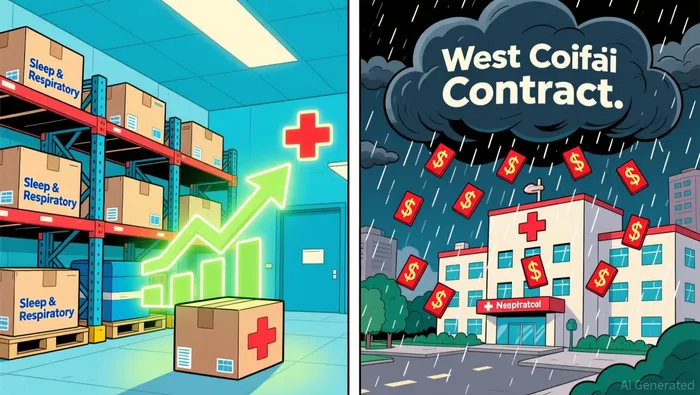
Revenue and Organic Growth:
- ADAPT Health reported second quarter net revenue from continuing operations of
$740.3 million, up12.7%versus the prior year quarter and15.9%on an organic basis. - This growth was driven by record volumes across the business, including contributions from the West Coast capitated contract and increased demand in sleep and respiratory segments.
Impact of Capitated Contracts and Operational Challenges:
- The West Coast capitated contract contributed
10.7 pointsto the organic growth, but also resulted in a$40 millionexpected impact on profitability due to elevated costs and inefficiencies. - The challenges were attributed to higher-than-expected order volumes and non-standard workflows, requiring operational and technological interventions to stabilize.
Portfolio Streamlining and Strategic Divestitures:
- The company signed a definitive agreement to sell its diabetes health business for
$235 million, reflecting a strategic move to focus on core segments like sleep and respiratory. - This action is part of a broader effort to simplify the portfolio, improve growth rates, and avoid industry-specific risks.
Manufacturing Price Increase and Financial Impact:
- ADAPT Health faced a
$30 millionimpact in the second half of 2026 due to a material price increase from a major manufacturer, effective July 1st. - The increase was sudden and necessitated active negotiations to secure improved pricing and terms, impacting the company's financial outlook.
Technological Integration and Cost Efficiency:
- The MyApp platform was adopted by
512,000users, representing a56%increase since the end of 2025, enhancing the patient journey with AI-powered features. - This integration aims to streamline operations, reduce human intermediary steps, and support cost efficiency improvements.
Sentiment Analysis:
Overall Tone: Neutral
- Management acknowledges 'near-term profitability challenges' and a $55M miss in second-quarter expectations for the West Coast capitated contract, but expresses confidence in the long-term value of the business and its strategic moves, stating 'we remain confident that with sustained work and additional time, the contract will be a strong contributor to our profitability.'
Q&A:
- Question from Michael Murray (RBC Capital Markets): The revised guidance includes a $30 million impact on the manufacturer price increase. What segment did this impact? And given the magnitude, what lever do you have to offset this?
Response: Management declined to name the segment but stated actions would include adjusting supplier mix and leveraging potential upcoming CPIU to offset the impact, with resolution pending ongoing negotiations.
- Question from Michael Murray (RBC Capital Markets): The revised guidance also includes a $15 million impact from other portfolio actions. Can you walk us through what those entail?
Response: This is a one-time headwind from shutting down non-core wellness product sales channels; revenue drops by ~35% but patient census care costs will persist for a few quarters until transition is complete.
- Question from Brian Tanquillette (Jefferies): How are you thinking about the strategic moves to shrink the business and delever corporate overhead?
Response: The strategy is to simplify and focus on core sleep and respiratory businesses to improve growth outlook and long-term margins, allowing more investment in core areas and enabling faster technology deployment.
- Question from Brian Tanquillette (Jefferies): What operational fixes are needed for the West Coast contract, and are there opportunities to reprice? Also, how is the Humana contract expansion working?
Response: Fixes involve managing order volumes/utilization (sleep resupply spike is transitory) and streamlining inherited workflows (e.g., urgent orders). The Humana expansion in 33 states is a tuck-in win, with the company performing well operationally and financially.
- Question from Pito Chickering (Deutsche Bank): Can you split the $55M West Coast contract miss between volume and logistics? Does this change your view on capitated contracts?
Response: The miss is roughly two-thirds volume and one-third labor. Management's view on capitated contracts remains positive for a healthy mix, citing strategic halo effects and long-term savings, though this contract requires significant cost work.
- Question from Pito Chickering (Deutsche Bank): Can you break down the free cash flow guidance and capex expectations for the back half of the year?
Response: Approximately $47-$48M cash used in first half; Q3 expects ~$50M positive free cash flow to offset, with remaining coming in Q4. Capex will dial back as overstock works through.
- Question from Richard Close (Canaccord Genuity): What is the target margin expectation for capitated agreements, and is it dependent on the halo effect?
Response: The target is 20% enterprise margin for capitated agreements, independent of any halo effect, which is considered upside.
- Question from Richard Close (Canaccord Genuity): On the remaining $30M of stranded corporate overhead from diabetes divestiture, how are you thinking about getting it out?
Response: The remaining $30M is expected to be addressed over time through organic growth, M&A, and continued expense discipline, complementing the $40M expected to be removed within the first 12 months.
- Question from Kevin Caliendo (UBS): How shocking is it that a manufacturer ripped up a contract with a price increase on June 30th, and what was the magnitude?
Response: It was unusual and a surprise; the specific percentage increase was not disclosed, but the company has taken the impact into its outlook while actively negotiating.
- Question from Eugene Park (Baird): Can you explain the cybersecurity incident, any disruptions, costs, and next steps?
Response: The incident involved a threat actor taking data, but the matter is closed with no ongoing risk. Settlement expenses are included in non-recurring expenses in adjusted results.
Contradiction Point 1
Resolution Timeline for Stranded Corporate Overhead
Contradiction on when the remaining stranded overhead from the Diabetes divestiture will be addressed.
Richard Close (Canaccord Genuity) - Richard Close (Canaccord Genuity)
2026Q2: The remaining ~$30 million in stranded overhead is expected to be addressed over time through organic growth, creative M&A... and continued disciplined expense management. - Jason Clements(CFO)
What is the timeline for addressing the remaining half of the stranded corporate overhead from the diabetes divestiture? - Richard Close (Canaccord Genuity)
2026Q2: The remaining ~$30 million of stranded cost is expected to be absorbed through organic growth and accretive M&A, which will bring in more revenue to offset the fixed costs. - Jason Clemens(CFO)
Contradiction Point 2
Impact and Disclosure of Manufacturer Contract Termination
Contradiction on the magnitude disclosure of the manufacturer price increase impact.
Kevin Caliendo (UBS) - Kevin Caliendo (UBS)
2026Q2: The magnitude of the percentage increase was not disclosed publicly, as the company is actively negotiating to improve terms. - Jason Clements(CFO)
What was the impact and magnitude of the manufacturer's last-quarter contract termination and price increase, and was there prior visibility? - Kevin Caliendo (UBS)
2026Q2: The percentage increase was not disclosed, as negotiations are ongoing. - Suzanne Foster(CEO)
Contradiction Point 3
Capitated Contract Profitability Timeline
Contradiction on when full profitability for capitated contracts will be achieved.
Brian Tanquilquette (Jefferies) - Brian Tanquillette (Jefferies)
2026Q2: Regarding Humana... The company has three years of successful experience serving Humana... run-rate profitability achieved next year. - Suzanne Foster(CFO)
What operational fixes and repricing opportunities exist for the West Coast capitated contract, and how is the Humana contract expansion progressing with regard to competitive displacement? - Pito Chickering (Deutsche Bank AG)
2026Q1: Capitated revenue is expected to accelerate, contributing to the full-year net revenue raise. The company expects an entire quarter of capitated revenue growth in Q2, driving overall organic growth acceleration. - Jason Clemens(CFO)
Contradiction Point 4
Operational Challenges and Margin Outlook for Capitated Contracts
Contradiction on the presence and nature of challenges affecting capitated contract profitability.
Brian Tanquillette (Jefferies) - Brian Tanquillette (Jefferies)
2026Q2: For the West Coast contract, two main issues need resolution... The long-term profitability target remains a 20% margin; sequential improvement is expected, with run-rate profitability achieved next year. - Suzanne Foster(CFO)
What operational fixes and repricing opportunities are needed for the West Coast capitated contract, and how is the Humana contract expansion progressing in terms of business impact and competition? - Michael Murray (RBC Capital Markets, on for Ben Hendrix)
2026Q1: At the midpoint of 2026 guidance, adjusted EBITDA margin is just over 20%. For 2027, margin should improve as... Elevated variable and fixed labor costs from the transition will be fully removed. - Jason Clemens(CFO)
Contradiction Point 5
Nature and Impact of Manufacturer Contract Changes
Contradiction on whether contract issues were a surprise or part of ongoing discussions.
Kevin Caliendo (UBS) - Kevin Caliendo (UBS)
2026Q2: The situation was unusual and somewhat surprising... the decision to terminate the contract came as a surprise. - Jason Clements(CFO)
What was the magnitude of the unexpected price increase imposed by the manufacturer at the end of the quarter, and was there any prior visibility? - Eric Coldwell (Robert W. Baird & Co. Incorporated)
2025Q4: The company has fixed any practices that could be interpreted as violating those technicalities... The decision to settle was made to de-risk the business. - Suzanne Foster(CEO)

Discover what executives don't want to reveal in conference calls
Latest Articles
Stay ahead of the market.
Get curated U.S. market news, insights and key dates delivered to your inbox.


AInvest
PRO
AInvest
PRO




Comments
No comments yet