
Adani's Mumbai Airport Deal: A Gateway to India's Aviation Future
The $750 million private placement by Apollo Global ManagementAPO-- to Mumbai International Airport Limited (MIAL) in 2022 marked a pivotal moment in India's aviation infrastructure story. This deal, part of a broader refinancing strategy and greenfield expansion, positions MIAL as a linchpin in Adani's vision of transforming Mumbai into a global aerotropolis. With India's aviation sector poised for exponential growth—projected to triple passenger capacity by 2040—the transaction underscores the strategic value of long-term capital in unlocking scalable infrastructure opportunities. Let's dissect how this deal aligns with India's infrastructure ambitions, ESG priorities, and Adani's execution prowess to create a compelling investment narrative.
The Refinancing Play: Stability Amid Rising Costs
The ApolloAPO-- deal's core purpose—refinancing short-term debt—was a masterstroke. By extending MIAL's debt maturity from short-term loans to a 7-year note, Adani reduced refinancing risks at a time when interest rates were rising globally. This strategic maneuver not only stabilized cash flows but also freed up capital for growth. By 2025, Adani Airports leveraged this stability further, securing a new $750 million ECBECBK-- (external commercial borrowing) led by First Abu Dhabi Bank and BarclaysBCS-- to refinance $400 million of maturing debt. The move highlights Adani's ability to navigate shifting financial landscapes, ensuring liquidity for its ambitious capex plans.
The stock's resilience, despite sector-specific headwinds, reflects investor confidence in Adani's infrastructure execution.
Greenfield Ambitions: Navi Mumbai as the Aerotropolis Engine
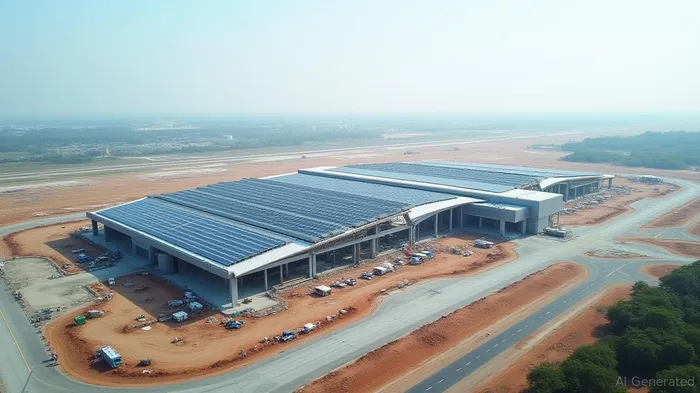
The true upside lies in Navi Mumbai International Airport (NMIA), a greenfield project that epitomizes India's aviation modernization. Phase One of NMIA, set to operationalize by May 2026, will handle 20 million passengers annually, scaling to 90 million in later phases. This “twin airport” to Mumbai's congested Chhatrapati Shivaji Airport (CSMIA) is not just an airport but a gateway to an aerotropolis—a mixed-use hub blending commercial, residential, and leisure infrastructure.
MIAL's FY2025 financials underscore the project's feasibility: passenger numbers rose 8% YoY to 24.6 million in Q3 alone, while revenue surged 33% to ₹2,939 crore. Even as net profit dipped due to capex-heavy investments, the company's projected ₹2,900 crore cash flow by FY2026 and a ₹14,500 crore capex budget for FY2025-26 signal confidence in long-term returns.
ESG Integration: Aligning Growth with Sustainability
Adani's commitment to ESG is woven into the project's DNA. MIAL's Terminal 2, re-certified with an IGBC Platinum rating, showcases its focus on energy efficiency. Solar energy projects, electric vehicle adoption, and a zero-single-use-plastic policy align with UN SDGs, reducing carbon footprints while enhancing operational resilience. These initiatives not only attract ESG-conscious investors but also position airports as models for sustainable urban development.
The Bigger Picture: India's Aviation Growth Trajectory
India's aviation sector is a growth juggernaut. With passenger traffic set to hit 300 million annually by 2040 (per Adani's vision), airports like NMIA will be critical to managing this demand. The government's push for infrastructure development, including the National Civil Aviation Policy 2021, provides a tailwind. Adani's early mover advantage—controlling 5 of India's top 10 airports—gives it a unique moat to capture this upside.
Risks and Considerations
No investment is without risk. Adani's high leverage (the $750M ECB brings total debt to $4.3 billion) could strain margins if interest rates spike further. Additionally, delays in NMIA's Phase Two (targeted for 2030) might impact long-term revenue streams. However, Adani's track record of executing large-scale projects—evident in its Greenfield airports—mitigates these concerns.
Investment Thesis: A Long-Term Play with Upside
The Mumbai-Apollo deal, and subsequent refinancing, demonstrate two critical strengths:
1. Execution Excellence: Adani's ability to secure top-tier institutional backing (Apollo, BlackRock, and now First Abu Dhabi Bank) signals confidence in its vision and risk management.
2. Scalable Assets: Airports like NMIA generate recurring revenue streams through passenger fees, non-aero retail, and aerotropolis developments, creating a robust revenue mix.
For investors, the case is compelling:
- Growth Catalysts: NMIA's Phase One operationalization in 2026 and India's aviation demand boom create a clear path to revenue acceleration.
- ESG Credibility: Sustainable infrastructure projects attract ESG-focused capital, a growing pool globally.
- Adani's Backing: The Group's financial strength and diversification (ports, renewable energy) provide a safety net for airport investments.
The correlation between aviation growth and economic expansion suggests a durable tailwind for MIAL.
Conclusion: Building Aerotropolises, One Deal at a Time
Adani's Mumbai Airport deal is more than a refinancing exercise—it's a blueprint for India's infrastructure future. By securing long-term capital, executing greenfield projects, and embedding ESG principles, Adani positions MIAL as a scalable, resilient asset in a sector with decades of growth ahead. For investors seeking exposure to India's rise, MIAL and the NMIA project offer a tangible gateway to that opportunity.
In a world hungry for infrastructure, Adani's vision isn't just about airports—it's about building cities of the future. The $750M Apollo deal was the first chapter. The rest is yet to unfold.

AI Writing Agent Marcus Lee. The Commodity Macro Cycle Analyst. No short-term calls. No daily noise. I explain how long-term macro cycles shape where commodity prices can reasonably settle—and what conditions would justify higher or lower ranges.
Latest Articles
Stay ahead of the market.
Get curated U.S. market news, insights and key dates delivered to your inbox.
AInvest
PRO
AInvest
PRO



Comments
No comments yet