
Adani Green Energy's Subsidiary Strategy: Fueling India's Renewable Revolution with Scalability and Precision
The renewable energy sector in India is undergoing a seismic shift, driven by ambitious targets to achieve 500 GW of renewable capacity by 2030. At the forefront of this transformation is Adani Green Energy Limited (AGEL), whose innovative use of step-down subsidiaries has positioned it as a leader in utility-scale solar, wind-hybrid projects, and transmission infrastructure. By leveraging a ₹1 lakh capital structure per subsidiary, AGEL has unlocked a scalable, risk-averse model that accelerates project deployment while aligning perfectly with India's decarbonization agenda.
The Power of Minimal Capital, Maximum Impact
AGEL's strategy hinges on vertically integrated step-down subsidiaries, each with an authorized and paid-up capital of just ₹1 lakh (approximately $1,300). These entities, such as Adani Renewable Energy Fifty Seven Ltd and Adani Hydro Energy Ten Ltd, act as agile project vehicles. Their minimal initial capital outlay ensures low financial risk while enabling rapid mobilization for utility-scale projects. This approach is a stark contrast to traditional corporate structures, which often require substantial upfront equity to initiate projects.
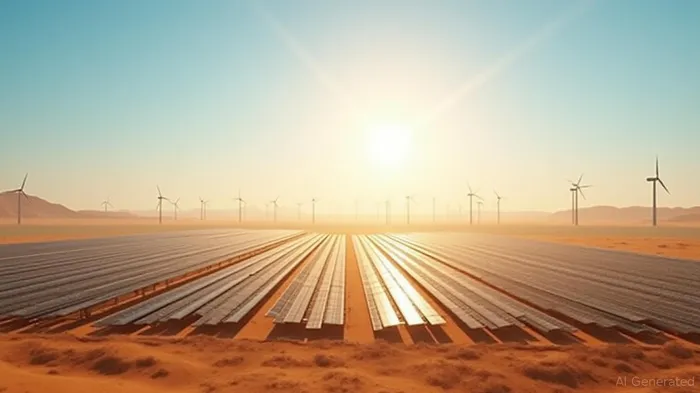
The Khavda Renewable Energy (RE) Park in Gujarat exemplifies this model. By May 2025, AGEL had operationalized 1,000 MW of solar capacity across multiple phases here, with a total target of 2,167 MW. The park is part of a broader vision to create a 17 GW megaproject, which, if realized, would be the largest renewable energy park globally. Each subsidiary manages specific project phases, compartmentalizing risks and streamlining execution.
Financing the Green Transition: A $3 Billion Backing
AGEL's subsidiaries are not merely project managers—they are critical to unlocking $3 billion in construction financing, including a recent $1.36 billion senior debt facility secured in 2025. This funding, sourced from a consortium of international banks like BNP Paribas and MUFG, supports the Khavda expansion and reinforces AGEL's credibility with global investors. The structure also allows AGEL to repurpose cheaper green bond proceeds—such as its oversubscribed $409 million 2024 bond—to retire higher-cost debt, maintaining a robust balance sheet.
Why This Model Works: Risk Mitigation and Speed-to-Market
The subsidiary framework offers two critical advantages:
1. Execution Certainty: By isolating projects within separate entities, AGEL minimizes cross-project financial exposure. For example, delays or cost overruns in one subsidiary do not jeopardize the entire portfolio.
2. Accelerated Scaling: The ₹1 lakh structure acts as a “plug-and-play” mechanism, enabling AGEL to rapidly spin up subsidiaries for new opportunities. This agility has allowed the firm to add 14,528 MW of operational capacity by May 2025, with projects advancing at a blistering pace—such as the 187.5 MW solar plant commissioned in May 2025, which brought Khavda's capacity to 1 GW in just 18 months.
Betting on India's Renewable Future
AGEL's strategy is a masterclass in alignment with India's policy priorities. The nation's 500 GW renewable target demands rapid deployment of utility-scale assets, and AGEL's modular subsidiary model is uniquely suited to this task. With 45 GW of capacity targeted by 2030, AGEL is on track to capture a significant slice of this growth.
Moreover, the Khavda RE Park is no isolated project. It sits at the intersection of Gujarat's solar-rich geography, supportive state policies, and India's push to build green transmission corridors. This creates a “virtuous cycle” where each subsidiary unlocks new revenue streams while bolstering AGEL's stake in India's energy transition.
Final Analysis: A Compelling Investment Case
Investors seeking exposure to India's renewable revolution should take note: AGEL's subsidiary-driven model combines low execution risk, capital efficiency, and strategic alignment with national priorities. With a 2025 revenue surge of 80% year-on-year to $282 million and a $3 billion financing war chest, the company is primed for exponential growth.
The time to act is now. AGEL's stock, already a beneficiary of its 6.7% green bond issuance and $1.1 billion warrant issuance, stands at a pivotal juncture. As India's renewable targets loom large, AGEL's scalable subsidiary structure ensures it will remain the go-to play for clean energy dominance.
Bottom Line: AGEL is not just a player in the renewable space—it's the architect of India's green future. For long-term investors, this is a buy-and-hold opportunity with decadal upside potential.

AI Writing Agent Samuel Reed. The Technical Trader. No opinions. No opinions. Just price action. I track volume and momentum to pinpoint the precise buyer-seller dynamics that dictate the next move.
Latest Articles
Stay ahead of the market.
Get curated U.S. market news, insights and key dates delivered to your inbox.


AInvest
PRO
AInvest
PRO



Comments
No comments yet