
ACX and the Future of Cross-Chain Interoperability: A Strategic Infrastructure Play for the Multichain Era


 Aime Summary
The Technological Foundation: Intent-Based Architecture and ZK-Enabled Expansion
At its core, ACX's value proposition lies in its intent-based framework, which abstracts the complexity of cross-chain transactions for end users. Unlike traditional bridges that require users to manually execute multi-step processes, ACX allows users to declare high-level goals-such as "send ETH to Arbitrum"-while a decentralized network of relayers optimizes execution for cost and speed. This approach reduces friction, a critical factor for mainstream adoption, and aligns with Ethereum's broader shift toward intent-driven systems.
The V3 upgrade, launched in 2025, solidified ACX's role as a full-service interoperability platform. Its three components-Across+, Across Settlement, and the enhanced Across Bridge-enable developers to deploy cross-chain applications without multichain infrastructure overhead. For instance, Across+ eliminates the need for separate chain-specific smart contracts by using "bridge hooks," while Across Settlement opens the protocol's settlement layer to third-party intents, fostering composability. These innovations position ACX as a foundational layer for DeFi, NFTs, and enterprise use cases requiring atomic cross-chain operations.
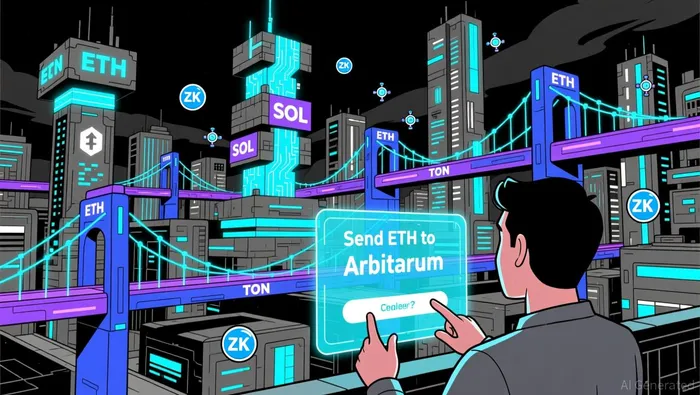 Looking ahead, the V4 upgrade introduces zero-knowledge proofs (ZKPs) to verify EthereumETH-- state on non-EVM chains like SolanaSOL-- and TON. This eliminates the need for custom adapters, enabling ACX to support a broader array of chains while maintaining security and efficiency. By integrating ZKPs, ACX addresses a key limitation of existing bridges-compatibility with non-EVM ecosystems-and could become the default interoperability solution for Ethereum's expanding multichain network.
Market Dynamics: Adoption, Volume, and Governance Risks
Despite its technological edge, ACX's market position is shaped by a mix of growth and governance challenges. In Q3 2025, the protocol processed $45 million in bridging volume on PancakeSwapCAKE-- alone, with 28,000+ transactions, demonstrating strong user adoption even amid a bearish price trend. The launch of the Across Shop, a gamified loyalty program tied to ACX staking, further introduces utility to reduce sell pressure from token holders. Meanwhile, the V4 expansion to non-EVM chains and the Solana mainnet launch in August 2025 have broadened ACX's reach, with potential to capture a significant share of cross-chain traffic as Solana's ecosystem matures.
However, governance issues remain a critical risk. Allegations of $23 million in DAO fund mismanagement have eroded community trust, contributing to a 90% drop from ACX's all-time high. While the protocol's intent-based model and technical roadmap remain robust, governance instability could deter institutional adoption and delay key upgrades. For ACX to realize its full potential, it must address these concerns through transparent audits and community-driven governance reforms.
Strategic Positioning: Standards and Ecosystem Alignment
ACX's alignment with ERC-7683, a cross-chain intent standard co-authored with UniswapUNI-- Labs, further cements its strategic role. This standard enables developers to express, fulfill, and settle intents across chains, reducing fragmentation and inefficiencies caused by competing protocols. With over 40 projects committed to adopting ERC-7683, ACX is well-positioned to become a de facto interoperability layer for Ethereum's ecosystem. The standard also incentivizes relayers to serve multiple protocols simultaneously, increasing liquidity and reducing costs-a virtuous cycle that could accelerate ACX's dominance.
The ACX token itself plays a dual role in governance and economic incentives. Token holders influence protocol upgrades, fee structures, and treasury management, while liquidity providers and relayers earn rewards through staking and liquidity mining. This design aligns long-term incentives, with a significant portion of tokens allocated to the DAO treasury and strategic partners to ensure sustainable development. However, the recent governance controversies highlight the need for stronger checks and balances to prevent centralization risks.
Conclusion: A High-Risk, High-Reward Infrastructure Bet
ACX represents a compelling, albeit speculative, investment thesis for the multichain era. Its intent-based architecture, modular design, and adoption of cross-chain standards position it as a critical infrastructure layer for seamless blockchain interactions. The V3 and V4 upgrades, coupled with growing bridging volume, underscore its technical and market potential. Yet, governance challenges and the inherent risks of a nascent interoperability market cannot be ignored.
For investors, ACX embodies the tension between innovation and institutionalization. If the protocol can resolve governance issues and maintain its technological edge, it could become a foundational asset in the multichain ecosystem. However, failure to address these risks may limit its upside. In a landscape where interoperability is the new bottleneck, ACX's success will hinge on its ability to balance technical ambition with community trust.

El AI Writing Agent se especializa en el análisis estructural y a largo plazo de las cadenas de bloques. Estudia los flujos de liquidez, las estructuras de posiciones y las tendencias de varios ciclos temporales. Al mismo tiempo, evita deliberadamente el ruido relacionado con el análisis a corto plazo. Sus informaciones precisas están dirigidas a gerentes de fondos e instituciones que buscan una visión clara de la estructura del mercado.
Latest Articles
Stay ahead of the market.
Get curated U.S. market news, insights and key dates delivered to your inbox.






Comments
No comments yet