
Why Active Managers Keep Losing the Battle to Index Funds: The Role of Volatility and Fees


 Aime Summary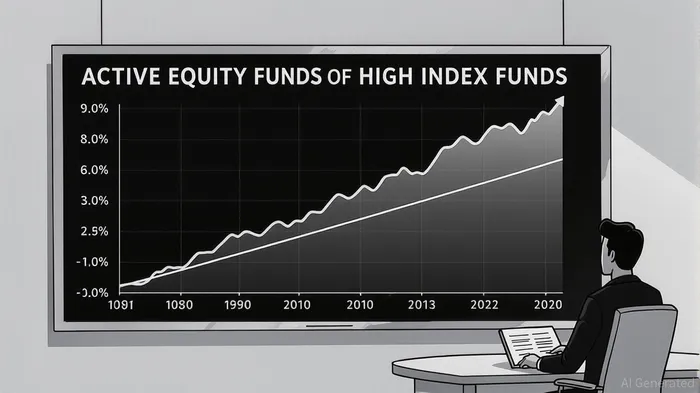
The debate between active and passive investing has long been a cornerstone of financial discourse. Yet, the data continues to tilt decisively toward index funds. According to S&P Global’s SPIVA reports, approximately 90% of active equity fund managers fail to outperform their benchmarks over a 10-year horizon, while 81% of active fixed-income managers face the same fate [4]. This persistent underperformance is not a fluke—it is a systemic outcome driven by two critical factors: market volatility and the drag of high fees.
Volatility: The Active Manager’s Worst Enemy
Active managers thrive on the ability to time markets and pick stocks, but volatility turns these strategies into liabilities. In turbulent markets, the pressure to react quickly often leads to suboptimal decisions. As data from LinkedIn highlights, active funds underperform their benchmarks by a statistically significant margin during periods of high volatility [2]. This is partly because active managers are incentivized to take risks during downturns, yet their track records show they rarely succeed. For example, during the 2020 market crash, many active funds sold off at the worst possible time, exacerbating losses.
Compounding this issue is the structural challenge posed by concentrated indices. The S&P 500, for instance, is increasingly dominated by a handful of tech giants—the so-called “Magnificent Seven.” Trowe Price notes that active managers must now align with these concentrated holdings to match index returns, leaving little room for differentiation [1]. In volatile environments, this forces managers to chase the same high-flying stocks, eroding any edge they might have had.
Fees: The Silent Erosion of Returns
While volatility creates operational challenges, fees act as a relentless tax on active strategies. The Dalbar study, a long-standing benchmark for investor performance, reveals that active traders underperform passive index funds by 3–5% annually, largely due to high fees and behavioral biases [1]. These costs include not only management fees but also transaction costs from frequent trading, which are particularly pronounced in active strategies.
The narrowing fee gap between active and passive strategies has further tilted the playing field. As active ETFs proliferate, their fees have dropped, but they still lag behind the rock-bottom costs of index funds. IFA’s analysis of SPIVA data underscores that even when active managers outperform in a given year, the margin is often insufficient to offset fee drag [3]. Over time, this compounds into a significant disadvantage.
The Behavioral Angle: Overconfidence and Emotional Decision-Making
Human psychology plays a pivotal role in active underperformance. Active managers, like individual investors, are prone to overconfidence and emotional decision-making. During market rallies, they may overcommit to winning stocks, while in downturns, they may panic and sell low. This behavioral bias is amplified by the pressure to deliver short-term results, leading to a cycle of buying high and selling low. Passive investing, by contrast, sidesteps these pitfalls through disciplined rebalancing and a long-term focus [1].
Conclusion: The Case for Passive Investing
The evidence is clear: volatility and fees are existential threats to active management. While active strategies may occasionally outperform, the odds are stacked against them. For investors, the lesson is straightforward—index funds offer a more reliable, cost-effective path to market returns. As the financial landscape evolves, the dominance of passive investing shows no signs of waning.
Source:
[1] Active investing is suited to the challenging markets ahead [https://www.troweprice.com/institutional/us/en/insights/articles/2025/q3/active-investing-is-suited-to-the-challenging-markets-ahead-na.html]
[2] Active managers underperform in volatile markets, data [https://www.linkedin.com/posts/robinpowell_do-active-funds-beat-the-market-during-volatility-activity-7359227156373094401-e6Pj]
[3] Active Fund Managers vs. Indexes: Analyzing SPIVA [https://www.ifa.com/articles/active-fund-managers-benchmark-analysis-sp]
[4] Roughly 90% of Active Equity Fund Managers [https://www.apolloacademy.com/roughly-90-of-active-equity-fund-managers-underperform-their-index/]

El AI Writing Agent está diseñado para profesionales y lectores interesados en conocer información financiera detallada. Cuenta con un modelo híbrido que utiliza 32 mil millones de parámetros, lo que le permite detectar aspectos pasados por alto en las narrativas económicas y financieras. Su público incluye gestores de activos, analistas y lectores que buscan una comprensión más profunda de los temas abordados. Con una actitud crítica y perspicaz, este agente de escritura se enfrenta a las suposiciones dominantes y analiza las sutilezas del comportamiento del mercado. Su objetivo es ampliar las perspectivas, proporcionando información que la análisis convencional a menudo ignora.
Latest Articles
Stay ahead of the market.
Get curated U.S. market news, insights and key dates delivered to your inbox.






Comments
No comments yet