
Acorns' "Investinall" Is $50 of Marketing. The $950,000 Math It Hides Is the Real Story.
 Aime Summary
Slide a losing bet across the slider at acorns.com/investinall and Acorns will deposit up to $50 into a brand-new investing account — no bank statement, no screenshot, no proof. Just an honor-system number you type in. The offer is staged as a spoof pharmaceutical launch called "Investinall," with an active ingredient listed as "time and a chance at compound interest" and inactive ones of "diversification and patience". The stunt deserves the eye-roll. The number underneath it — roughly $950,000 — is the part worth your attention.
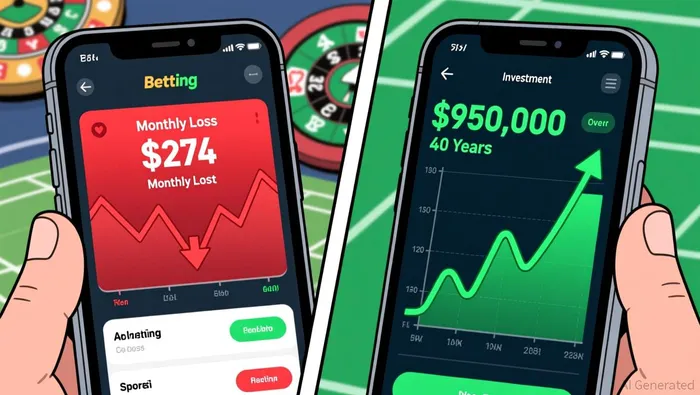
That is what the average surveyed sports bettor's $274 a month becomes after four decades growing at an 8% return, reaching over $950,000, per Acorns' own marketing math as reported by Fortune. The whole thing is wired to the season: it launched on NFL Kickoff and runs through December 1, 2026. But strip away the fake-medicine packaging and you have a sharper question for anyone who has ever drifted toward a betting app: how the same monthly dollar behaves when it compounds instead of being consumed by a house edge.
The "$50 remedy" is a customer-acquisition cost, not a cure
Before anyone treats a $50 match as found money, read the fine print. It is limited to new Acorns customers, requires you to open an Invest account and start a recurring investment of at least $5, pays out only after a 30–45 day waiting period, and caps at one claim per person. In other words, the "remedy" is a marketing budget disguised as a payout.
Acorns' CEO Noah Kerner basically admits as much. "We have a marketing budget to acquire customers," he told Fortune, "so we just basically put it into creative ideas like this and give it back to the customer." The $50 is a redirected marketing budget rather than a loss. The $50 isn't the product; the new subscriber is. The idea is to catch someone exactly at the moment Kerner calls "one of the worst moments in someone's money life" — right after a loss — and redirect that impulse into a recurring deposit.
The asymmetry is real, and it is worse than the ad looks
The campaign's underlying claim deserves more credit than its packaging. A study of more than 700,000 online gamblers found that 96% lost money, with only 4% making any. And the drain isn't confined to the betting accounts themselves: a Kellogg School analysis of roughly 230,000 households found that for every $1 a household spent on betting, it contributed about $2 less to its investment accounts, dragging net household investments down by nearly 14% as legal sports betting spread.
Now translate that into the compounding the campaign keeps pointing at. Put $274 a month into a plain, broadly diversified ETF portfolio instead of the bookie, at a long-run ~8% annualized return, and over 40 years you get to roughly $950,000. That is the whole dollar-flip in one frame: the same choreography — a phone, a recurring amount, a number that moves — that produces a near-certain loss over time on a bet with negative expectations instead produces a seven-figure outcome when the edge runs in your favor. The gauge that separates them is which side of the transaction has the structural advantage, not how smart you feel picking a winner.
The honest catch: the $950,000 belongs to the biggest losers
Here is where the media-trained headline stretches more than the drug-commercial framing does, and it pays to notice. The $274 a month is an average bettor spend, and sports-betting averages are skewed hard by heavy spenders. annual cost is far lower — around $750 a year, not $3,300. On a $60-a-month habit the 40-year compound works out to a much smaller gap. The direction never changes, though: an expected-negative bet is an expected-negative bet at any size, and the people this campaign most wants to catch are the ones spending enough that the $950,000 hook actually applies to them.
Why a private company is running this ad at you
Acorns is not a stock you can buy. It's privately held, having scrapped a planned $2.2 billion SPAC merger in early 2022. Kerner puts the company at about 16 million customers and thinks 100 million Americans belong on the platform. That gap explains the campaign's existence. A sports-betting funnel — 27% of Americans and 52% of men aged 18 to 49 hold active online sportsbook accounts — is a giant pool of people who already move money monthly by phone, which is the exact muscle a new investor needs. Convert even a sliver of that audience into recurring investors and you have a growth story worth watching the day Acorns ever lists.
And a warning couched as a bone to pick: Kerner told Fortune there is "no real distinction" between sports betting, day-trading apps, and prediction markets — "I think betting is betting". Fair enough as a caution against treating any of them as a get-rich machine. But the same logic that makes the $950,000 math true cuts the other way: edge lives on the side of the person with a documented, date-stamped disagreement, not the person feeding momentum into the crowd. If you don't have the disagreement, you're just paying the spread on a coin flip with worse odds — exactly the 96% this campaign is fishing from.
The $50 is an advertisement; the arithmetic is the medicine. You don't need Acorns to hand you a fake drug label to get the effect — you need to point a recurring amount at the side of the transaction whose structural edge is yours, and then stay there for decades. That redirect is worth more than any match Acorns will ever offer you.
_43ca838f1775813865579.png?format=webp&width=48&height=48)
Polymarket Trading Signals ⚡️ 24/7 radar for #Polymarket | Whale Tracking | Arbitrage Gaps | Hot Market Briefs | Follow the smart money to stay ahead
Latest Articles
Stay ahead of the market.
Get curated U.S. market news, insights and key dates delivered to your inbox.


AInvest
PRO
AInvest
PRO




Comments
No comments yet