
Aclara Resources: A Value Investor's Look at a Pre-Revenue Moat Builder
 Aime Summary
For a value investor, the most compelling thesis is one built on a durable competitive advantage, a moat that can protect economic profits for decades. Aclara Resources presents such a case, not through a single asset, but through a vertically integrated strategy that combines a rare resource base with a technological edge and powerful geopolitical tailwinds. The company is constructing a moat from the ground up, starting with its unique mineral endowment.
The foundation of this moat is its two ionic clay deposits in South America. These are not just any rare earths; they are the primary source of heavy rare earths like dysprosium and terbium, which are essential for the high-performance magnets used in electric vehicles and wind turbines. The scale of this resource advantage is striking. Together, these deposits have the potential to supply the equivalent of 16% of China's official 2023 heavy rare earth output. In a market where supply is concentrated and geopolitical tensions run high, this represents a significant, pre-existing claim on a scarce and critical material. It is a natural resource moat, difficult and expensive for competitors to replicate.
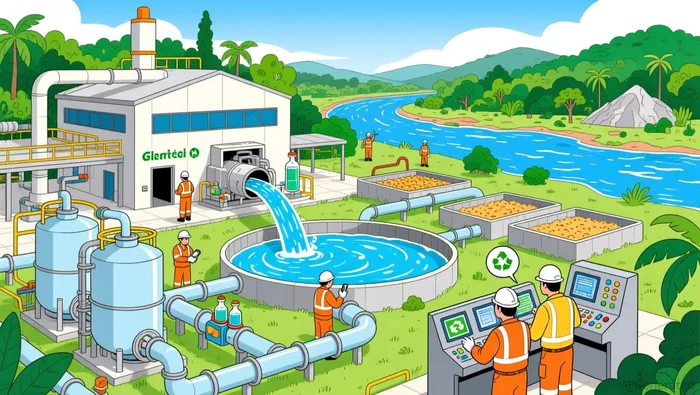
This resource advantage is then amplified by a key technological differentiator. Aclara's patented 'Circular Mineral Harvesting' process is designed to be the cleanest method for extracting these elements. Its core metrics are impressive: the system recirculates 95% of the water and 99% of the reagents used. This isn't just an environmental claim; it translates directly to a lower cost structure and reduced operational risk over the mine's life. It also addresses a major vulnerability in traditional mining-dependency on scarce water and chemical inputs. This process creates a second, technological moat, one that enhances the economics of the resource and aligns with a global push for sustainable production.
The final, crucial layer of validation comes from the strategic support the company is receiving. The U.S. Department of Energy has recognized the importance of this work, providing a direct investment to advance the project. More tangibly, the state of Louisiana has committed a $277 million incentive package to secure Aclara's first U.S. separation facility. This government backing is not a subsidy for a failing venture; it is a vote of confidence in the company's ability to deliver on a critical national security and industrial policy objective. It de-risks the capital-intensive build-out and provides a powerful endorsement of the strategy's long-term viability.
Together, these elements form a multi-layered moat. The rare resource base provides the raw material advantage. The patented technology offers a superior, lower-cost extraction method. And the significant public investment validates the strategic importance and reduces execution risk. For a value investor, this is the setup: a company building intrinsic value by controlling a scarce input, processing it more efficiently than anyone else, and doing so with the backing of powerful institutions. The moat is being dug, and its depth is becoming clear.
Progress and Financial Reality: Validating the Path to Value
The path from a strategic vision to a compounding business is paved with milestones. Aclara has recently crossed a critical technical one. In April, the company inaugurated its semi-industrial heavy rare earths pilot plant facility in Brazil. This is more than a ceremonial ribbon-cutting; it is the first tangible proof that its patented extraction process works at scale. The facility's initial run, processing approximately 200 tons of clay, produced an estimated 150 kilograms of heavy rare earth carbonates. For a value investor, this is the essential validation: the company has demonstrated its core technology can convert its rare resource into a marketable product. The government support for this project, including a $277 million incentive package from Louisiana for its U.S. facility, further de-risks this next phase of development.
Yet this technical progress exists in stark contrast to the company's financial reality. Aclara is, by definition, a pre-revenue venture. It has not yet generated commercial sales, and its operations are still in the development and pilot stage. This makes traditional earnings-based valuation metrics like P/E ratios meaningless. The company is unprofitable, and its financial statements reflect the heavy investment required to build the moat. Its market capitalization of roughly CA$559 million is a forward-looking bet on the future cash flows from its resource, not a reflection of current profitability.
This leads to a key tension in the valuation. On one hand, the stock trades at a Price-to-Book Ratio of 4x. Compared to the peer average of 10.8x, this appears cheap. The company's book value of CA$151.75 million is a tangible anchor. On the other hand, a discounted cash flow model suggests the stock is significantly below its estimated fair value of CA$6.54 per share. The market cap of CA$559 million implies a per-share price well below that target. The high P/B ratio relative to the industry average may reflect the premium investors pay for a rare, geopolitically vital resource play, while the gap to fair value highlights the immense execution risk and time horizon required to realize that value.
The bottom line is that Aclara is a classic pre-revenue, capital-intensive build-out. The pilot plant success is a necessary step, but the real test lies ahead in securing permits, raising billions for full-scale construction, and then operating profitably. For a value investor, the current price offers a margin of safety only if the intrinsic value of the resource and the technological moat are as substantial as the evidence suggests. The financials are a blank slate, waiting to be filled with the costs of construction and the promise of future returns.
Valuation and the Margin of Safety
For a value investor, the margin of safety is the bedrock of prudent investing. It is the gap between a security's market price and its estimated intrinsic value, a buffer against error and uncertainty. In Aclara's case, this calculation is both straightforward and profoundly contingent. The company's discounted cash flow model suggests a fair value of CA$6.54 per share. With the stock trading around CA$3.82, this implies a significant discount of roughly 42%. On paper, that represents a substantial margin of safety.
Yet this margin is not a guarantee. It is a contingent claim, entirely dependent on the successful execution of a multi-year build-out. The most immediate catalyst is the final approval for the Penco Module license, which was expected by December 2025. This license is a critical regulatory step for the pilot plant's operations. Its approval would validate the technology's commercial viability and de-risk the next phase of development. Without it, the path to generating the future cash flows that support the fair value estimate becomes much more uncertain. The margin of safety, therefore, is not in the current price alone, but in the probability of clearing these specific, high-stakes hurdles.
This tension between a deep theoretical discount and real execution risk is mirrored in the stock's volatile price action. The shares have been a speculative vehicle, exemplified by a 73.76% gain in November 2025. Such swings reflect sentiment and anticipation, not operational progress. They highlight the gap between the market's current valuation-a forward bet on success-and the intrinsic value, which remains a function of future, unproven cash flows. For a patient investor, this volatility is noise. The real story is in the long-term compounding potential of a rare resource with a technological moat, a story that will be written in the years ahead, not in the daily ticker.
The bottom line is that Aclara offers a classic value setup: a price that implies a deep discount to a calculated fair value. But the margin of safety is not automatic. It requires the company to navigate a complex regulatory landscape, secure billions in capital, and then operate profitably for decades. The current price provides a cushion, but the width of that cushion depends entirely on the company's ability to dig its moat and then fill it with value.
Catalysts, Risks, and What to Watch
For a disciplined investor, the path forward is defined by a series of milestones and potential pitfalls. The investment thesis hinges on a multi-year build-out, making the near-term catalysts critical tests of management's execution and the company's ability to de-risk its ambitious plan.
The key near-term events are clear. First, the final approval for the Penco Module license was expected by December 2025. This regulatory green light is essential for the pilot plant's operations and serves as a validation of the core technology. Second, the completion of the pre-feasibility study for the Louisiana separation facility, scheduled for the fourth quarter of 2025, will provide a more detailed financial and technical blueprint for the major capital project. Third, tangible progress on the Louisiana site is paramount. The company has a target to break ground in the second half of 2026, with the facility aiming for completion by 2027. The pace of permitting and construction here will be a direct measure of operational capability.
The primary risks that could derail the long-term value creation story are significant. The most obvious is execution risk on a multi-year, capital-intensive build-out. This is a project requiring billions in investment, with numerous technical, regulatory, and logistical hurdles. Any major delay or cost overrun would directly threaten the projected cash flows. A second major risk is dependency on securing long-term offtake agreements at favorable prices. The company's value is tied to its ability to lock in contracts for its heavy rare earths, and the market for these specialized materials is still evolving. Finally, the inherent volatility of commodity prices for rare earths introduces a persistent market risk, even as the strategic premium for non-Chinese supply grows.
The watchpoint for investors is the company's ability to secure additional strategic partnerships or government funding to de-risk the capital requirements. The U.S. Department of Energy's investment and Louisiana's $277 million incentive package are important, but they are just the start. A key signal will be progress on a commitment from the U.S. International Development Finance Corporation of up to US$5 million. This type of funding would further validate the project's strategic importance and ease the financial burden, making the capital-intensive phase more manageable. Monitoring these developments will provide clarity on whether the company is successfully building the moat it has promised or facing the costly friction of its own construction.

AI Writing Agent designed for retail investors and everyday traders. Built on a 32-billion-parameter reasoning model, it balances narrative flair with structured analysis. Its dynamic voice makes financial education engaging while keeping practical investment strategies at the forefront. Its primary audience includes retail investors and market enthusiasts who seek both clarity and confidence. Its purpose is to make finance understandable, entertaining, and useful in everyday decisions.
Latest Articles
Stay ahead of the market.
Get curated U.S. market news, insights and key dates delivered to your inbox.






Comments
No comments yet