
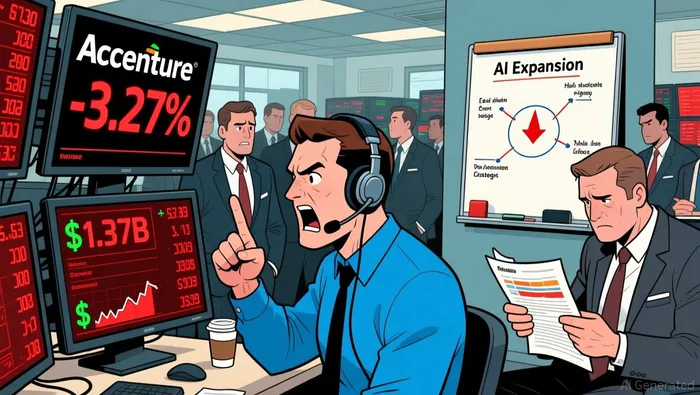
Accenture Shares Fall 3.27% Amid $1.37B Trading Volume 107th in U.S. Activity Despite AI Expansion
 Aime Summary
Market Snapshot
On November 24, 2025, , , . markets. The drop occurred despite the company’s recent announcements of expanded AI and cloud partnerships, which had previously positioned AccentureACN-- as a leader in enterprise digital transformation. The volume suggests moderate investor activity but does not fully explain the price movement, which appears influenced by broader market sentiment or sector-specific pressures.
Key Drivers Behind the Move
Accenture’s recent partnership announcements with Apptio and Microsoft, unveiled on November 11, 2025, represent a strategic pivot toward integrated AI and cloud solutions for clients such as PPL Corporation and Essity. These collaborations aim to enhance technology financial management and leverage advanced platforms for efficiency and innovation. The partnerships underscore Accenture’s commitment to expanding its enterprise AI capabilities, a critical component of its long-term investment narrative. However, the immediate impact on stock performance remains muted, as analysts highlight the company’s ongoing challenges with margin pressures.
The news summary emphasizes that while these partnerships reinforce Accenture’s market positioning, they do not directly address short-term risks tied to cost and pricing competition. The cost of delivering advanced AI and cloud services has intensified scrutiny over the firm’s ability to maintain profitability in an increasingly competitive landscape. For instance, Accenture’s work with PPL Corporation to overhaul technology financial management exemplifies its digital reinvention strategy but also highlights the operational costs associated with large-scale transformation projects. This duality—between long-term growth potential and near-term margin concerns—appears to have weighed on investor confidence.
Accenture’s projected revenue and earnings growth, , respectively, . , . However, . This dispersion underscores lingering uncertainty about Accenture’s ability to execute on its strategic initiatives without compromising margins.
The article also notes broader industry trends, such as the global race for , which are critical inputs for high-tech devices and electric vehicles. While unrelated to Accenture’s core operations, these developments highlight the macroeconomic context in which the stock is trading. Investors may be recalibrating their exposure to technology-related equities amid heightened awareness of supply chain risks and geopolitical tensions affecting raw material availability. , as risk-off sentiment often impacts high-growth stocks disproportionately.
Finally, the emphasis on strategic partnerships as a growth driver aligns with Accenture’s historical business model but also exposes vulnerabilities. The article’s reference to C3.ai’s expanded Microsoft collaboration—though not directly related to Accenture—signals a competitive environment where hyperscalers like Microsoft are deepening their ecosystems. For Accenture, maintaining its position as a premier AI integrator requires continuous innovation and cost efficiency, both of which are under pressure. The stock’s performance, therefore, reflects not only company-specific factors but also sector-wide dynamics that could influence its trajectory in the near term.

Stay ahead of the market.
Get curated U.S. market news, insights and key dates delivered to your inbox.
AInvest
PRO
AInvest
PRO



Comments
No comments yet